
Readers' Letters: Sinking feeling over Swinney plans to buy Ardrossan Harbour
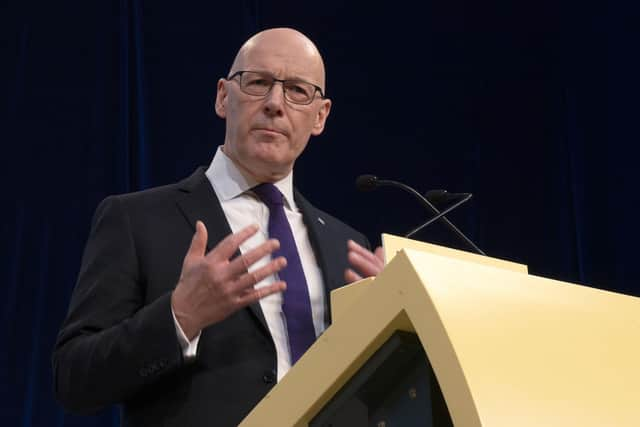
The SNP’s vision for Ardrossan Harbour doesn’t impress reader
News of the SNP's plans to nationalise Ardrossan Harbour, and amend it and make the changes necessary to allow newer ferries to stop there, filled me with horror. I would have thought that after the ferries fiasco they would have steered well clear of being involved in any maritime project. But no, here we go again.
Prepare yourselves for the worst. Projects that the SNP oversee or with which they become involved tend to end in tears for everyone involved and the taxpayers always pick up the gross incompetence tab. They have the Midas touch in reverse.
Be afraid, be very afraid.

Alexander McKay, Edinburgh
No case for trams
Derek Stevenson would be surprised if the consultation for the proposed Granton to Shawfair tram route showed the public in favour of it (Letters, 2 January).
Unfortunately, Edinburgh Council have a track record of proceeding anyway, despite a high number of objections. The city centre to Newhaven extension is a case in point. The council points to 65 per cent of residents and 18 organisations supporting further tram expansion in 2020 so it seems a fait accompli.
I am concerned that the council is willing to waste an estimated £2-3 billion on a route already served by the number 24 bus, which takes around an hour to travel to the Royal Infirmary from Granton, about the same time the tram is projected to take. Edinburgh should learn from Aberdeen Council, which has procured or converted a total of 36 electric buses, if it is concerned about emissions.
Electric buses are proving successful. They are more flexible and don’t need heavy infrastructure. At £13 million the Aberdeen buses were considerably cheaper than spending billions on a tram route.
The council is also concerned about car use, but Edinburgh has a much lower household car ownership than Scotland as a whole and that is expanding at around 2 per cent annually against 11 per cent nationally.
As Mr Stevenson argues, the road infrastructure badly needs investment, with nearly all the future congestion hotspots shown in the council’s City Mobility Plan on the bypass.
Add that to ailing housing, education and public services, and the fact that the number 17 and 100 buses to the airport are quicker than the trams, and surely the council will realise that the commercial business case for another very costly tram route does not stack up, and invest in the award-winning bus service instead.
Neil Anderson, Edinburgh
Swinney’s tightrope
Brian Wilson (Perspective, 3 January) points out how it may suit both the SNP and Reform to claim the next election contest is a fight between the two, but I wonder if John Swinney realises what he is doing here?
Many are anxious to remove this inept SNP administration, so may take Swinney at his word, and vote Reform, as the best way of doing it. Perhaps aided by the fact that voters have two votes – they could vote Reform in the constituency part, then vote for their normal party in the second vote, knowing it will produce seats for it.
William Ballantine, Bo'ness, West Lothian
Telling tales
The response of party leaders to Donald Trump's latest actions, the attack on Venezuela and kidnapping of President Nicolás Maduro, is revealing.
Prime Minister Sir Keir Starmer wants to wait for full details. The Conservative shadow home secretary Priti Patel copied Starmer in “awaiting the full facts”. Green Party leader Zack Polanski and Liberal Democrat leader Ed Davey both condemned the US moves. SNP leader John Swinney said he is “deeply concerned” but avoided criticism of Trump.
Reform leader Nigel Farage, in an insight into what a potential government led by him could have as its foreign policy, supported the attack on Venezuela and kidnapping of its president, saying it was “a deterrent to future Russian and Chinese aggression”.
Is there nothing President Trump will do that will be met with anything other than admiration from Mr Farage?
William Loneskie, Oxton, Lauder, Berwickshire
Lo ose cannon
What next for Venezuela? Is it fated to be an American colony? Certainly, President Trump is behaving like an imperialist dictator, ousting Venezuela's President Maduro, spiriting him and the First Lady away to New York.
All this, described by Trump himself as a “brilliant coup by brilliant people”, was achieved without reference to Congress or anybody else. Comparisons with his mentor, Vladimir Putin, made by J Moore (Letters, 5 January) are entirely justified.
Scarily, Trump may well not stop there. He is already making noises about neighbouring South American states, as well as “failed state” Cuba. Even Greenland is not beyond his tyrannical grasp. “Loose cannon” doesn't begin to describe him.
Trump was elected on an America First platform, not a policy of foreign conquest. Americans have not forgotten that promise. Surely that explains why he is one of the most unpopular Presidents ever.
Ian Petrie, Edinburgh
Don’t fail kids
Jill Stephenson’s letter is striking not because it identifies a problem – classroom violence is real and deeply concerning – but because of what it assumes and proposes in response (Letters, 5 January).
She implies that violent behaviour is primarily the result of poor parenting before children even reach school, with little acknowledgement of poverty, trauma, neurodiversity, unmet additional support needs or the impact of chronically under-resourced schools.
She speculates, without evidence, that a small group of children are repeatedly responsible, and then builds her argument on that assumption.
Her proposed “radical solution” becomes clearer as the letter unfolds: remove disruptive children from mainstream classrooms, isolate them, subject them to a “strict regime”, tolerate truancy as collateral damage, and ultimately place the most “obdurate” children in residential units to be shown “standards”. This language treats children as problems to be contained rather than young people to be supported. Many of us who attended school decades ago remember exactly where this thinking leads.
Violence was commonplace. Physical punishment was routine. Bullying, especially of those seen as “other”, flourished.
It did not produce calmer classrooms or healthier adults; it produced fear, silence, and lasting harm.
Children deserve respect, kindness and clear boundaries, but boundaries are not the same as punishment.
The strongest evidence points towards early intervention, trauma-informed practice, properly funded pastoral and mental-health support, smaller classes, specialist staff and genuine partnership with families, not segregation and stigma.
If we want safer schools and better outcomes, we need more imagination, more compassion and more investment, not a return to exclusionary models that failed children then and will fail them again now.
Nick Gellatly, St Neots, Cambridge
Renewed anger
John McLellan is to be congratulated for his article “Uprising against Renewable Energy” (3 January), highlighting the pressure our communities in the Scottish Borders are under – and telling readers that there will be a convention at Hawick on 17 January for local communities and people to make clear to our elected representatives our opposition to the never-ending flood of renewable applications in the Borders.
Local people have had enough. Our small, dispersed community already hosts three wind farms. We have accepted those. But since 2010 there have been a constant succession of further applications. There have been 12 applications directly affecting Heriot – ten of which went to Public Inquiry. We succeeded in getting them all rejected, one way or another.
That is the past. We now face a further seven applications, plus the two pylon lines John McLennan describes. They are right around the compass and will be visible over huge areas due to the enormous heights of current turbines. The workload dealing with each application is enormous. Every application has seven to ten volumes of documents, compiled by a range of experts working for the developers. We have a handful of volunteers giving their time and energy.
After the Greystone Knowe Public Inquiry we wrote to Scottish ministers pointing this out, and requesting financial assistance to level the playing field somewhat. Of course, we were brushed off with an anodyne reply. The Scottish Government has steadily changed policy over the years to make it easier for developers to secure consent. An obvious set of examples are Landscape Capacity Studies (LCS). Scottish Borders had experts draw one up for the Borders, which made it clear many areas are totally unsuitable for large turbines. The latest National Planning Framework, NPF4, has now excluded such studies – which we relied on heavily.
Needless to say the current applications are all unsuitable judged by the standards of the Borders LCS.
John Williams, Chairman Heriot Community Council, Crookston Old Mill, Heriot, Midlothian
Comments
Want to join the conversation? Please or to comment on this article.