
Readers' Letters: Scotland does not want or need nuclear power stations
A reader says Scotland produces more than enough energy of its own without nuclear power
Scotland produces far more energy than it uses. The vast bulk of that energy emanates from clean non-nuclear renewable sources. With several new developments in our renewables industries that will add to its energy production currently in the pipeline, it is patently obvious that Scotland does not need new nuclear power stations on its soil.
With this in mind it was both disappointing and indeed worrying to hear the threats from UK shadow energy secretary Andrew Bowie at the Conservative Party Conference that the next Westminster Tory government would impose the building of nuclear power stations in Scotland (Scotsman, October 5)against the wishes of the democratically elected government at Holyrood
At the moment there is one nuclear power station under construction at Hinkley Point in the south of England. When it was originally planned the completion date was estimated to be 2025 at a projected cost of £18 billion. The current revised estimate for completion is 2030/31 with a revised cost of £45-£49bn. Does Andrew Bowie seriously consider that it would be sensible to foist such an enormous bill for the production of energy at some future point on a country which already produces energy it does not use?
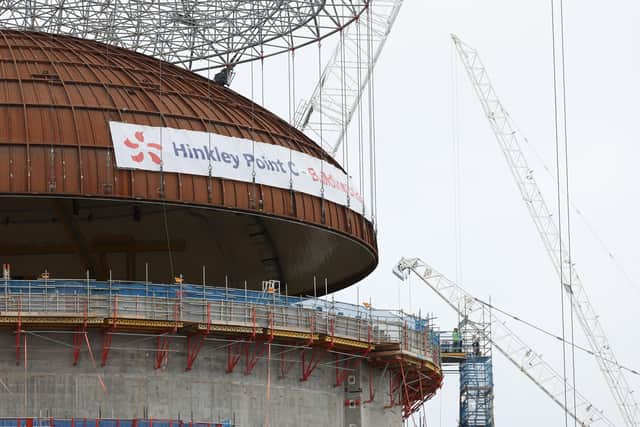

A further point for Mr Bowie relates to the source of funding of any future nuclear build. China General Nuclear owns approximately 25 per cent of Hinkley Point. A few weeks ago, Mr Bowie described the SNP government as “naive” due to its support for a Chinese company (Ming Yang) which wishes to invest £1.5bn in building a wind turbine plant near Inverness. We were told by Mr Bowie and others at Westminster that these wind turbines could potentially pose a threat to the UK’s future energy supply. He failed to explain why a Chinese-funded wind turbine plant near Inverness was capable of posing such a threat while a Chinese-funded nuclear power plant in the south of England wasn’t.
Residing in Mr Bowie’s constituency I am aware of his party’s opposition to the proposed siting of wind turbines on the Hill o’ Fare near Banchory. One of the main objections relates waste disposal and the problems of recycling turbine blades, which may then lead to landfill usage. I wonder if Mr Bowie’s constituents would have any objections to having spent nuclear waste stored in their vicinity?
Jim Finlayson, Banchory, Aberdeenshire
Making waves
Andrew Bowie has made it exceedingly clear that any future Conservative government would build nuclear power stations in Scotland. They haven’t yet realised that the one that is currently being built for London is not only extremely costly but if wiped out by a single missile from Russia (as is currently taking place in Ukraine to their power stations) much of London would be deprived of power for years.
We are an island nation and we should have smaller and more power-plants connected to the sea and everlasting tidal power. Each of our coastal cities should have its own, individual power sources... reaping power from the coming and going of the tide. No amount of incoming missiles can turn the tide off.
Archibald A Lawrie, Kingskettle, Fife
McHinkley Point
“Bring it on” states Andrew Bowie as he imagines himself Energy Minister in a Conservative government, taking on the Scottish government’s refusal to allow new nuclear power stations (Scotsman, 6 October).
He must have a fevered imagination if he thinks the Conservatives will win the next election, and a complete lack of awareness if he thinks that taking back planning within referred powers to allow a nuclear go-ahead, will have no consequences for the strength of the Union in Scotland.
Scotland’s renewable energy generation is often well in excess of its own needs, but much of this is wind-generated, and in windless conditions we do indeed need some other source to meet our baseload demand.
But this baseload should not be nuclear-provided. Nuclear power stations take an age to build (Hinkley Point C estimated at 13 years), cost a fortune (Hinkley Point C £49 billion), are notorious for problems during construction, leave a legacy of dangerous waste, and have to have their electricity priced well above the market rate to persuade builders to sign up, with the price difference made up by taxpayers.
A dependable, endless and unpolluting source of baseload power is available from the tides. Surely distributed tidal power generation can be developed to supplement wind generation. But this will take time and money. Surely not more than the 13 years and £49bn that Andrew Bowie would force us to spend to construct a McHinkley Point?
Ken Gow, Banchory, Aberdeenshire
Pensions row
Admittedly First Minister John Swinney could have been more precise in his choice of words when he referred to the future reduction in Scottish pensions due to the ending of the “triple-lock” to fund a new National Care Service for England.
Brian Barbour (Letters, 6 October) on the other hand accuses the First Minister of misleading people and of spreading “disinformation.
First of all, to my knowledge, no details have yet been announced by the Labour UK government as to how the new care service will be funded in practice, and what “consequentials”, if any, will be passed on. If there are reductions in spending in other departments of the NHS in England when the new care service is introduced, it is possible that there will be no additional funding coming to Scotland, but Scottish pensioners will still have lower UK state pensions than the pensions they would have received had the triple-lock been retained.
Stan Grodynski, Longniddry, East Lothian
Stop digging
I have no doubt that in his own mind John Swinney wants the very best for Scotland. What I fail to understand is why he would persist to dig himself deeper into a hole when a proposed policy from Westminster would be good news for our nation.
Suggesting a loss of around £2,000 per pensioner per year is disingenuous as best. The fact is, is that the state pension would continue to rise by at least 2.5 per cent per year, or the level of inflation if this is higher. There is also the provision to ensure that the figure does not drop below 30 per cent of average wages.
The First Minister also chooses to ignore the fact that any extra funding raised from pension changes, that lead to increased spending on social care in England, would lead to an increase in Holyrood’s block grant. This money could be spent on any devolved area, including maintaining the existing triple lock for Scottish pensioners.
It would very much benefit us all if the default position of our government was not simply to look at issues through a narrow separatist lens.
Paul Sewell, Peebles, Scottish Borders
Swinney’s dilemma
John Swinney was adamant he would have nothing to do with Reform UK at Holyrood and could not work with them due to that party being “racist”. Now he is confronted with the exact same problem except the party in question is now the Scottish Greens.
Its co-leader, Ross Greer, endorsed the English Greens’ attack on Israel and Zionism. How can Mr Swinney work with the Greens under these circumstances? Without the support of the Greens, the chances of the SNP fulfilling its full term look miniscule.
Gerald Edwards, Glasgow
Informed choice
I have long understood the balance of logic and emotion when my clients made key financial decision. Rarely is one or the other completely absent when big decisions are being considered. Running another independence referendum vote as a simple Yes/No strikes me as hugely flawed. Using my logical brain, I want to know the detail of the terms for leaving the Union. Those details can only be known after negotiations between Westminster and Holyrood are concluded.
I have long thought that only a two-stage referendum process can deliver a fair and democratic choice to all Scots. No doubt the campaigning phase, prior to any vote, would feature claim and counter claim on the many issues that would only be settled following negotiations with Westminster. This would repeat the Brexit experience, when the final agreement bore little resemblance to all the campaign bluster.
The two-stage process would require careful prior planning and agreement from both Westminster and Holyrood and would need “best endeavours” and “good faith” at its heart. An independent chair should be appointed, like the role of George J Mitchell during the negotiations leading to the Good Friday agreement.
The Stage One vote should pose a question that would authorise the Scottish government to negotiate terms of separation, Yes or No. In the event of Yes, both parties would, in a defined timescale, agree terms of separation following the agreed process under the independent chair. The Stage Two vote would pose a simple question: “Do you accept the agreed terms for Scotland to leave the Union? ”
This approach means leaving the Union needs two Yes votes and remaining, only one No vote. But the alternative – voting to leave largely blind to the terms upon which we leave – is not logical and certainly not democratic.
Research from 2014 shows that many potential Yes votes were cast as No due to fears over uncertainties in many areas. The two-stage process deals with much of that uncertainty and provides a fair way for all Scots to make a fully informed choice.
Colin Milne, Aberdeen
Write to The Scotsman
We welcome your thoughts – NO letters submitted elsewhere, please. Write to [email protected] including name, address and phone number – we won’t print full details. Keep letters under 300 words, and in the body of the email – no attachments – and avoid ‘Letters to the Editor/Readers’ Letters’ or similar in your subject line. If referring to an article, include date, page number and heading. No poems.
Comments
Want to join the conversation? Please or to comment on this article.