
Readers' Letters: Green MSP's reparations call highlights problem
A reader seeks to understand Green MSP’s call for Scots pay reparations money to Palestine
Just because someone has the right to stand for election, does that make it right for our democracy, ponders Jenny Lindsay (“The Q Manivannan ‘pile-on’ misses the most important question”, Perspective, 18 May).
As reported in Monday’s Daily Telegraph, Q Manivannan – who describes himself as a “queer Tamil immigrant” – has called for Scots to fund reparations to Palestinians for our “complicity” in the occupation.
That does appear to underscore Lindsay’s concerns. Scots face high taxes and strained public services, yet here is an MSP calling for payments over distant historical grievances.
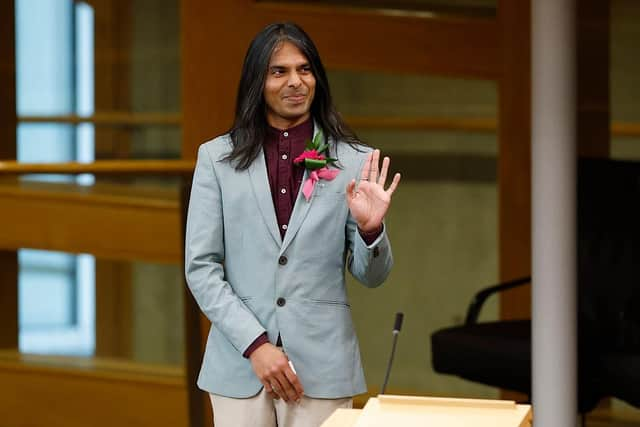

The proposal might be viewed, in part, in the context of Tamil Hindu traditions, which place emphasis on atonement, moral responsibility and ritualised self-sacrifice. This is seen during the Thaipusam festival, where devotees perform acts of self-mortification — body piercing with vel skewers, carrying heavy kavadi structures hooked into the flesh, and other forms of physical penance as atonement for past failings.
Manivannan’s stance on reparative justice may, consciously or not, draw on this rich cultural inheritance of self-examination and sacrificial responsibility. In the diaspora, such traditions can translate into a heightened postcolonial urge to make amends for historical injustice.
The proposal, sincere though I’m sure it is, perhaps highlights the challenge of integrating markedly different ethical frameworks into Scottish public life.
Brian Forsyth, Edinburgh
Monumental fail
It is shameful to note reports that Edinburgh University has pulled the plug on financial support for a proposed £750,000 sculpture in the heart of the city’s Old Town, marking the capital’s historic links with the slave trade in the Caribbean.
This comes less than a year after a review of its own historic links to slavery and racism revealed that the university had received the equivalent of at least £30 million in “philanthropic gifts” that can be traced to the profits of colonial commodities like tobacco, sugar and cotton. Based on present-day earnings, that is equivalent to £202m today, or as much as £845m based on the UK’s growth in overall wealth and productivity since then.
The Edinburgh report found 27 specific endowments from donors directly linked to the slave trade and colonial profiteering. These were responsible for funding professorial chairs in music, agriculture and engineering, as well as student bursaries, prizes and scholarships. Funding also contributed to the construction of university buildings, including Old College, New College and the Medical School.
To put matters in context, in its most recent financial year the university reported a surplus of £43m on a total income of £1,477 million.
It is quite disgraceful that a university that has benefited so extensively from the wealth created on the back of slavery is not willing to contribute what is a relatively paltry sum to deliver a memorial to mark this hideous trade.
Alex Orr, Edinburgh
Passing fame
It seems to me from playwright Joe McCann's boo-hoo tone that he intends using his A Play, A Pie and A Pint show The Corinthian as an exercise in race grievance-monging (“Story of world's first black international footballer who captained Scotland 145 years ago to be told”, 19 May).
It's complete fiction to claim that Andrew Watson's deeds were “forgotten” – despite the best attempts by the race relations industry in the British media because they annulled the “first black footballer” myths carefully constructed around England's Arthur Wharton promoted by Phil Vasili, Irvine Welsh and other Waitrose-shopping lefties – Wharton first kicked a ball a decade after Watson and others.
The cold, hard facts are that Andrew Watson was not merely “the first black footballer”, he was one of the game's original pioneers, full stop. Race doesn't come into it when talking about the “Scotch Professors” who popularised the passing game.
An exemplary academic and athlete (after matches he would run, still in full kit, to participate in local athletics meetings), Watson was both player and match secretary for Govan's Parkgrove playing alongside fellow black player Robert Walker.
The bigger clubs soon came a-calling, Watson to Queen's Park again as full back and secretary, Walker to their rivals Third Lanark. They reunited years later as two of the game's earliest professionals at Bootle FC. As Queen's Park's captain, Watson took them to back-to-back Scottish Cups in 1881 and 1882. He captained Scotland to record victories against England – including 6-1 in London on 12 March 1881.
After an eventful and successful life on and off the sporting field, he retired to London – whose pollution perhaps made it not the best choice for a man such as he, and tragically Watson died in 1921 of pneumonia.
McCann says: “As a black man growing up in Glasgow, I wish I knew about Andrew Watson.” I put it to him that a few visits to libraries or the Hampden Museum would have alleviated this problem. There's even a mural to Watson at the site of the first Hampden, for crying out loud!
Mark Boyle, Johnstone, Renfrewshire
Gospel of John
And John brought down the Tablet and told the people what was written thereon. And there was much rejoicing in the land, for he said, “let there be cheap milk, bread and eggs”. And there was and it was good.
And then John said, “let there be a cap on bus fares at two shekels. And there was.” And it was good. Yea, verily, for John can do no ill.
Then, John said, “let there be men who say they are women” and the people were amazed, for they knew not of such things, for they were of woman born.
Then, said John, we have the best health service in the Kingdom and the people waxed doubtful, for they had had to wait two weeks to see a consultant. And, it was so.
Then, John said, “I do not want you to render unto Westminster what is Westminster's” but, the people did and, lo! they each received two thousand five hundred shekels more each year than they would have had they heeded him.
And, yea! John's Tablet ran out of battery power, because he had offered to give the people things he could not afford. And, it was so, because John still had to pay for another ferry repair, five million loaves of bread and fishes, milk and eggs, dualling of the A9 which was two decades late, cheap bus fares and yet another independence campaign in Gaelic. And, it was so.
And, when the people realised that John was giving them what was not in his gift to give and learned that they would be greatly in debt to money lenders, they waxed wroth and smote him, hip and thigh.
Peter Hopkins, Edinburgh
Get talking
In response to challenge about his intentions with Sinn Fein, John Swinney’s response was: “I deal with elected politicians.”
Perhaps he needs reminding that Reform UK achieved 17 MSPs. To exclude Reform from cross-party talks is hypocrisy and double standards of the highest order.
Brian Petrie, Edinburgh
No convert
Christopher Clannachan of Equality Network writes of “ending abhorrent conversion practices’ (“LGBTQIA+ people’s trust in politics needs to be restored”, 19 May). What practices is he referring to which are not already unlawful?
It is surely a contradiction that the Scottish government commits itself to ending conversion practices while continuing to fund the Equality Network, which seeks to convert people to accepting its contested ideology.
George Rennie, Inverness
Battling Hastings
Scott Hastings, who died this week, was simply Scotland’s most charismatic rugby player. Like the advertisement of him that hung for years near Murrayfield he was larger than life. The poster of a beaming younger Hastings brother with the words “Great Scott!” portrayed him as a legend of the Scottish game and a great Scotsman. That cheeky smile masked a mischievous sense of humour but most of all he was a great ambassador for rugby and for charity, he will be sorely missed.
Rugby fans will have memorable moments of Scott on the pitch too. As a Watsonians supporter throughout the 1990s I witnessed the most important games against local rivals like Heriots and Boroughmuir. It was during one of those latter derbies that Hastings performed a try-saving “tackle” on Boroughmuir’s Iwan Tukalo. It was typically brave, a few feet from where I was standing and caused Tukalo to be injured. Hastings was first to check on the Scotland wing, knowing he had been over-exuberant, but not malicious, as he played with his heart on his sleeve.
While, rightly, many fond memories will involve brother Gavin, particularly during the famous 1986 and 1990 victories against England, the standout pairing was with Sean Lineen, with whom Hastings was half of the most famous centre partnership in the Scottish game if not the British game. It helped ensure Scotland leaked only 20 points in the 1990 Grand Slam campaign and was the bedrock of the team for several years; that experience served Scott well as a British Lion.
As coach Ian McGeechan said, “whatever jersey Scott wore, he just made it better”.
Neil Anderson, Edinburgh
Comments
Want to join the conversation? Please or to comment on this article.