
Readers' Letters: Expect disaster if SNP tries for a Scottish currency
Reader reacts to reports of SNP’s ‘secret’ plans for a Scottish currency
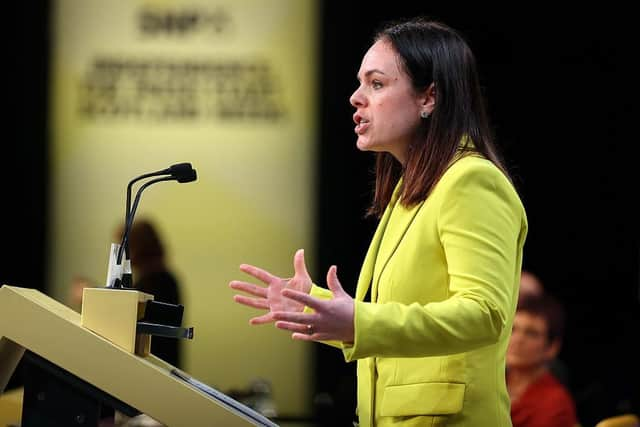
I note that the SNP's latest plans include implementation of a Scottish currency and party members have been warned not to discuss these controversial plans publicly.
An independent Scotland might try to adopt a new currency, but by what means would they defend the value of such a currency?
Plans by the Scottish Government to create an independent Central Bank could prove difficult. At present the Bank of England is the Central Bank for the entire UK, with its Regional Office for Scotland in Glasgow.

It is by no means an English Institution – 12 regional agencies cover the entire UK.
In my view the SNP would be entering unknown territory if their aim is to create a Scottish Central Bank. History records the plight of a previous venture in these northerly parts.
But it is widely known that the SNP is not famed for accepting sound advice, hence the frequent changes in SNP leadership.
Robert I G Scott, Northfield, Ceres, Fife
AI and water
As I read the article by Dr Kat Jones of Action to Protect Rural Scotland (“AI and data centres are huge threat to our countryside”, The Scotsman, 28 October), I was reminded of the historical parody 1066 and All That by WC Sellar and RJ Yeatman, published in 1930. The book famously reduces complex issues and events to absurd, catchy summaries, often defining them as “a Good Thing” or “a Bad Thing”. With Dr Jones’s comment that “data centres use monumental amounts of energy and water”, they are clearly being classified as “a Bad Thing”.
Although Dr Jones does not expand on water usage, a BBC Scotland report on 16 October took up the same theme. The reporter said data centres in Scotland each year use the equivalent of 27 million 500ml bottles of water – describing this as a “huge amount”. Linking this to potential water scarcity, she asked members of the public whether knowing their use of ChatGPT “can be bad for the environment” would change how much they use it.
Yet the same article noted data centres consume just 0.005 per cent of Scotland’s water supply. To put that in context, if a household bath represented the country’s entire water supply, the share used by data centres would amount to one teaspoonful.
Data centres undoubtedly use significant quantities of electricity and water, but their consumption is far less than that of industries from earlier generations such as iron and steel production or paper milling. Dr Jones’s suggestion that planning legislation should require an Environmental Impact Assessment for data centres is sensible. What is unnecessary is to demonise the technology that underpins Scotland’s transition from an industrial past to a digital future.
George Rennie, Inverness
Good bad news
The collapse of oil and gas firm Petrofac is described in The Scotsman as “catastrophic for the North Sea” (28 October). Would it not be truer to say it's a catastrophe for the employees affected? The sea itself may well be cleaner as a result.
George Morton, Rosyth, Fife
Man of honour
The Scottish Government should refuse to accept Lord Bracadale's resignation as Chair of the long-running Sheku Bayoh Inquiry, so emphasising that Public Inquiries are essentially inquisitorial proceedings intended to be conducted with economy and dispatch at the discretion of the Chair. They are not to be treated as the equivalent of court proceedings with all their attendant legal rules, and this tendency has resulted in the inordinate length of similar Inquiries.
Lord Bracadale is a respected judge and an honourable man who should be trusted to produce a fair and comprehensive Report.
Michael Bruce, Edinburgh
Awful airport
Reading the Scotland on Sunday article about Edinburgh Airport (26 October) I have to say, as a seasoned international traveller, this one is a shocker. There is not space here to recount the many discomforts and incompetence of the system. I have to say that the individual staff are nice enough, but the place really does not want to deal with people.
One recent example – my wife and I were stranded in Edinburgh by fog at our international destination. Nobody’s fault, but we paid to enter the lounge only to discover it was about to close. We sat for many hours through the night at an uncomfortable gate while the terminal closed around us.
We were given £45 each by our airline, but this was limited to basic food and drink. We had to spend it before the shop closed and, in the end, we bought £90-worth of Toblerone and took it back to family in Australia. Alternatives were crisps and 7 Up.
Vast amounts are spent on enticing visitors to Scotland’s attractions, yet the gateway to the country stuffs it all up.
Bill Boyd, Mackay, Queensland, Australia
Celtic future
Following the historic Welsh by-election result, respected pollster Professor Sir John Curtice announced Labour are in “severe trouble”. He then commented that Plaid Cymru, in winning comfortably, are “well placed to provide Wales with its next First Minister”. Furthermore he predicts the SNP are “likely” to form a pro-independence majority at next May’s Holyrood election, as both Scottish Labour and the Tories will lose votes to Reform. With Plaid winning over 47 per cent of the vote, Welsh Labour acknowledged their very poor 11 per cent showing. Strangely Scottish Labour chose to mostly ignore this significant event.
Since there is political and financial turmoil throughout the UK, the Celtic Nations elections next year will be crucial in deciding the future make-up of the British Isles.
Grant Frazer, Newtonmore, Highland
Tax the land
No, local income tax should not “be part of the conversation” (Editorial on Council Tax reform, 28 October). As many, including me, have pointed out, the answer is a land value tax (LVT). Tax the land value via the landowner, regardless of what's on it. It's a tax used in many countries.
Steuart Campbell, Edinburgh
Personal Budget
The media is reporting that in the autumn budget Chancellor Rachel Reeves has to find somewhere between £20 and £50 billion to fill the black hole in the country's finances.
Well, that shouldn't be too difficult – put 2 per cent on VAT and 10 per cent on luxury goods, 10p per litre on fuel, and raise the basic NI allowance from £5,000 to £7.5,000. Then, for OAPs and welfare recipients, have a specific inflation allowance, one that covers energy, food, rent, and clothes – the costs which affect them.
No triple lock and no change to Income Tax.
Will this happen ? Well pigs don't fly.
James Macintyre, Linlithgow, West Lothian
Citizens first
The suggestion by Prime Minister Sir Keir Starmer to house hundreds of men at Cameron Barracks “to get people out of hotels” is a solution, but only one of expediency, and probably economics (your report, 29 October).
There could be some validity in this approach if the reclaimed rooms were made available to long-term homeless people. Help everyone but think about your own citizens first.
Dennis Fitzgerald, Melbourne, Australia
Welcome migrants
The planned housing of 300 refugees in Cameron Barracks near Inverness city centre is indeed bizarre.
Whether we like it or not, these are desperate people, who have risked their lives on their perilous journey to our shores, only to have their suffering prolonged in demeaning and Spartan accommodation. For many of them, “going back home” is not an option.
Agonisingly, their fate will not be resolved for many months at the very least. Surely with a will, the vetting process could be speeded up, to the desirable extent of the barracks accommodation becoming redundant.
Only the Green Party offers a refreshingly positive view of immigration. Leader Zack Polanski, asked what he would do to “stop the boats”, replied that he would find a safer route.
While the migrants may have no right to be here, most, perhaps all, have a need.
Ian Petrie, Edinburgh
What’s in a name?
Congratulations to Edinburgh Trams on their foresight by eliminating York Place from their map as thePrince Andrew controversy continues.
Now it only remains for St Andrews to revert to the older name of Kilrymont.
John Yellowlees, Edinburgh
Wrong impression
Sarah Pochin MP has certainly pressed the virtue signalling minority's go-buttons by her comments about the predominance of non-white people on TV adverts.
But she is simply saying there are far too many adverts featuring non-white people on TV, giving the impression that white people in the UK are in a minority. This is yet another example of the ideology of Diversity Inclusion and Equality gone mad. And from the advertisers’ point of view, counterproductive. Britons don't like unfairness.
It's also another example of a Reform MP saying things with which the silent majority agree, as shown by opinion polls.
William Loneskie, Oxton, Lauder, Berwickshire
Write to The Scotsman
We welcome your thoughts – NO letters submitted elsewhere, please. Write to [email protected] including name, address and phone number – we won't print full details. Keep letters under 300 words, with no attachments, and avoid 'Letters to the Editor/Readers’ Letters' or similar in your subject line – be specific. If referring to an article, include date, page number and heading.
Comments
Want to join the conversation? Please or to comment on this article.