
Readers' Letters: Budget shows Labour don't know how to run country
The much-trailed Budget of Rachel Reeves got readers talkng
The real blunder concerning the Budget was not the OBR release prior to the actual announcement. The blunder was Rachel Reeves’s Budget itself.
Ms Reeves looked pathetic as Tory leader Kemi Badenoch, eviscerated the just-delivered Budget. Labour just does not know how to run the country. The message Ms Reeves sent out was clear. Seek benefits, not employment. No country in history has done well with that mantra. We really need a general election before the UK is beyond rescue.
Gerald Edwards, Glasgow
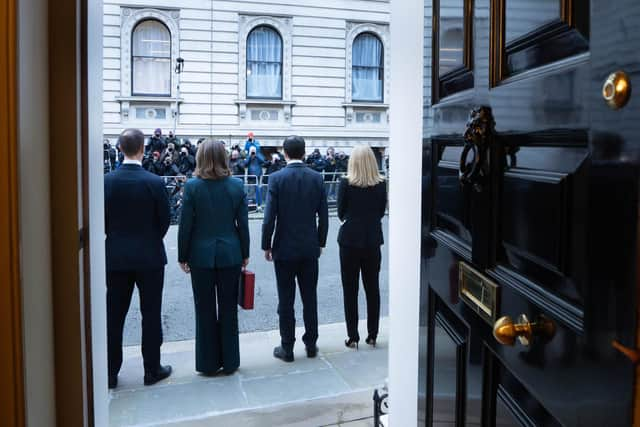

Crash coming
Rachel Reeves, incredibly, did nothing to reduce the UK's national debt, which has reached £2.8 trillion or £98,000 for every household. She increased government expenditure further. It continues to grow and is unsustainable.
Furthermore, all the economic indicators are flashing red. Experts warn that a crash is not only likely, it is certain. The OBR warns that if the AI bubble bursts it would increase the budget deficit by £26 billion. Yet we have a Chancellor who is pandering to the Labour left and is actually increasing borrowing and the enormous interest payments which go with it. She has – to use a railway term – passed a signal at danger. The debt train careers on.
When the crash comes, could Reeves react like Alistair Darling did in 2008 when Fred Goodwin phoned him up and said RBS was bankrupt and if he didn't do something they would run out of cash by the next morning? I doubt it. This Labour government, like the SNP, do not know how to manage public finances. They do not have financiers or business people in their ranks, They are, however, experts at spending other people’s money.
When the crash comes it is possible that Keir Starmer's government will fall. They do not deserve to be in office. They are Labour in name only.
William Loneskie, Oxton, Lauder, Berwickshire
Forget growth
Ewen Peters (Letters, 26 November) misses the point about the Budget, wrapped up in history and the minutiae about the expected tax changes but forgetting that Labour were elected on the promise of growth. Growth barely got a mention in yesterday’s Budget as the Government’s economic advisers don’t think there will be much at all.
It was the least surprising Budget for years, with all the announcements signalled weeks ago. I wrote in Letters recently that I expected changes in income tax and pension tax relief and those were the two biggest tax announcements in terms of tax take, with all working people who pay income tax taking a huge hit through fiscal drag.
Rachel Reeves faces a day of reckoning given that growth has not materialised and the economy is not expected to grow as fast from next year, with the OBR forecasts at little more than 1 per cent. While this Budget was built to placate disgruntled Labour backbenchers, taxpayers can’t be expected to pay a record 38 per cent of GDP in tax with little return. Only the richest feel better off and small businesses must feel betrayed by another huge hike in staff costs. “Thinking caps on” writes Mr Peters. Well giving SMEs something to cheer about would be a start to stimulating growth.
Neil Anderson, Edinburgh
Workers betrayed
Labour entered office promising not to raise taxes on working people. The OBR’s latest assessment shows the opposite is happening. Taxes will rise to 38 per cent of GDP, the highest level in modern British history, with two-thirds of the increase since 2019 coming from personal taxes. Much of this is the result of repeated freezes to Income Tax thresholds. Labour has now extended those freezes and will pull nearly one million more people into the higher rate.
At the same time, the much-discussed mansion tax has been redrawn to start at £2 million, which conveniently spares several senior Labour figures from paying it. This does little to build public confidence.
The OBR also confirms that national debt now stands at 96 per cent of GDP, almost twice the advanced economy average. Borrowing costs are the highest in the G7 apart from Iceland. Productivity growth has been cut again and real household disposable income is set to rise by only a quarter of one per cent per year. The UK faces high taxes, high debt and low growth, yet neither Labour nor the Conservatives seem willing to change course.
This is why more people are looking to Reform UK. The familiar economic model has failed and voters want something better.
Alastair Majury, Dunblane, Perthshire
Not so solo
It is interesting that the EU’s highest court has ordered Poland to recognise same-sex marriages, regardless of the fact that Poles do not allow it (your report, 26 November). Never mind the rights and wrongs of the issue, surely it is up to Poles to decide?
This is before we get around to economic affairs, ie, new entrants will eventually have to join the euro, thus losing much economic control. Do those who wish for “independence in Europe” – the SNP – realise what joining the EU actually entails?
William Ballantine, Bo'ness, West Lothian
Poor comparison
It is interesting to see reports that the Labour Party in England is developing something akin to Scotland's Curriculum for Excellence.
Opposition parties in Scotland have used Pisa data to attack the Scottish system, claiming it shows pupil performance in maths, science and reading has “slumped” relative to other nations. What must be understood is that the data that goes into the Pisa reports is gathered from 14 and 15 year-olds, this being the final year of compulsory education in some nations, so the only age at which comparison can be made between like and like. Scottish pupils have a further year or so of compulsory education beyond the point at which Pisa gathers its data.
Better measures of actual performance would be fourth to sixth year exam performance (although that information has its own flaws and demonstrates performance on only a limited range of outputs), or better still, the outcome data that tells us the rate at which young people progress from high school to further education, training or directly into employment. Pisa cannot use this data since many countries compared in its reports do not generate this information.
By any measure of outputs or outcomes Scottish education is performing well; why else would the Labour Party in England be preparing to emulate our models?
When next we hear Scottish Labour leader Anas Sarwar claiming the SNP government has failed on education, let's ask him to account for why, then, his party leader has the Government in London preparing to follow the successes achieved in Scotland.
Ni Holmes, St Andrews, Fife
Peer pressure
Regarding Charles Lowson's letter (25 November), reform of the House of Lords should be based on the structure of the Irish Senate, which consists of a mixture of members chosen by various methods. Of the 60 Senators, 11 are nominated by the Taoiseach, six are elected from universities and 43 are elected from five special panels of nominees.
The House of Lords has too may members (850) and is politically unrepresentative. Is the UK prepared to learn from the Irish?
Steuart Campbell, Edinburgh
No bones
Murdo Fraser perpetuates the myth created by Fordun that a 4th Century monk called Rule or Regulus brought the bones of St Andrew to Fife (Perspective, 26 November).
In fact they were brought to Fife by Bishop Acca of Hexham in 732 AD after he fell out with the king of Northumbria. Fordun invented the story as he did not like the idea that the bones came from England. In fact, neither England nor Scotland existed in 732 AD
Colin McAllister, St Andrews, Fife
History vandalised
With my childhood memory of Sir Kenneth Clark's first ever TV colour arts documentary, Civilisation, in 1969, a cherished one; I looked forward to BBC2’s Civilisations: Rise And Fall on Monday, looking at the Roman Empire. As a schoolboy I was fascinated by the story of the fall of Rome in 410AD led by King Alaric and the Visigoths. Subsequent incursions came from Attila the Hun in AD451.The Vandals under King Gaiseric sacked Rome in 455AD. You would think, if you were a Roman in 410AD, the threat of these three tribes would be your greatest concern. But no; for this is not history. This is BBC agenda-ridden history. On came a long queue of fervent left wing, mainly US historians, and talking heads, to argue that climate change, immigration and the gulf between rich and poor would have been their main concerns.
The BBC cannot help themselves can they?
John V Lloyd, Inverkeithing, Fife
Bad news for SNP
Maybe not the best of news for those Scots seeking the break-up of the UK, but the latest figures reveal a broken-off Scotland's most important market by far – worth tens of billions annually – is the rest of the UK.
It is so large that it dwarfs the value of the European Union and international markets combined.
This being the case, erecting a new, hard border, inevitable under SNP plans, would seem almost to be net zero level masochism.
These facts will have the SNP's Spad Army at full stretch trying to spin it all away.
Alexander McKay, Edinburgh
Write to The Scotsman
We welcome your thoughts – NO letters submitted elsewhere, please. Write to [email protected] including name, address and phone number – we won't print full details. Keep letters under 300 words, with no attachments, and avoid 'Letters to the Editor/Readers’ Letters' or similar in your subject line – be specific. If referring to an article, include date, page number and heading.
Comments
Want to join the conversation? Please or to comment on this article.