
Infected blood report: whistleblowers need more protection - readers' letters
Following the findings of the Infected Blood Inquiry, can we now expect that the four governing parties of the past 40-odd years (Conservative, Labour, Lib Dem and in Scotland the SNP) and the relevant NHS medics and management, will now issue their profuse and credible apologies for their inexcusable actions and inactions, to the victims both living and dead and to their families, along with fair compensation?
Further, in view of recent appalling reports, can we also expect prompt legislation enacted to protect genuine whistleblowers not only in the NHS and Post Office but in the private sector and all public bodies, such as but not limited to building control following the Grenfell tragedy, RAAC approval and other cost- or-corner-cutting practices?
John Birkett, St Andrews, Fife
Shameful cover-up
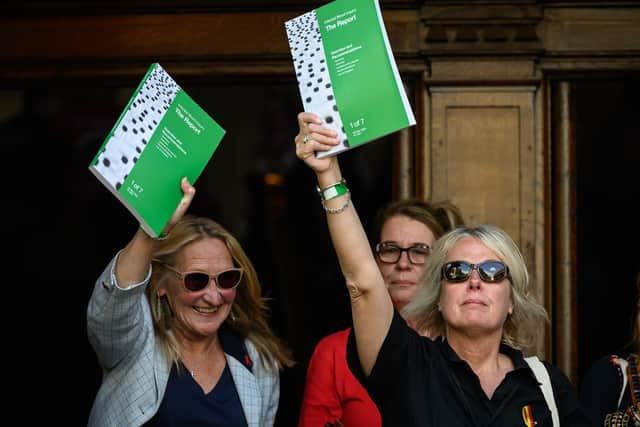

The report on the infected blood scandal is devastating and one can’t imagine what the victims and their families have gone through since the 1970s and 1980s with their claims of wrongdoing being ignored by the establishment. No amount of compensation can bring back the lives unnecessarily lost nor restore the quality of life to those still living.
At that time contracting AIDS and Hepatitis C was a death sentence and the massive cover-up has brought shame upon the medical profession, civil service and politicians. Trust has been broken and for some it will never be restored.
We will be told that lessons have been learned but so long as those in authority don’t have the courage to admit their mistakes with honesty and contrition, there is very little to prevent a repeat in the provision of some kind of public service. To me, one of the most despicable aspects was the finding that some civil servants destroyed evidence to aid the cover-up and they should be held to account for this.
Bob MacDougall, Kippen, Stirling
Politics has failed us
On Monday the normally insipid leader of the Labour Party said something that was undeniably true. Following the Government statement on the contaminated blood products scandal and cover-up he looked up at the public gallery in the House of Commons and said to the campaigners who were at last being heard: “Politics has failed you.”
Of course the BBC and media are themselves part of the problem as they long ago lost any pretence of holding the political class to account, instead fraternising with them and forgetting what their profession is meant to be about. Is it any wonder that voter disaffection is rampant?
Meanwhile the ICC issues an arrest warrant for Netanyahu, and his enablers – Biden, most of the EU and of course our own discredited leaders – squeal in outrage, having utterly failed to rein Israel in after eight months of carnage.
Just one political leader had the vision, guts and courage to call for Netanyahu’s arrest 48 hours before the ICC did. That leader was Alex Salmond, still standing up for Scotland and for what is right, despite the efforts of lesser politicians and the craven “chattering classes” to finish him off.
Our democracy may not appear to be as fragile as that of the United States but it is entirely possible that huge Conservative losses will herald the return of Farage, Johnson and other populists. We can only hope Scotland will resist being dragged down with the rest of the failed and compromised UK.
Marjorie Ellis Thompson, Edinburgh
Promise of change
Martin O' Gorman thinks that being called “extremists” by the Prime Minister is appropriate for all those who support Scottish independence (Letters, 21 May) because of the association with Scottish Green Party.
That would mean, by same logic, that every Tory agreed with the absolutely shambolic leadership of Prime Minister Boris Johnson during the Covid-19 pandemic, the parties in Downing Street and the total disregard for the rules.
That every Tory subscribed to the plans of Liz Truss that ruined the economy in the space of seven weeks and that every Labour supporter agrees with the right-wing drift of the party under Sir Keir Starmer.
I doubt they do and the problem with tarring all of us with same brush is that we could, if we wanted, apply the same standards to every unionist and federalist, but it would not get us very far.
I don't particularly care, having never voted for the Tories or Labour at a general election, that what they are doing puts the Union at risk. However, I do care that they promised change in 2014 and have spectacularly failed to deliver it.
Peter Ovenstone, Peterhead, Aberdeenshire
Political tantrum
I have just read about the Scottish Greens candidate attacking JK Rowling (Scotsman, 21 May). And if I was able to vote in the Gordon and Buchan ward in any elections, I would have to think hard about giving my vote to the Scottish Greens.
If Sophie Molly turned up at my doorstep and I didn’t agree with her, would she have a tantrum and call me all sorts of names Iike torn-faced etc?
I am glad that the Scottish Greens have decided to tug her sleeve and have a quiet word in her ear – like maybe, as my grannie used to say “If you've not got anything nice to say about someone then better to say nothing”, or to quote Mark Twain: “It is better to keep your mouth closed and let people think you are a fool than to open it and remove all doubt.”
J Moore, Glasgow
University cuts
I don’t understand why the Scottish Government is being so hard on higher education.
Universities like Aberdeen have been central to our national well-being for centuries, making Scotland famous for its philosophers, scientists and doctors. Our university leaders should be able to spend their time enhancing the ability of their institutions to continue such activities, rather than fighting for access to begging bowls.
But history repeats itself. When Margaret Thatcher was prime minister, university funding was not devolved. It came from London. I was Dean of Medicine at Aberdeen, and fighting her funding cuts became a way of life. The money now comes from Edinburgh. The cuts are even bigger!
Hugh Pennington, Aberdeen
Relative risks
Alex Orr is correct in reminding us that there were perhaps 16,000 deaths throughout Europe in the years following the Chernobyl disaster as a result of exposure to radioactive fallout (Letters, 21 May).
This is approximately equal to the number of road traffic deaths, in the UK alone, in the three years after the Chernobyl accident. We should keep these risks to life in perspective.
WB Campbell, Edinburgh
Bank under fire
A group of 44 Conservative MPs are demanding a review of the Bank of England’s independence, accusing it of costing taxpayers thousands of pounds.
They criticised its response to QT – Quantitative Tightening, where the taxpayer is made to pay for any losses from the sale of government bonds the Bank had previously bought up in an effort to stabilise the economy.
This is not the only area where the Bank’s competence is being questioned. There are the numerous increases in interest rates in an attempt to reduce inflation, but the problem is that the areas causing inflation do not react to the base rate – energy prices, for example have doubled in the last year, caused by Vladimir Putin cutting off supplies to Europe and then invading Ukraine. Mr Putin does not react to the Bank’s interest rate. The only way to reduce energy prices is to increase supply, reduce demand, or both.
The current base rate of 5.25 per cent is too high and is creating problems for small businesses and people with mortgages, and it almost caused the country to go into a mini-recession last year.
The Bank needs to get the base rate down to 4.5 per cent over the next six months by making three reductions of 25 basis points each. Then we might see some real growth in the economy.
James Macintyre, Linlithgow, West Lothian
A positive choice
I recently listened to a recording of Danny Dorling’s talk at an Edinburgh bookstore about his book, Shattered Nation, which chronicles the UK’s decline. Dorling, Professor of Human Geography at Oxford, told the story of a European country in 2020 that, when faced with the cost-of-living crisis and a pandemic, convened a government emergency committee and introduced a payment of £10 per week for each child under six in families receiving benefits. In 2022 this was then increased to £25 per week for each child under 16. For a family with three children, this meant an extra £4,000 per year. He asked the audience to guess which country he was talking about. Someone immediately responded: “Scotland.”
When he poses this question to an English audience, it takes ten guesses to land on Scotland. That’s because England has no idea what Scotland has done to blunt Westminster welfare cuts, or anything else for that matter. The media doesn’t report it and Gordon Brown doesn’t talk about it.
Professor Dorling said the Scottish Child Payment is responsible for the biggest reduction in child poverty in a year anywhere in Europe since 1989. Scotland accomplished this within the Barnett Formula budgetary straightjacket.
This shows that alleviating poverty is a political choice, not one that the Tories or English Labour are willing to make.
Leah Gunn Barrett, Edinburgh
Write to The Scotsman
We welcome your thoughts – NO letters submitted elsewhere, please. Write to [email protected] including name, address and phone number – we won't print full details. Keep letters under 300 words, with no attachments, and avoid 'Letters to the Editor/Readers’ Letters' or similar in your subject line – be specific. If referring to an article, include date, page number and heading.
Comments
Want to join the conversation? Please or to comment on this article.