
How one of Scotland’s biggests ports is responding to increasing demand for supply chain resilience
‘Just in case’ is replacing ‘just in time’ in response to need for larger warehousing
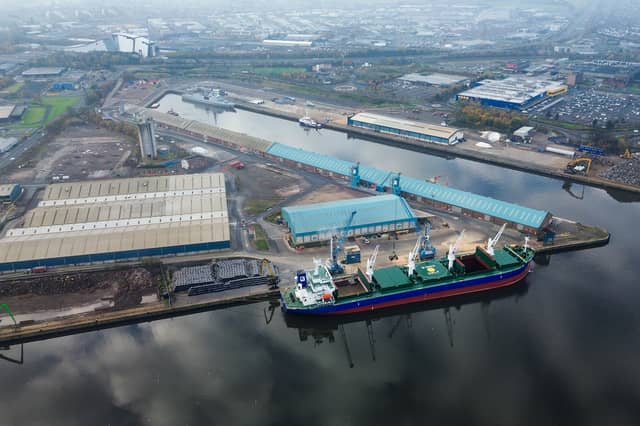

At the King George V Dock in Govan the blue hull of a cargo vessel, the Aysel, looms over the quayside as work finishes unloading thousands of tonnes of animal feed destined for farms across Scotland.
This cargo has long been the bread-and-butter of the port, part of the Clydeport network in Glasgow that dates from its creation in 1966. Since 2003 it’s been run by Peel Ports, the UK’s second-largest port operator, which also owns Port of Liverpool, London Medway and Dublin.
Clydeport isn’t one port, but a sprawling collection of assets: the cruise liner and container terminal at Greenock, linking Scotland through trade with Ireland and North America; Rothesay Dock; Inchgreen Marine Park; and Hunterston PARC, a 300-acre energy and marine campus on the Ayrshire coast.
At King George V Dock, or “KG5”, a row of warehouses stretches the length of one quayside. Here, Peel Ports’ customers such as US agribusiness ADM and cement companies Holcim and Nova store product before it is trucked away.
Nearby, a mound of salt brought in from Northern Ireland awaits distribution for gritting Scotland’s winter roads. About half of Clydeport’s throughput by tonnage is aviation fuel, via Rothesay Dock.
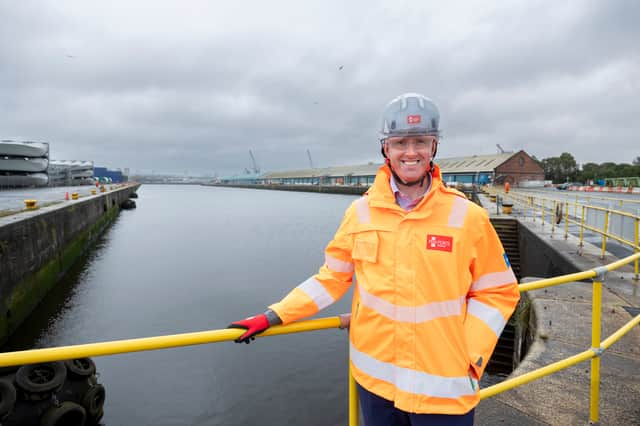
“We are a very diverse port operator,” says Jamie Strain, as he gives a tour of the site. The 45-year-old took over as Clydeport port director from industry veteran Jim McSporran in September, arriving from Amazon, where he ran its massive distribution centre at Dunfermline for more than six years. That followed 13 years with Tesco. “When you work for Amazon and Tesco, everyone knows what these businesses do,” Strain says. “But it really struck me coming into this business that the ports really are one of the biggestindustries that no one really knows about.”
Yet understanding what ports do, and what flows through them, is in turn vital to understanding how Scotland’s economy is being reshaped amid a generational upheaval in geopolitics and conflict-related supply chain disruption, not to mention the energy transition driven by climate change.
READ MORE: The dangerous belief in 'inevitability' shared by Donald Trump and the SNP – William Deans
Last weekend, KG5 took its first delivery of battery energy storage system (BESS) units from China, one of a series expected between now and the end of December. This is a direct result of the renewables build-out in Scotland, a major part of which is BESS projects under development in South Lanarkshire.
This builds on Peel Ports’ recent history handling green tech, after it reconfigured part of KG5 to store onshore wind turbines. Last year it invested £3 million expanding that capacity, most of it on a road out of the dock able to take lorries carrying 80.5-metre wind turbine blades.
Strain says shifts in the global economy mean that “there’s a ton of opportunity to be thinking about”.
“If you look at some of the biggest ports in the world – Shanghai, Singapore, Dubai – and what those in North and South America are doing, what markets are we not in yet that might be the future in five, 10 years’ time? That’s something that I and the team are looking at,” he says.
One possibility is importing electric vehicles as demand for Chinese brands continues to grow. Another is marketing Clydeport as a way to get goods more directly to the source of demand in Scotland, rather than relying so heavily on ports in London and Dover for imports, and trucking them north. “This is a key selling point if you think about how well-connected we are logistically in the west coast here,” says Strain. “If you can use the current infrastructure here rather than driving 450 miles up the M6 then that’s worth considering. And we have the capacity to take that volume [of business] here.”
READ MORE: Like many young people I lost faith in climate politics - could going to COP31 change my mind?
But arguably the biggest change afoot at KG5 is the expansion of warehousing.
As unglamorous as it may sound, warehousing is a good proxy for how global supply chains are being redesigned for stability of supply. In other words, “just in case” is replacing “just in time”.
At KG5, work started this week on a new 100,000 sq ft warehouse behind the KG5 administration building, which dates from 1930. It is part of a group-wide programme to build 1m sq ft of new warehousing, equivalent to around 13 football pitches, with construction already under way at Port of Liverpool.
The move responds to rising UK demand for larger warehousing. Announcing the programme last month, Peel Ports cited a recent report by property consultants Savills describing “a fundamental shift in how occupiers manage supply chains after the shocks of Brexit, Covid-19, and wider global conflicts”.
Against this backdrop, Peel Ports said businesses were “increasingly reviewing their supply chain strategies in response to changing global trade patterns, evolving customer requirements and the need for greater resilience”.
In the latest Bank of Scotland Business Barometer, published today, Scottish businesses named tariffs and trade-agreement uncertainty as their biggest international trading challenge, followed by supply chain complexity or disruption risk.
Peel Ports says more organisations are now seeking “port-centric warehousing solutions” that reduce transportation costs, improve operational efficiency and provide direct access to major import and export routes. Demand is being driven by a number of “strategically important sectors”, including fertiliser, chemicals and defence.
At KG5, the idea is to give customers what Strain calls a “bridge” – effectively a warehousing buffer – that can act as a back-up to ensure goods flow freely if supply chains are disrupted.
“If something’s broken anywhere along the supply chain, customers are turned off because it adds cost and it kills resiliency,” he explains. “Customers’ needs are changing in terms of what they store, where they store it. It’s about offering flexibility.”
Comments
Want to join the conversation? Please or to comment on this article.