
The truth behind the SNP's big boast about free prescriptions in Scotland
The SNP’s decision to give free prescriptions to five per cent of Scotland’s population who could afford to pay for them doesn’t impress Brian Wilson
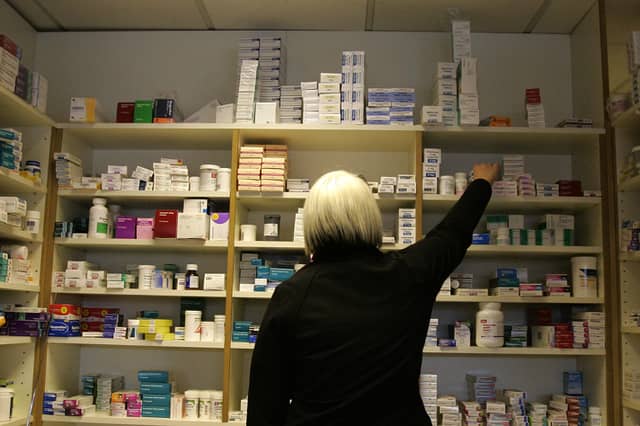


Anyone who clings to the “Honest John” myth might wish to subject one of Mr Swinney’s recent pronouncements to analysis. At a photo-opportunity in a pharmacy, he stated: “Fifteen years ago, we made prescriptions free in Scotland – while people south of the Border pay £9.90 an item”.
This is a regular thread in SNP propaganda and to say it is playing fast and loose with the truth is generous, as Mr Swinney well knows. But if dodgy history is the best he has to offer, that tells its own story.
It is true some people in England pay for prescriptions. It is also true that over 90 per cent are dispensed without charge. Equally, it is true that the SNP made all prescriptions free in Scotland – at a point where 95 per cent were already free under the previous administration.
So a more accurate statement would be: “Fifteen years ago, the SNP extended free prescriptions in Scotland by five per cent, to include those most able to make a contribution. In England, the vast majority of people receive free prescriptions but a minority who can make a direct contribution continue to do so.”
Actually, the decision about “free prescriptions” for the tiny minority of Scots who paid pre-2011 was utilitarian rather than one of high principle. Northern Ireland (2010) and Wales (2007) had done the same for a simple reason – so few were paying that the administration costs made it not worth the trouble.
In England, as a reflection of scale, the cost to the NHS would have been much higher and a different decision was taken, leaving ten per cent still charged for. That’s how devolution is supposed to work. Not as a competition but as different outcomes in different circumstances.
It cost the Scottish NHS very little to give the five per cent free prescriptions. In England’s NHS there were higher priorities. So what? To present this as a difference between the “people” in general relies on ignorance of the reality, which is not a very dignified way for a First Minister to behave.
It also points to the wider problem with universality, or “free things” which the SNP love to boast about. They don’t benefit the poor, the sick or the elderly because they were getting them anyway. That helps to explain why, despite all the rhetoric, poverty and attainment gaps in Scotland continue to widen rather than narrow.
Sadly, the principle of universality does not apply to other aspects of the NHS. These are still subject to laws of supply, demand and good governance, which explains why so many people wait record times for treatment while only a minority can escape into the private sector to avoid that imposition.
On the same day as Mr Swinney’s pharmacy photo-op, his promise of 12 months ago that no patients would be waiting more than a year for treatment by the end of March 2026 was confirmed for what it was always likely to be – a headline without substance. At the last count, there are 52,000 Scots in that situation. No photo-op for them!
One of many reasons Scotland requires change is that every spending silo needs to be re-examined for the value it produces and the priority it reflects. If there is ever going to be real progress in making Scotland more successful and socially just, shibboleths have to be challenged and priorities re-assessed.
It was, for example, inevitable when Holyrood was given power over some benefits that the race would be on to make them more generous and accessible than in England, without much regard for outcomes. It is easy to dress this up in terms of being more humane, more caring and all the rest of it.
However, if the outcome is that a higher proportion of people are incentivised not to make themselves available for work or training, as appears to be the case, then it is far from clear that this is in the interests of either the individuals or the society we live in.
The Centre for Social Justice reported recently that Scotland spends almost £1 billion more on devolved benefits than it receives for them in Barnett funding. It found “minimal” evidence this “spending with abandon” is delivering even in its own terms, with child poverty at 23 per cent while Scotland has the highest proportion of long-term workless households in Britain.
This ties into educational priorities and another boast about “free” university tuition which is in urgent need of review. Not, I hasten to add, to remove it from those who need it to access university. In fact, the problem with universalism is that it limits the ability to deliver higher levels of support to those who will otherwise still never see the inside of a university.
Another contradiction lies in the fact that while “free university tuition”, regardless of economic status, is one of the untouchable holy grails, treatment of further education has been consistently appalling. Yet where do Scotland’s needs lie in training a workforce and providing the vital bridge to a more hopeful future which is often denied to that 23 per cent?
So how about an election campaign fought about Scotland as it is now. What an achievement it would be if, in five years’ time, we had a better-educated workforce, higher skill levels which could give young people from all backgrounds careers for life, an NHS in which nobody waited more than a year for treatment, and a political environment in which public services and individual aspiration are celebrated.
That would be a lot more inspirational agenda to fight on than misleading claims about how five per cent of the population were given free prescriptions 15 years ago.
Comments
Want to join the conversation? Please or to comment on this article.