
The horrific truth behind the painful deaths of 90% of British pigs – Philip Lymbery

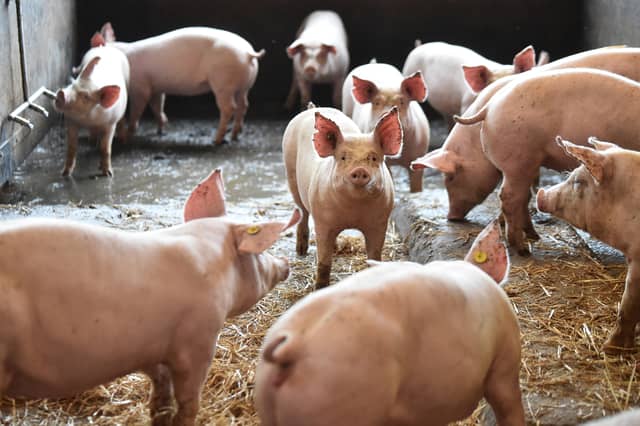

After decades of warnings about slaughtering pigs using carbon dioxide, things may be finally about to change
Christmas is still a few weeks away, but you wouldn't know it from the shops. The tinsel is up, festive music is playing and supermarket shelves are rapidly filling with the foods of the season. For many, that will include pork in one form or another: pigs in blankets with the Christmas turkey, sausage rolls at parties, perhaps a glazed ham for Boxing Day. Then there’s that evocative smell of bacon frying on a cold winter morning.
We might check where it came from, whether it was outdoor-reared or perhaps how much it costs. But there is one question few of us are likely to ask: how was the pig killed?
The answer brings us to one of the most uncomfortable practices in modern farming: slaughtering pigs using carbon dioxide. Fully conscious pigs are lowered into a chamber filled with the gas, where they struggle to breathe and can experience acute pain and panic before losing consciousness. It can take up to a minute. A long time when you’re in agony.
Difficult as that reads, there is something unusually hopeful about this story. This isn't simply another case of animal welfare campaigners demanding change. This time, the UK government and the Scottish government want to end the practice.
‘Significant pain, suffering and distress’
The commitment was made in the UK government's Animal Welfare Strategy. Now things are moving forward with a public consultation on phasing out carbon dioxide killing of pigs. And here comes the extraordinary part. The consultation says: “The evidence that carbon dioxide gas stunning causes significant pain, suffering and distress to pigs at the time of killing is well known.”
“Well known.” Those two words stopped me in my tracks. If the suffering is well known, how did we allow this method to become so widespread?
As far back as 1996, scientific research highlighted serious welfare problems with using carbon dioxide, finding that pigs showed profound aversion to the gas and suffered “severe respiratory distress”.
The warnings kept coming. In 2003, the government's own expert advisers, the Farm Animal Welfare Council, recommended that the practice should be phased out within five years. The European Food Safety Authority subsequently described high concentrations of carbon dioxide as aversive to pigs, while European slaughter regulations stressed the need for alternatives.
Yet instead of disappearing, carbon dioxide became commonplace. As scientific warning signs accumulated, the technology became entrenched. So how did that happen? How did a slaughter method so widely condemned become the norm?
Part of the answer lies in the industrialisation of meat production. Carbon dioxide systems offered some practical advantages: pigs could be kept in groups rather than individually restrained, while abattoirs could process large numbers efficiently.
Out of sight, out of mind
But somewhere along the way, one crucial consideration got lost: what the pigs experience. Intelligent, sensitive animals were paying the price for greater efficiency in the system.
It became a real-world case of out of sight, out of mind. Abattoirs don't have glass walls. Most of us never see what happens inside them. And so, largely beyond public view, a controversial method became the dominant one. Today, around nine in ten pigs slaughtered in Britain are stunned using high concentrations of carbon dioxide.
The spread of carbon dioxide stunning therefore tells us something about the wider industrialisation of meat production: when systems are designed principally around volume and throughput, the experience of the individual animal can too easily become secondary.
But what about humane alternatives? The pig industry argues that alternatives have yet to prove they can deliver better welfare reliably at the scale required by modern abattoirs. That's a legitimate practical concern: any replacement must work effectively in the real world, not just in theory.
However, it isn't an argument for carrying on with a method whose welfare problems are already so well known. And alternatives do exist. Electrical stunning is one and was widely used before carbon dioxide became dominant.
There are alternatives
Many years ago, I travelled in Asia with animal-welfare scientists from the University of Bristol, helping to train professionals in the Philippines and Taiwan. It was there that I learned something I've never forgotten about stunning.
Pain isn't registered instantaneously. It takes the brain a fraction of a moment to process it. Properly applied, electrical stunning renders the pig unconscious and insensible extremely rapidly, so that they don’t experience what follows. That's the essence of humane stunning: the animal should know nothing of what follows. Another promising alternative is argon, an inert gas that can render pigs unconscious without the severe respiratory distress associated with carbon dioxide.
So, I warmly welcome the government's proposal to consign this method to history. It comes after 30 years of campaigning by animal welfare organisations like Compassion in World Farming and the RSPCA. But what matters most now is not how long it has taken. It's that we finally have the opportunity to get it done.
The government has made clear that anyone can respond to the consultation. That gives all of us the chance to make our feelings known. Recent opinion polling shows the vast majority (78 per cent) of the UK public find carbon dioxide pig slaughter unacceptable.
By the time Christmas arrives, the consultation will have closed. We have just a few weeks to tell the government that a practice known to cause pain, panic and distress has no place in a country that prides itself on caring for animals.
Perhaps this Christmas, we can give pigs something they have been denied for far too long: a more humane end.
Philip Lymbery is chief executive of Compassion in World Farming, president of EuroGroup for Animals and a UN Food Systems Advisory Board member. His latest book is Sixty Harvests Left: How to Reach a Nature-Friendly Future. He is on X/Twitter @philip_ciwf
Comments
Want to join the conversation? Please or to comment on this article.