
Scottish economist Adam Smith's fingerprints are all over the US Declaration of Independence – Bruce R Shaw
Several of America’s founding fathers cited Adam Smith’s works and found common cause with the philosopher’s ideas
It’s hard to imagine what America might look like today had it not been for the influence of Adam Smith and his fellow Scottish Enlightenment thinkers. This year offers a unique invitation to revisit the connection, as both Smith’s best-known book, The Wealth of Nations, and the United States mark their 250th anniversaries. Smith’s writings arguably had an outsized impact on the American founders, yet his role in shaping the American experiment is too often underappreciated and only partially understood.
If Smith is referenced at all, his contributions are typically confined to economics. Because An Inquiry into the Nature and Causes of the Wealth of Nations, published in March 1776, is his better-known book, many think that his sole contribution to the American idea was discovering the “invisible hand” and individual self-interest – key ingredients driving laissez-faire, free-market capitalism.
But Smith’s economic ideas overshadow his larger significance: he was a moral philosopher, a keen observer of the conditions that enable people and societies to flourish. His first book, The Theory of Moral Sentiments, published in 1759, lays the foundation for his later reflections on the workings of commercial society. In fact, Smith published six editions of this first book, finishing the final edition just before his death in July 1790, and therefore making Moral Sentiments, in effect, his first and last book.
READ MORE: Adam Smith work 'prophetic' says paper published to mark 250th anniversary of Wealth of Nations


‘Render their happiness necessary to him’
To better understand Smith’s influence, it helps to briefly revisit the world he lived in. He referred to the mid-18th-century economy in Britain and its European neighbours as the “mercantile system”. At its core, mercantilism consisted of government-sponsored companies with exclusive trading rights, like Britain’s East India Company.
In addition, the national economic objective was to build the largest possible trade surplus, filling the treasury with as much gold as possible. Smith recognized that this model was flawed. It enriched a powerful few, limited competition, and was prone to corruption. In response, he argued that the country’s true wealth lay in its people, its capital, and the creative combinations of both – offering a more optimistic and dynamic view of economic life.
The first sentence of Moral Sentiments reveals a side of Smith that surprises modern readers: “How selfish soever man may be supposed, there are evidently some principles in his nature, which interest him in the fortune of others, and render their happiness necessary to him, though he derives nothing from it except the pleasure of seeing it.”
READ MORE: 250 years after Adam Smith's Wealth of Nations, Scotland can once again reshape global finance
What encourages virtue?
On the surface, Smith’s ideas in Moral Sentiments might seem at odds with those in The Wealth of Nations, but he was simply observing how human beings behave in real life. Self-interest and sympathy for others are both present in human experience, and each play an important role in framing society.
Even so, what basis is there to believe America’s founders borrowed more from Adam Smith than his economic ideas? According to some accounts, in 1759 – 17 years before the Declaration of Independence was signed – Smith and his friends hosted American founder Benjamin Franklin for dinner in Scotland.
Franklin, himself a writer and publisher, likely quizzed Smith about the themes in Moral Sentiments. However, Franklin was not the only founder to be familiar with Smith’s writings. Though the Scottish philosopher never visited the United States, his books certainly made the trip.
John Adams, Alexander Hamilton, Thomas Jefferson, and James Madison are among the nation’s early leaders who cited Smith’s works as the American experiment took shape. They found common cause in many of the questions Smith wrestled with: What makes a society prosperous? What encourages virtue? How should freedom and responsibility be balanced?
Attempting to address these questions, the American founders would have referenced Smith’s most famous line from The Wealth of Nations: “It is not from the benevolence of the butcher, the brewer, or the baker that we expect our dinner, but from their regard for their own interest. We address ourselves, not to their humanity but to their self-love.”
At the same time, they must also have contemplated his observation from Moral Sentiments about sympathy for others and the wisdom of caring for the public interest: “The wise and virtuous man is at all times willing that his own private interest should be sacrificed to the public interest of his own particular order or society.”
Cookouts and fireworks
The founders would have appreciated Smith’s honest view of the complexity of human behaviour, both in the transactional relationships that make up commercial society and in interpersonal relationships within families and among neighbours. They also must have grasped the importance of economic growth and healthy market competition supported by the societal institutions that shape informed members of society.
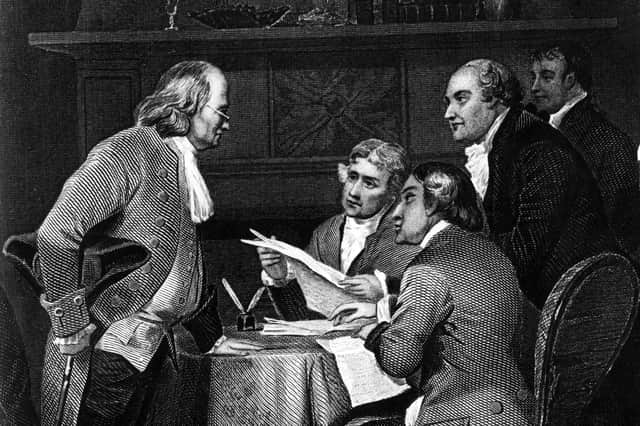
As its citizens celebrate America at 250 this July 4, they will gather for cookouts and fireworks – and take time to reflect on the many blessings the nation has bestowed over its relatively short history. If they pause long enough, they will also recognise that the American idea is both resilient and fragile, captured so well by a remarkable group of 18th-century leaders in the Declaration of Independence.
While Adam Smith’s signature is not on that groundbreaking document, his fingerprints surely are, and it’s only fitting to include the Scottish philosopher in this year’s celebratory toast. Here’s to America, Adam Smith, and the next 250 years.
Bruce R Shaw is the executive director of The Denny Center for Democratic Capitalism at Georgetown Law in Washington DC. The Denny Center, in partnership with Adam Smith’s Panmure House and Windrider Productions, recently produced a documentary film, Adam Smith: The Currency of Thought, from which much of this content was drawn.
Comments
Want to join the conversation? Please or to comment on this article.