
No one knows how this Gulf War will end – but we should welcome the downfall of the Iranian regime
A US victory over the Tehran regime will make Iran, the Middle East and the world a safer and better place

He is not Winston Churchill and this has not been his finest hour. Sir Keir Starmer’s dithering response to geopolitical tectonic plates shifting beneath his feet invited an unflattering comparison from the US President with the Prime Minister’s wartime predecessor.
Starmer, influenced by prominent Cabinet colleagues such as Ed Miliband, initially refused Donald Trump’s request to use British bases in Cyprus and the Chagos Islands in the joint US-Israeli attack on Iran.
So much for the special relationship. As former Labour Prime Minister Sir Tony Blair pointed out, it is not as if the Americans were asking us to commit troops. The US was seeking somewhere to refuel its planes. At the heart of Starmer’s indecision lies the question of whether war on Iran is justified.
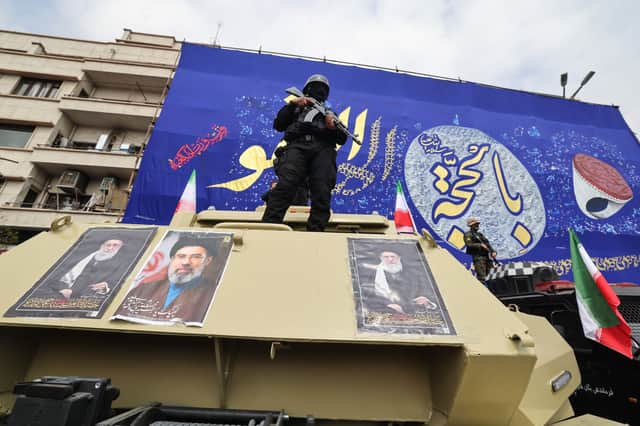

‘Great Satan’ and ‘Little Satan’
Legally, intervention could be justified on the grounds that Iran has essentially been at war with the US since the regime seized power in 1979. The chant “Death to Israel” (demonised by the regime as the “Little Satan”) is often accompanied by “Death to America” (the “Great Satan”).
There have been many attacks over the years on US installations and armed forces in the region. Hundreds of US, and British, servicemen and women were killed in Iraq and Afghanistan by proxies of Iran’s Islamic Revolutionary Guard Corps (IRGC). Iranian terror plots are continually foiled in the US, the UK and elsewhere.
There is also a moral case for intervention to protect Iranians from a regime that massacres its own people by the tens of thousands. To intervene on these grounds would require a UN Security Council resolution – over which the likes of China and Russia would have a veto.
International law, to which Starmer claims to be so beholden, is amorphous and bends to political will. Legal arguments can be made both for and against action in Iran. Ask two international lawyers to take a view and you may very well get three opinions.
It can be weaponised against countries that seek to uphold it, protecting despots from retribution or retaliation. How closely was the late Ayatollah Ali Khamenei adhering to international law when he murdered an estimated 30,000 protesters over just a few days in January?
Iraq War doubts persist
Another factor that no doubt looms large in Starmer’s thinking is past experience in Iraq and Afghanistan. But no one is talking about US boots on the ground followed by attempted nation-building. The Iraq experience is not a justification for never doing anything anywhere.
But what is the objective? Critics argue there is no clear mission, but the US administration has set out several. It is possible for many things to be true at once. Opponents can disagree with the objectives but that does not mean the objectives do not exist.
Trump set out four two days after the military operation began. Firstly, to destroy Iran’s missile capabilities, which the regime had been ramping up at pace. Secondly, to destroy the Iranian navy. The Americans claim that so far around 60 vessels have been destroyed.
Thirdly, to ensure the world’s largest sponsor of terrorism cannot obtain a nuclear weapon. We know the first thing the theocrats in Tehran would do with a nuclear bomb is fire it at Little Satan Israel, which they believe should be wiped off the map. We know this because they have been saying it for decades. Another bomb may well be aimed at the Great Satan across the Atlantic, and others at any sort of medium-sized Satans in between.
A tyrannical regime with nuclear weapons is untouchable. This is the case with North Korea. The difference between Kim Jong Un and the ayatollahs is that the former is motivated by worldly gain, whereas the latter and their followers are driven by an apocalyptic theology. Kim Jong Un and his supporters do not draw strength from the belief that they love death more than their enemies love life.
Warfare has changed
The final objective set out by the president was to ensure the Iranian regime cannot continue to arm, fund and direct terrorist armies outside its borders. For almost half a century, the IRGC has been the nerve centre for a network of terrorist groups including Hamas, Hezbollah and the Houthis.
A welcome consequence of achieving these objectives would be the facilitation of the overthrow of the Iranian regime by the Iranian people themselves.
This is not 2003. Warfare has changed. There is no likelihood of a ground invasion followed by cack-handed attempts at nation-building. This does not feel like the sort of “forever war” experienced in Afghanistan.
Less than two weeks in, the operation has already decapitated the Iranian leadership and degraded its military capabilities, while Tehran’s scattergun response has been ineffective and alienating. Many fear what comes next in Iran might be worse than what has gone before. But what could possibly be worse?
What could be worse than a regime that treats women as less than animals, killing them for the ‘crime’ of being raped or wearing a hijab in an unsatisfactory way? Or that hangs gay men from cranes? Or that brutalises and murders protesters and dissidents of all kinds by the tens of thousands?
No one can put this question to those truly brave members of the Iranian women’s football team who refused to sing the regime’s anthem and are returning to whatever dreadful fate awaits them in their homeland.
We do not know how this will ultimately play out, and wars are easier to start than to end. But perhaps the only powers who will be sorry to see the back of the Iranian regime will be Russia and China.
It seems likely that US victory will make Iran, the Middle East and the world a safer and better place. The very least our erstwhile staunchest allies might have hoped from us would be that we would not stand in their way.
Comments
Want to join the conversation? Please or to comment on this article.