
I've moved to Leith and I'm totally smitten by its most maligned residents
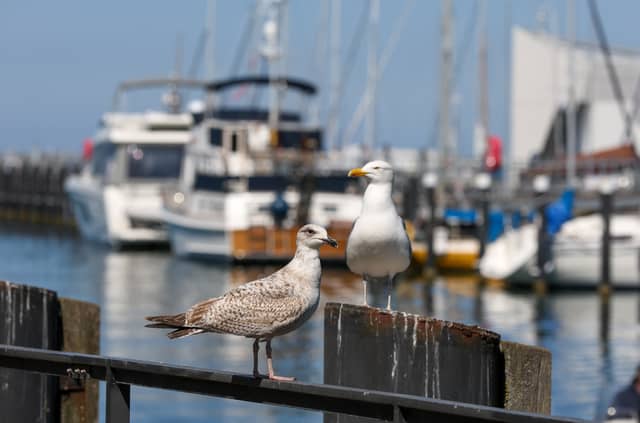

They are everywhere down here, and I’m happy about it
When Storm Floris hit, a couple of weeks ago, something made me feel uneasy.
I wasn’t freaked out by the gusty wind, so much, as the total silence from my new pals.
When I moved to Leith, a month ago, I hadn’t really thought about the seagull population down here.
There weren’t many, near my old house, on the other side of Edinburgh.
Only pigeons, assorted corvids and spuggies. Here - nearer the sea - it is, of course, herring gull-tastic.
I know that pigeons, thanks to Shona Kinloch’s sculptures on Elm Row, are this area’s official bird, but urban gulls should have that particular honour.
Sadly, it seems that most people aren’t keen on them. They have a bad rep. It’s partially the ransacking habit. Indeed, the bins outside Leith’s big Tesco are like the tail end of a jumble sale, when everything has been reduced to 20p. The omnivorous gulls are always happy to guddle around for meal deal detritus.
There are other favourite bins, too. I was walking across Leith Links the other day and a violent gull fight broke out over the remains of a Maccy D that had been fished out of the rubbish. It turned into whatever the winged version of fisticuffs is - feathericuffs, perhaps.
They don’t care about avoiding ultra-processed foods. They love a bit of it.
Then there are the dive bomb guano ejections. Since moving, our car has been thoroughly christened with splatter, and so has the pretty stained glass side window in our house. It’s not accessible, so we just have to wait for it to degrade and drop off, in a few years, probably.
Still, they don't have full control over their bowels, so I won’t take it personally.
It could be worse, as a Leith-based friend of mine recently had his face pooped on, while he made his way to work.
It’s supposed to be good luck, he told himself.
Perhaps, if that happened to me, I’d change my mind about them. However, as I work from home, they’re the soothing soundtrack to my life. I love the seaside-y sound, which only stops when the weather is terrible.
It’s nesting season until the end of September, so they have been especially bonkers, loud and busy.
My area is heavily occupied, so it’s difficult to imagine that the herring gull populations have declined by 50 per cent since the late 1960s, according to the RSPB.
At some points, there will be about ten doing an accapella of that “mew” sound, or the “ha-ha-ha”. Then there’s that long territorial barking sound, when they dip their heads, before throwing them back. This is supposed to be a territorial warning to other birds. They have the projection of opera singers.
Interestingly, the old name for a gull is a “mew” and, in Shetland, they are called “maws”.
Anyway, there is a lot of that noise.
They have big feelings, and their behaviour is like an outdoor soap opera.
They’re only still when they’ve come to rest at a high point, and survey their manor with those pale yellow eyes. There’s one that sits on our chimney pot, and uses its beak to play the metal cowl like it’s a xylophone. Evelyn Glennie, I’m calling her.
Also, we’re near a school, and this week’s new term has caused huge excitement amongst the herring gull community. They have been stirred up and are soaring, beside the gates, in anticipation of whatever highly processed scraps have been discarded by the youth of today. It is typical kleptoparasite behaviour. Always ready to pinch a half eaten Freddo.
There is currently a gull chick on our roof, and we regularly hear its plaintive peeps.
It stands on the bathroom cupola, so we can see its speckled and fluffy crinolines, and the leafy veins in its sweet pink webbed feet.
Occasionally it’ll look down, and through the window, and it is an extremely cute sight.
I have cross-species maternal urges towards this guileless chick. I saw a crumpled and dead one, by the tram tracks on Constitution Street, yesterday, and it made me feel devastated. The babies, with their bad hunched posture and knobbly knees, are just so confused and dense looking. Do they even know that they’re alive?
It’s hard to believe that they turn into hard-faced elite flying machines, like their parents.
Their eyes and breaks will turn from black, to yellow, as they mature. If they make it to adulthood, they can live for 10-20 years, though one in captivity has been recorded as making it to 49.
These creatures are smart, too, and they have been observed using tools, like bread, to catch fish. Their eyesight is excellent, and they can see ultraviolet light.
There is no point in putting fake hawks or owls up, to scare them off. Do you know who would win in a Seagull vs Kestrel match? Probably the former.
I love watching them fly, as they are totally magnificent. There’s that long wingspan that has a slight hinge and an aerodynamic nick in the feathers, like they’ve been cut with paper scissors.
At my Leith Edinburgh Leisure gym, they have a Victorian studio, with skylights.
While I’m doing crunches, I can see them paraglide across the sky, hitting all the thermals and getting into the airspace that pigeons can only dream about. No ugly and desperate flapping.
It’s very restful to watch.
I love them. Even if they steal my chips, I will continue to do so.
Comments
Want to join the conversation? Please or to comment on this article.