
How two local pensioners defeated plans for Galloway National Park
John McLellan, the lead Media House consultant on the anti-park campaign, explains why Denise Brownlee and Liz Hitschmann deserve the plaudits

Was it Media House wot won it? Widely recognised as an extraordinarily divided process, the fierce arguments over the creation of a national park in Galloway and Ayrshire are over. Opponents have won the day decisively, and in their struggle to understand how they lost after years of preparation, supporters point to the involvement of a public relations company as the reason for their defeat.
Rather than focusing on the substance of the fundamental weaknesses in the case for imposing a new layer of expensive bureaucracy on an area crying out for investment in poor infrastructure to service an economy reliant on mature dairy and forestry sectors and heavy transport, pro-park campaigners have instead sought to blame the messengers.
It was no surprise when Galloway was selected – ahead of four rival bids from campaigners in Lochaber, Loch Awe, Tay Forest and the Scottish Borders – because there was no organised grassroots opposition and, as well as a third park being a commitment in the Bute House agreement between the Greens and SNP, a park in Galloway was a Conservative manifesto pledge, the local Labour MSP Colin Smyth was fully in favour and the local councils also appeared supportive.

Shocked by stiff resistance
It looked like a slam dunk, and perhaps the Galloway National Park Association (GNPA), Action to Protect Rural Scotland (APRS) and the Scottish Campaign for National Parks (SCNP) thought so too.
However, it was not that simple. The pros and cons of a park in Galloway had never been properly tested locally, and despite years of lobbying, the GNPA, APRS and SCNP seemed shocked when stiff resistance appeared from what looked like nowhere.
But the arguments had been thoroughly road-tested elsewhere, particularly by the National Farmers’ Union Scotland, and problems in the existing two parks led to protests in Braemar and Lochaber campaigners petitioning the Scottish Parliament for an independent review of Cairngorm and Loch Lomond before a third was designated. The Scottish Government’s refusal to do so only fuelled suspicions there was something to hide.
The examination of the five bids, contained in last week’s NatureScot report on the Galloway consultation process, is revealing. “Galloway was clearly the least divided with the conversation much more focused around exploring ideas and opportunities rather than asking questions about what a national park is or the process,” it said. “This will without a shadow of a doubt be because the GNPA have been promoting their campaign for over seven years now within the local area so a lot more people are aware of what a national park is and what the process is as well.”
Hardly convincing
This was, to put it mildly, an overstatement because there was little evidence of a proper examination of the issues. “The four engagement sessions took place in four very different communities, however there was an overall sense… that the creation of a national park within the area is something a majority of the community want to see happen,” it continued.
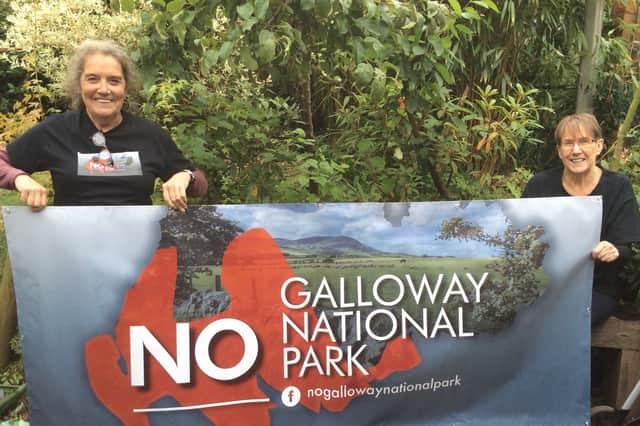
Four low-key “engagement” sessions producing “an overall sense” in such a large area was hardly convincing and the selection from applications submitted by activists seemed based on which offered the path of least resistance. Galloway looked like it fitted the bill until Denise Brownlee and Liz Hitschmann, two Gatehouse of Fleet pensioners who decided they were not going to let it become a national park without a fight, got the bit between their teeth.
Despite being near neighbours, they were only nodding acquaintances until Galloway’s selection brought them together and they launched the No Galloway National Park Facebook page to make their opposition known.
Media House had helped the Lochaber campaigners so knew the background, but by the time we were put in touch with Liz and Denise, the Facebook page was already building momentum. They had a strong brand – a logo professionally produced for free by a sympathetic graphic designer – and banners were already being printed for prominent roadside positions.
Amplifying the message
As the lead Media House consultant – described as “slick” by the BBC amongst others – maybe I should just sit back and take the plaudits, but that would be unfair to Liz and Denise’s impressive intelligence gathering, their energy in attending public meetings, and the speed with which they approved news releases and kept campaigners informed. They were relentless and all we had to do was amplify their message.
Our involvement attracted media attention, with the inference of some mysterious right-wing conspiracy, but oddly that attention did not extend to the other side, who had employed consultants, Scottish Festivals PR, for some time.
They also had support from the Unesco Biosphere, South of Scotland Enterprise and the South of Scotland Destination Alliance, and still they failed to convince enough local people to pledge their support in the consultation, defeated by 54 per cent to 42, with the rest undecided.
What was never answered was why an area crawling with government-funded agencies needed another expensive layer of bureaucracy to give it a boost. And the NC 500, rather than the Lake District, showed what happens when a region with poor infrastructure is over-promoted.
What now? The NatureScot report recommends strengthening existing arrangements, including more resources for the Biosphere Reserve, a new plan for the Galloway Forest Park, completion of the coastal path as a key visitor attraction, investment in existing community-led projects, and support for the Solway Firth Partnership. So the often bitter debate has not been for nothing.
As for No Galloway National Park, the Facebook group will soon reappear under a new name with Liz and Denise still very much at the helm, but devoted to ensuring the recommendations are delivered, and campaigning for long overdue infrastructure improvements. The Scottish Government has been warned.
Comments
Want to join the conversation? Please or to comment on this article.