
How the SNP's new independence campaign fell flat almost immediately – Murdo Fraser
The Peter Murrell scandal suggests that, despite being the SNP’s chief executive for years, he didn’t believe there would be an independence referendum anytime soon

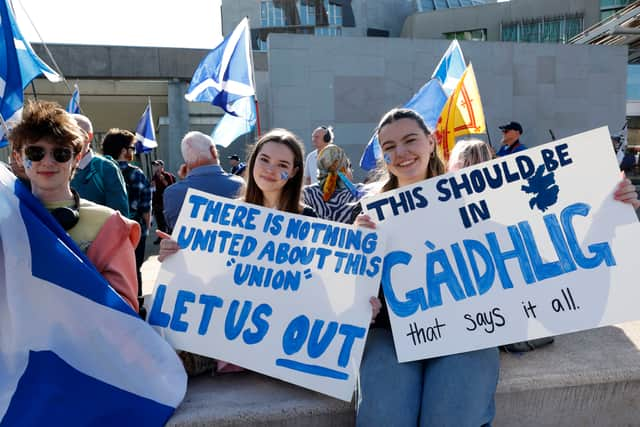
It should have been a jubilant day for the SNP. At the start of the first full week of parliamentary business after the election, First Minister John Swinney, newly reappointed, was delivering on his promise to have Holyrood endorse calls for another independence referendum.
With 15 Green MSPs guaranteed to vote alongside 57 from the SNP, there was never any doubt that the motion would be carried. And yet it was a strangely flat and lacklustre performance from Swinney, whose heart simply did not seem to be in it from the start.
The mandate which the SNP had sought from the electorate for another independence referendum had not been delivered. All the way through the election campaign, Swinney argued that it would take a majority of SNP MSPs at Holyrood to be able to demand Indyref2. And the SNP fell well short, with just 58 seats out of 129 returning an SNP member.
Undeterred, Swinney shifted ground, presumably hoping that nobody would notice, arguing that he could add in the seats for the pro-independence Greens to make a majority. But this was not, of course, what he said during the election campaign, and it is no wonder therefore that his mandate claims came across as unconvincing.

SNP now the butt of jokes
Even worse for Swinney is the fact that the SNP secured only 38 per cent of the votes in the election, on a national turnout of just 53 per cent. This means that barely one in five of the total electorate actually backed the party and their demands for another referendum.
But there was another more serious matter impacting the SNP last week, and that was the dramatic news that their former chief executive, Peter Murrell, had pled guilty to embezzling more than £400,000 of party funds.
The SNP has now found itself the butt of jokes, a deeply uncomfortable position for any politicians to be in. The infamous campervan has been an object of humour for years, but to that we now have to add the Lalique salt and pepper grinders at £2,618, the silver wine coaster at £3,500, the library ladder for £943, and the £2,495 jewellery box, amongst much more.
Nicola Sturgeon, through her lawyer’s statements and being interviewed by the BBC’s Laura Kuenssberg, has made increasingly desperate claims that she was entirely unaware of any of the many extravagant purchases her husband had made. This might best be described as an extraordinary lapse of curiosity in somebody holding such a prominent position in public life, and someone always known to have mastery of detail.
READ MORE: Peter Murrell scandal 'embarrassing internationally' for Scotland, says former first minister
Murrell didn’t expect Indyref2 anytime soon
Sturgeon’s defence that she could not be held responsible for the actions of her husband, and that those claiming otherwise are guilty of misogyny, is so pathetic as to be laughable. Murrell was not simply her husband but, as chief executive of the SNP, someone under her command. As leader of the party, she ultimately has responsibility for its finances. It is those failures, and for her aggressive closing down of any internal criticism or questioning of the party’s financial positioning, for which she has to take responsibility, and so far seems entirely unwilling to do so.
Numerous questions around the Murrell affair remain unanswered. Why were criminal proceedings not taken against Sturgeon herself? Why was the date of Murrell’s appearance in court delayed until after the Scottish Parliament election last month?
One interesting aspect of the Murrell case is that it is now clear that he did not anticipate a referendum coming any time soon, despite his wife’s insistence to the contrary while she was First Minister. Had the referendum been called, it would have become very quickly apparent that the £667,000 supposedly ring-fenced for an independence campaign no longer existed, Murrell having helped himself to the lion’s share of it.
Perhaps he calculated the risk of the theft’s discovery was low because another referendum was not likely to happen. It does say a great deal about the mood within SNP headquarters around the prospect of another independence referendum, if the chief executive himself was not fully committed to the cause.
Nor does it seem that any policy work has been done within the SNP to advance the case for independence. We still do not know how the gaping black hole in the Scottish public finances is to be filled. There is also a £26 billion difference between the amount raised in taxation as opposed to the level of public spending.
Indy drive only going backwards
In last week’s Holyrood debate on energy, the SNP were calling for all energy policy to be devolved, but were singularly unable to explain how dismantling a single UK energy market would be of benefit either to the industry or Scottish consumers.
We heard throughout the election campaign that independence could cut energy bills by a third. But anyone watching last Thursday’s Holyrood debate on the subject would have noticed there was no explanation as to how this could be delivered. When challenged by opposition MSPs, the new energy minister, Stephen Gethins, could provide no more detail.
Scotland is abundant in energy resources, but these can only be exploited at cost – a cost currently spread across 70 million UK consumers. Share those costs instead across just 5.5 million people in Scotland, and it’s clear that the generous subsidies which are required to support renewable energy projects, grid upgrades, and comprehensive storage are simply unaffordable.
The independence drive hasn’t just stalled, it is taking several steps backwards. The fallout from the Murrell case, on top of the SNP’s other failures, will prove deeply damaging. The SNP have a huge fight on their hands if they are to secure the referendum they are fixated on at any point in the next five years.
Murdo Fraser is a Scottish Conservative MSP for Mid-Scotland and Fife
Comments
Want to join the conversation? Please or to comment on this article.