
How Russia is putting symbols of its war on Ukraine on Scottish war memorials
Russian and Belarussians flags and St George’s ribbons, used as part of Vladimir Putin’s ‘Z-swastika’, are being put on Second World War memorials in Scotland, even though the our ally at the time, the Soviet Union, included Ukraine


The Kremlin’s hybrid warfare doctrine entails attacks executed with different means than troops, tanks and rockets. Complacent Europeans and Scots fail to notice this insidious Russian conquest of our minds and public spaces.
Unless we wake up to the ugly reality, soon we may have to live under Moscow’s dominance, diligently learning Russian and careful not to anger the overlord in the Kremlin.
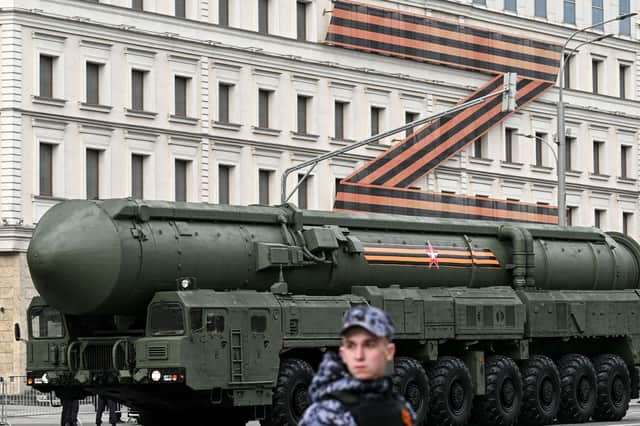
Russian propagandists claim that since the dissolution of the Soviet Union, Russia has been under the West’s relentless attack. Meanwhile, Moscow’s patience wore thin and, thus, it had no choice but to start defending the Russians against ‘neo-Nazis’ in Ukraine. In June 2025, the Kremlin dictator stated “all of Ukraine is ours”.
Taking out democracies one by one
Notwithstanding the direct military involvement of the fellow totalitarian states of Belarus and North Korea on Russia’s side in this war, the West still tries not to anger the Kremlin. Besides insufficient and faltering weapon and ammunition supplies, no Western troops have been deployed in a combat role on Ukrainian soil to help Kyiv in the unequal fight against the Russian invaders.
Apparently, democracies do not fight each other, and neither do they come to each other’s aid. That is the best recipe for a resolute alliance of autocracies to take out one democracy after another.
Europeans – who still enjoy the privilege of living in the countries that do not border on Russia or on the states under Russian attack – prefer to see the war in Ukraine as not of their (immediate) concern. They want a return of the old normal that is never going to be re-established. The world has irrevocably changed.
Posing as friends
The American beacon of democracy dims, replaced by authoritarianism and the cult of personality. Neither democracy nor peace and prosperity in Europe can be taken for granted any longer. The preservation of these achievements depends on how Europeans will reply to aggressive Russia’s nefarious designs on Europe.
Meanwhile, Russians already lurk in Europeans’ backyards, posing as friendly and unobtrusive neighbours and fellow Europeans. These Russians, however, are not what they appear to be. Instead, they just wait for the right moment to do the bidding of their overlord in the Kremlin.
I do not mean the obvious cases of Russian illegals, poisonings, arson attacks or assassinations. No sensible person is going to overlook them. Yet, such cases just amount to the tip of an iceberg.
The challenge is to learn how to soberly perceive the full extent of Russian influence aimed at undermining Europe, carefully designed to bring the continent under Moscow’s direct or indirect control.
In early 2025, Britain and Ukraine signed a 100-year partnership agreement to signal both countries’ unshakable alliance in the face of Russia’s aggressive imperialism. But this document does not scare off Russians from continuing to claim British public spaces for the Kremlin’s ideology and war effort with their enemy symbols.
Warping the past
Unfortunately, the British fail to notice, treating these symbols and their display as harmless ethnic flourishes of no importance. In this context, it is especially galling that warmongering Russia’s propagandists, posing as diplomats, are allowed free rein to spread their neo-imperialist message of the Russian world (Russkii mir), for instance, in the Scottish city of Dundee.
A coordinated action of this type takes place each year on VE Day, under the guise of commemorating the Allied victory over Nazi Germany. Another was held on Sunday.
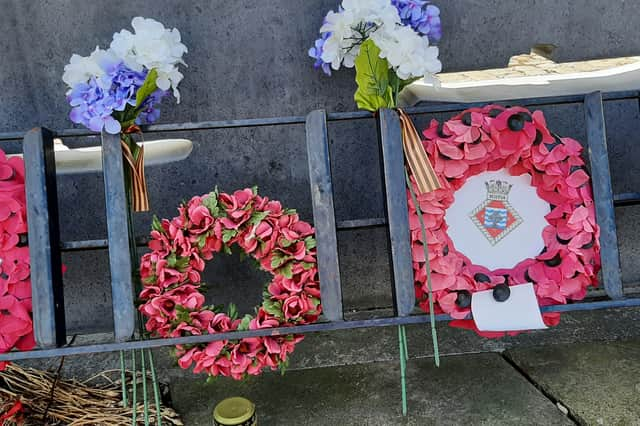
Wreaths and bunches of flowers laid in abundance by Russian and Belarussian diplomats at the Dundee Submarine Memorial – and elsewhere at war memorials across Scotland – feature ribbons in the colours of the flags of Belarus and Russia. These two states did not exist in 1945; they were not the allies of Britain and America; the Soviet Union was.
Hence, this Soviet legacy now belongs to each of the 15 post-Soviet states, including Ukraine. Besides this mendacious warping of the past for present-day uses, quite shockingly, Dundee and other Scottish authorities tolerate the employment, in these wreaths and flowers, of black and orange ribbons of Saint George, first introduced when Russia annexed Crimea in 2014.
After 2022, this ribbon underpins the Z symbol of Russia's war on Ukraine, or the ‘Z-swastika’, dubbed so because of its visual similarity with the Nazi symbol. Both were deployed for similar ideological ends, to propagate imperialism, war and racism for the sake of replacing democracy with totalitarianism.
Wrong message to Navy cadets
Ironically, the aforementioned Submarine Memorial is located next door to the Dundee headquarters of the Royal Navy Cadet Forces Training Centre. It is the place for Scottish teenage cadets to learn how to sail, military-style discipline and to train for a potential career in the Royal Navy.
Hence, in the future they may have to defend Britain and Nato allies against a Russian onslaught. But now, year after year, tasked with the maintenance of this memorial, the cadets are inadvertently exposed to Russian imperialist symbols. In this manner, the sight of these anti-Western and anti-British symbols becomes normalised and may make them acceptable in the cadets’ eyes.
What a cheap and easily preventable win for Russia in this simplistic psyop. If the cadets ever find themselves in battle with Russian troops festooned with these symbols, some may doubt they are facing a genuine enemy. Should we really let the Kremlin expose European soldiers to symbols of Russian imperialism when it is seeking to destroy Europe?
Dr Tomasz Kamusella is a reader in modern history at the University of St Andrews
Comments
Want to join the conversation? Please or to comment on this article.