
How a grassroots army of passionate volunteers is setting Glasgow’s trees free – Ria Dunkley
Of the 451 trees recorded in Glasgow in 2014, 40 have disappeared, with more than a third lost to ash dieback


In late October, a storm brought down a weeping willow beside the River Kelvin. Within days, one of our mappers had put it on our community science app, communiMap.
“Heartbroken to see the storm has toppled this stunning weeping willow that’s admired by many people on a daily basis and a real feature of the area. Can it be saved?” she wrote. The next day she answered the app’s prompt – “if this tree could talk, what would it say?” – in the tree’s own voice: “Why did they have to chop me up? They could have saved me, I had just fallen over!” She questioned whether felling the tree was the right decision.
She is one of the Glaswegians who care deeply about what they see in nature in the city, and who have learned to read trees by looking closely. Like many people who use the app, she voices her hopes and fears through the tree, sometimes with humour, which is very Glaswegian. When grief at the loss of the natural world is all too real, that playfulness matters. It helps us raise subjects that are hard to talk about.
I work with communities on Gallant, a University of Glasgow project in partnership with Glasgow City Council on the changes our city needs to face nature loss and climate change. We are a small team of researchers and a growing circle of volunteers, working alongside people who have long done this work, like the Friends of Elder Park and the Friends of the River Kelvin.
READ MORE: Plans for 5,000 hectare expansion of one of Scotland’s last remaining Caledonian pinewoods
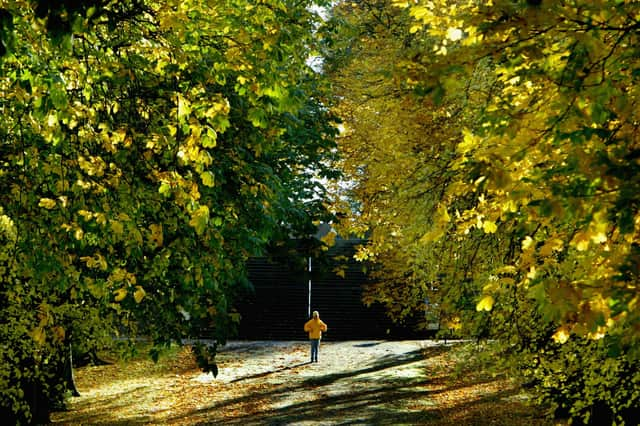
Glasgow wants more trees
In Govan, where Isabella Elder gave Elder Park to the community in 1885 in memory of her husband, the shipbuilder John Elder, we set ourselves and the arborist David Treanor a challenge: to bring local people together to map every tree in the park and compare it with a survey made in 2014 by Bob Gray of the Glasgow Tree Lovers’ Society.
Glasgow aims to grow its tree canopy, so knowing exactly which trees we have, and which we are losing, matters. Over eight months, around 20 people took part. They recorded each tree’s location, height, girth, and species and the life it supported, including birds, squirrels, insects and lichens.
David Treanor, who nominated Glasgow’s Argyle Street Ash for UK Tree of the Year 2025 and has looked after it in recent years, shared a lifetime of tree knowledge. We provided the app, training, a warm room and plenty of tea and biscuits!
Bob Gray’s 2014 paper map is now digital and it was sobering to find in the process that, of the 451 trees recorded in 2014, 40 have disappeared, more than a third of them ash trees lost to ash dieback.
Free to grow
At the end, the mappers took direct action. With permission from the Friends of Elder Park, they removed the stakes from newly planted trees, so the young trees were left free to grow and the wood could be reused by local groups.
Planting a tree is the easy part. Young trees need years of watching to see what support they need, and the mappers are well placed to give it. David Treanor wrote on communiMap: “I can see this turning into a movement to free trees across Glasgow.”
Research can feel like something done to a community. Here we all learned together, and by the end the mappers were deciding things for themselves, with us alongside them.
We asked the mappers how their relationship with trees had changed. “I’ve started to see trees as teachers,” one said. Another told us that knowing trees better had helped them “breathe deeper and longer”. A third was blunt: “I can’t cope with seeing them being chopped down.”
‘Disconnection’ from nature
We will not solve the climate and biodiversity crises without reconnecting people to nature, and that has to happen in communities, together. The 2024 assessment of transformative change by the Intergovernmental Science-Policy Platform on Biodiversity and Ecosystem Services (IPBES) named “disconnection from and domination over nature and people” as one of three underlying causes of nature’s decline. What we see in Glasgow is that trees are a way back to realising that we are nature.
The city’s online environmental map shows where trees stand, using aerial imagery, but a map is always a snapshot, and from above it cannot tell you what a tree is. The council has detailed records of only some. To understand how our urban forest is changing, we need people observing it over time.
City-wide figures can’t show what is happening street by street; the people who live there can. One aim we are working on with council partners is to bring what communities collect into the council’s mapping, so that officers can see what people have already told them and people can see their records have been received.
What happens next is unfolding. Our communiMap app is free and works anywhere in the world. It also records compost, flooding, active travel, community energy, air and heat, and nature connection, our most popular feature. You can start by searching for “communiMap” in your app store.
If we each mapped just one tree nearby, we could soon have a complete map of Glasgow’s trees, and beyond.
The willow can’t be put back, but it is on our map, first recorded on a photo walk in April 2023 and again in October. The community that watches the city’s trees is still there, and it is growing by the day. And for that, I am so very thankful.
Ria Dunkley is professor of environmental pedagogy at the University of Glasgow and leads community collaboration research for the Gallant project
Comments
Want to join the conversation? Please or to comment on this article.