
Geopolitical winds are blowing Scotland's offshore ambitions off course
It is time to for a reality check on Scotland’s offshore wind plans
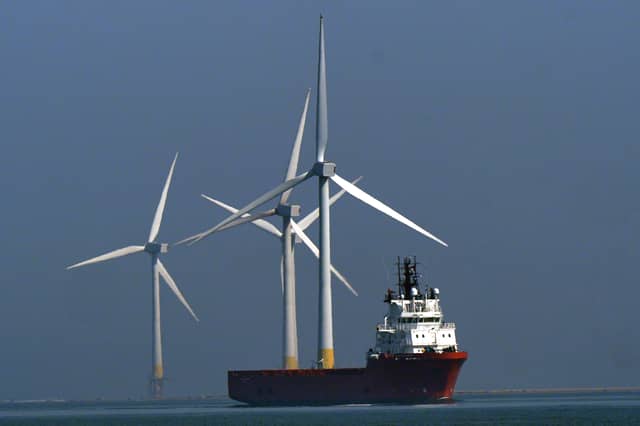


Pub quiz question: what is Waterkant?
It’s not the street that runs through the capital of Suriname. Nor has it anything to do with De Waterkant, the historic Cape Town suburb. It’s the name of a wind farm planned for the North Sea off the German coast. This week, Waterkant made news when the German business developing it dropped plans to use wind turbines made by Chinese company Ming Yang Smart Energy. Instead, it is now looking at using turbines from Siemens Gamesa, a European rival.
It’s a decision with profound implications for Scotland’s ambitions for rolling out a vast collection of wind farms in the North Sea. That’s because it came after the German government last year flagged concerns about Chinese involvement in critical national infrastructure. Glenn Tiffert, distinguished research fellow at Stanford University’s Hoover Institution, says: “It is conceivable that malign actors could weaponise networked infrastructure projects such as wind installations and cause large-scale disruptions or damage to a country.”
Such concerns have been central to a months-long debate at the highest level of the UK government – including Cobra, the security committee chaired by the prime minister - over whether Ming Yang should be allowed to supply turbines to developers of wind farms in the UK. This includes ScotWind and a smaller set of projects known as INTOG, designed in part to decarbonise the operations of nearby oil and gas rigs.
Crown Estate Scotland in early 2022 awarded seabed options for the two projects to consortia involving some of the world’s biggest renewable energy companies like SSE Renewables, Marubeni of Japan, Sweden’s Vattenfall, France’s Total Energies, and Fred. Olsen Seawind of Norway.
A key related consideration is whether Ming Yang should be allowed to build a planned £150 million factory near Inverness to make turbine blades. Such a facility, for which the Scottish government last year earmarked £30 million, would be the Guangdong-based company’s first outside China.
Set against such concerns are commercial attractions. Ming Yang turbines are about a third cheaper than those of European rivals, including Denmark’s Vestas. They would create green jobs in the Highlands. And the Chinese company has proven expertise in the deep-water floating wind turbines that are to make up 60 per cent of ScotWind (the rest being “fixed bottom” wind farms secured into the sea bed in shallower waters).
It is a tough call. However, I understand that the UK government recently decided not to commit either way for the time being. “It’s been kicked further than into the long grass,” says one senior source.
Now, with the Waterkant decision sending a clear signal from Germany, it appears Ming Yang’s chances of entering the UK market have diminished considerably, even though this week the company was reportedly working on ways to allow external “audits” of its turbine technology to allay security concerns.
European turbine makers are the obvious alternatives to Ming Yang for ScotWind and INTOG developers. But there are two problems. First, both Siemens Gamesa and Vestas are distracted by mending damaged balance sheets hurt by inflationary pressures while focusing on a backlog of fixed- bottom orders.
Second, turbine size is key to the economics of floating wind farms. That’s because a larger turbine can sweep more area, and with larger turbines, you need fewer sea surface foundations on which turbines sit – and the foundation is the most expensive component in a floating wind farm. In the arms race underway between Chinese and European turbine makers, Ming Yang is ahead with a 20-megawatt (MW) turbine, compared with the 14-15MW available from Europe.
By the time most ScotWind projects are due to be built in the early 2030s, it will therefore be essential for Siemens Gamesa and Vestas to be able to offer larger turbines, especially given the increasingly challenging economics of offshore wind globally.
Yet as Endri Lico, principal analyst, global wind supply chain and technology at Wood Mackenzie, says: “European manufacturers have a low appetite to enter the floating market because the project economics are very capital intensive, and they are trying to maximise their profitability right now, while the Chinese are mature, having leveraged expertise in their home market.”
The inescapable logic of all this leads to three conclusions. One, it makes sense for the UK government to focus on incentivising as much fixed-bottom capacity as possible if it has a chance of meeting its much-vaunted Clean Power 2030 target. This is presumably why under the latest “contracts for difference” subsidy scheme, which closed this week, such projects will now be allowed to bid without first having to go through certain consents.
Two, I understand that energy secretary Ed Miliband has asked Siemens Gamesa if it can step up on floating wind technology. Earlier this year, the company installed a 21.5MW prototype at a technical university in Denmark under an EU-financed project. But Germany could now super-charge this effort. Notably, of the €500 billion earmarked by Berlin for investment in infrastructure over the next 12 years €100bn is for supporting energy transformation.
Finally, it is time to for a reality check on Scotland’s offshore wind plans. The Scottish government often says they “put Scotland at the forefront of development globally”. In many ways this is true.
But the fact that so much of ScotWind depends on floating wind technology has become an Achilles Heel exposed by the increasingly fraught geopolitics of national energy security. If this means scaling back Scotland’s ambitions, so be it.
Comments
Want to join the conversation? Please or to comment on this article.