
Denmark's 'Folkemødet' shows how to use people-power to restore faith in Scottish politics
Denmark has come up with a way to help people and politicians to disagree more agreeably that Scotland should copy
There is some dispute whether the former German Chancellor Otto von Bismarck said “Laws are like sausages, it is best not to see them being made.” Regardless of who made the comment, there is much truth in it. Legislating and decision-making can be complex. Democratic politics is a messy business given the vast array of stakeholders, opinions and interests that should be accounted for.
Too often in our political discourse, commentators and others see simple solutions. That is rarely the case, as 21st-century statesman Barack Obama reflected after leaving the White House: “One of the first things I discovered as President of the United States was that no decision that landed on my desk had an easy, tidy answer.” In other words, if the answer was easy, it would never have reached the Oval Office.
The sausage-making process is an important one. Democracies tend to be better at decision-making because they are more complex and consider a wider range of freely expressed views. No politician or political party in a democratic system is ever entirely right or entirely wrong. The process of debate and discussion is an integral part of eventually getting to better decisions, like any theory it isn’t entirely foolproof but also helps break us free from our individual silos.

We are all politicians
In a world with increased polarisation and misinformation, too often because we disagree with someone on one issue, we think that person must be wrong on every issue. If you don’t believe me, have a look at the comment pages in this and other media sources.
Having the widest possible stakeholder engagement results in greater ownership of a decision and hopefully better decisions. That is one of the reasons democracies are overall better at making decisions and improving citizens’ lives. In a democracy everyone is a politician – like it or not, you are too dear reader, and the actions of citizens have meaningful consequences. The act of not voting, for example, is itself a political act, even unconsciously, that could have profound implications. An omission is not without consequence.
That is why citizen engagement is important, alongside quality discussion and debate. Greater citizen participation means decisions are made that are more reflective of the society that our politics is due to serve. Successful democracies understand that, not least our next-door neighbours in Denmark.
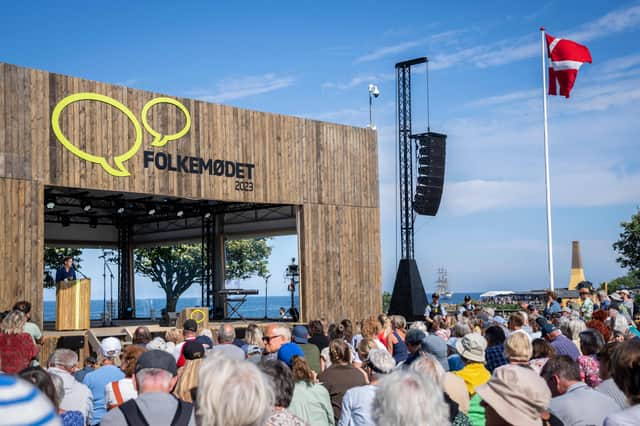
Just a couple of weeks ago, I was invited to see one aspect of Danish democracy in action. At the end of the parliamentary term, Denmark’s politicians, journalists, businesses, NGOs, universities, and others involved in the political ‘bubble’ and tens of thousands of ordinary citizens decamp to a Danish island, Bornholm for an annual Folkemødet, or people’s meeting.
READ MORE: How ‘single stupidest thing any country has ever done' is behind benefit cuts and high taxes
Battleship discussion about security
Over three days Danes, and a small number of international visitors, meet, talk and listen to one another in a relaxed and informal environment. Crucially the events are free and there is no bar to attending – except if a contribution breaks the criminal code or an act runs contrary to the Danish constitution.
Over a short 24-hour visit, I was able to witness a debate about sustainability in a tent (most meetings are under canvas) led by young people, a discussion on a docked battleship over Denmark’s security priorities with a former Nato Secretary-General and a talk about Georgia and the path to its EU accession, including a discussion about what that meant for Denmark. Our neighbours have, of course, just taken over the influential presidency of the EU, and citizens were clearly taking those responsibilities seriously.
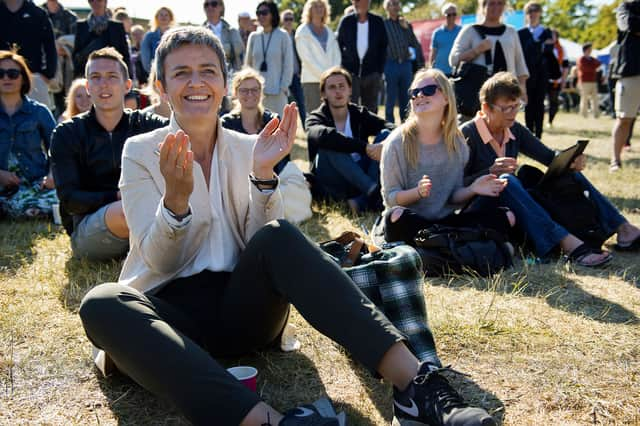
Meetings were respectful, well attended with citizens and senior politicians wandering around enjoying the discussion, sunshine and perhaps the odd Danish beer. What for me was most striking was just how many young people attended, and participated. The age range was a wide one with Danish young people, many camping in fields around the festival, well represented. An Edinburgh fringe festival environment but focused on politics.
Politics matters, really matters. The success of Nordic states in recent times in reducing inequality, boosting income and increasing the rights of their citizens is in part due to the success of their democratic model. The Folkemødet was a fantastic illustration of improving engagement and bringing down barriers.
Danger of polarisation
It is fine to disagree, if we all agreed with one another the world would be a dull place leading to worse policy outcomes. However, if we don’t manage to disagree more agreeably it can also lead to greater polarisation and lead to people feeling the political process is not for them. It was also great news for Bornholm’s local businesses, extending the short tourist season on the island for an additional week.
Since the first Bornholm event in 2010, copying a similar event in Sweden, the Folkemødet has grown, now attracting attracting 110,000 attendees over three days. It is an industry in its own right on the island, employing a dozen full-time staff including a native of Skye enthusiastic about bringing the idea back home.
Holding a Folkemødet-style event here in Scotland would not be a panacea, leading to better politics overnight, but given the damaging threats of polarisation, lower turnouts and misinformation, it is worth considering. Like the Nordic states, Scotland has a relatively small political and stakeholder base.
We also have plenty of islands, and other areas, outside the Central Belt, that could easily host such an event. Away from the cameras, Scotland’s politicians will often discuss ideas in a more open manner that is discouraged by a gotcha culture in some parts of the media. Nuance and constructive discussion is difficult but crucial when there are no easy solutions to the challenging problems we all face.
Just think what we could achieve if only we could bring people together in a slightly more constructive manner. Like the Danes we might benefit from the sunshine too.
Stephen Gethins is the MP for Arbroath and Broughty Ferry
Comments
Want to join the conversation? Please or to comment on this article.