
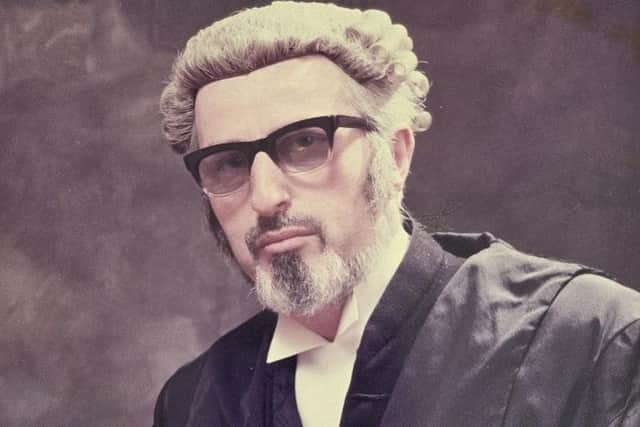
Obituary: Sir Gerald Gordon, judge and academic who wrote definitive Scottish criminal law book
Small in physical stature, and humble in character, anyone outside the legal profession who met Gerald Gordon would have no inkling of his intellectual breadth and distinguished professional achievements.
Small in physical stature, and humble in character, anyone outside the legal profession who met Gerald Gordon would have no inkling of his intellectual breadth and distinguished professional achievements.
Rather, their first impression would be of a courteous, relatively quiet gentleman with a great sense of humour. They may also have picked up that he was a loving husband with a keen interest in the achievements of his family and was proud of both his Jewish and Scottish roots.
Sir Gerald was born in Glasgow on 17 June, 1929 and lived in Scotland until 2022 when he moved to spend his last few years near to family in Manchester. His father Simon was a master draper and company director who crossed the border to marry Rebecca Bulbin in Glasgow in August 1928. As well as Gerald, they had a second son, Stanley, who became a chartered accountant.

Sir Gerald attended Battlefield Primary School and then the local Queen’s Park Secondary in Glasgow in a high-achieving class which also included Winnie Ewing, the SNP politician. During the war, he also spent time in school in Falkirk.
He studied at Glasgow University and obtained the first of his many degrees in 1950; a 1st class MA Hons in philosophy with English literature, followed by a LLB with distinction in 1953.
Sir Gerald carried out his national service as a staff-sergeant in the Army Legal Aid team in the British Army of the Rhine. In later years, he often reminisced about the officers’ mess and referred to his helping to make up a “minyan” (the quorum of ten required for communal prayers in a synagogue) as another important “national service”.
He was admitted to the Scottish Bar in 1953 while beginning his academic career with the support of a Faulds Fellowship at Glasgow University. From 1956 to 1959, he was a Procurator Fiscal Depute in Edinburgh and had his first publications in the Scots Law Times.
His mother died of cancer in July 1956, aged 59. The following year, he married Marjorie Joseph and started married life in Marchmont, Edinburgh. They had three children – Susan (an accountant), David (who was also a law academic and barrister before a career in business) and a younger daughter who works in the mental health sector.
Sir Gerald had a prestigious memory and knowledge over a wide range of subjects including literature, art, philosophy, classical music and history. Gordon family mealtimes were usually accompanied by “Round Britain Quiz” or “Brain of Britain” followed later in the evening by “University Challenge”, “Ask the Family” or “Mastermind”. Gerald knew most of the answers (and Marjorie often filled any gaps) but he declined to take up the challenge of entering any of them.
He did later represent Giffnock Synagogue in an inter synagogal quiz but, having helped the team win several years in a row, was “barred” to give others a chance.
In 1960, Sir Gerald was awarded a PhD by Glasgow University for his thesis, “Criminal Responsibility in Scottish Law”. He decided to move into academia full time and in 1960 became a law lecturer at Edinburgh University, being promoted to a Senior Lecturer and Head of the Department of Criminal Law and Criminology in 1965.
The first edition of his “magnum opus” (more than 1,000 pages of text) – The Criminal Law of Scotland – was published in 1967, for which he was awarded a LLD by Edinburgh University.
Sir Gerald noted in the book’s Introduction that criminal law had long been neglected by Scots lawyers and hoped his book would provide a systematic analysis of modern Scots criminal law and provide the practitioner with an account of the principal criminal offences. He clearly succeeded as “Gordon’s Criminal Law” was cited on a daily basis in every court in Scotland and respected by judges, practitioners and academics.
In October 1969, he was awarded a Personal Chair of Criminal Law by Edinburgh University and then the Chair of Scots Law which he held from 1972 to 1976. From 1970-1973, he was the Dean of Edinburgh’s Law Faculty. He was a Commonwealth Visiting Fellow at the University of Toronto’s Centre of Criminology in 1974-1975.
In 1972, he became a QC and the editor of Renton and Brown’s Criminal Procedure According to the Law of Scotland. In December 1973, he was appointed to the bench as a Temporary Sheriff and three years later took the decision to leave academia and become a full-time Sheriff, first based in Hamilton and then, from January 1978 until 1999 in Glasgow. His judicial role provided the opportunity for the family to move to Glasgow in 1977.
In 1992, he was appointed as a Temporary Judge of the Court of Session and High Court of Justiciary and (once the age limit for sitting on the bench was extended) continued in that role until 2004.
Between 1970 and 2015, Sir Gerald was a member of various senior committees reviewing Scottish law and procedure. Most prominently, he was a founding member of the Scottish Criminal Case Review Commission, whose work included reviewing the Lockerbie bombing convictions.
The Scottish Criminal Case Reports (SCCR) were launched in 1981. Sir Gerald was their editor until 2020. At an anniversary dinner for the SCCR it was said that, “Thanks largely to Sheriff Gordon’s industry and skill – and not least to his learned and pithy comments – it quickly established itself as the Rolls-Royce of law reports”.
Sir Gerald received two honorary LLDs – from Glasgow University in 1993 and Aberdeen University in 2003. In 2002, he was elected as an Honorary Fellow of the Royal Society of Edinburgh, the first lawyer to receive that honour.
In 2009, Glasgow University launched the Sir Gerald Gordon Seminar on Criminal Law which is still an annual event. A festschrift was published in his honour in 2010 – “Essays in Criminal Law”.
Sir Gerald finally retired at the end of 2020, aged 91, when he edited his last issue of the Scottish Criminal Case Reports.
Former colleagues said he was a generous and patient mentor, always happy to share his knowledge and time and described him as a brilliant jurist and one of the finest legal minds of his generation.
He and his wife were both very active members of the Jewish community. They shared an interest in language and words (and numerous Scrabble matches) as well as a love of music and books, with a large collection of both. Before his wife fell ill, they enjoyed walking and travelling.
He had never learnt to swim but, after the Commonwealth Swimming Pool opened in Edinburgh for the 1970 Games, in his 40s, he joined a class and learnt to swim. He then swam regularly for exercise. Another sporting venture was not so successful. When one of his daughters started horse riding lessons, Sir Gerald, possibly taking his role as a “Sheriff” too seriously, began to learn as well until a fall put him off.
In 1995, when his wife was seriously ill with cancer, he was awarded a CBE. Arrangements were made for the ceremony to take place at home so that Marjorie could be part of it. Marjorie died in 1996, aged 60.
In the millennium honours list, Sir Gerald received a knighthood for services to the Scottish legal profession.
He would never have imagined that he would be blessed with more than 75 grandchildren and great grandchildren – he referred to them as a “clan”. They have fond memories of how he took the time to write them personal messages when they sent him drawings or photos.
Gerald Gordon died after a short illness on 16 September, 2025, aged 96. He would have found it ironic that, in the week of his death, the Scottish Parliament approved legislation to abolish the “not proven” verdict.
Obituaries
If you would like to submit an obituary (800-1000 words preferred, with jpeg image), contact [email protected]
Comments
Want to join the conversation? Please or to comment on this article.