
My fight to protect controversial Scottish creature from the bullet on my Perthshire farm


After battling to rehome beavers to his Perthshire farm, Tom Bowser saw first hand how the semi-aquatic rodents transform their habitats for the better and enrich the wildlife living there.
Every beaver supporter has a story. Each of us has experienced that moment when you first realise exactly what these animals mean to our planet’s health.
My moment came in 2018 with a visit to a wetland in Knapdale, Argyll, home to an officially reintroduced beaver population. I will never forget it. The air thrummed to the tune of thousands of insects, drawn in by the deadwood and the impounded water. Fish rose repeatedly to feed upon them. Birdsong filled the surrounding woodland. The whole place was bursting with colour and noise the like of which I’d never experienced before. All of this was thanks to the beavers who’d dammed a small stream and created a new world, a birthplace of life.
Seeing that place, something switched inside me. Until then I’d thought that Scotland’s countryside was rich and diverse. I’d been a victim of shifting baseline syndrome, accepting this nature-depleted country as normal because I had no means of travelling back to a time when our ecosystem functioned as it should and animal populations were at their true baseline. Normal? Scotland was anything but. The beavers taught me that.

Later, as the light was fading, bats took to the sky, midges mined blood from my skin, and I saw my first beaver. Breaking the water’s surface, she glided calmly past. I watched her go, little imagining that this would be but the first of many beavers I’d know in my life, that they’d come to play a major part in my story and I, perhaps, a small role in theirs. Every beaver believer has a story. That was mine.
Our fight for these animals would begin two years later. In 2020, my friend James Nairne - of the Scottish Wild Beaver Group charity - visited my Perthshire farm, Argaty, wishing to know if we’d try to rehome beavers that might otherwise be killed. My life will forever be divided into two parts: the time before that moment and the time after.
If you are new to this subject, you’re perhaps wondering how beavers came to face so bleak a fate: eviction or death? Allow me to explain. Beavers are native to Scotland. However, by some undefined point, perhaps the 1600s, we wiped them out. You might suppose that their problem was that they were considered a pest, but the opposite is true. They were too valuable for their own good. They were hunted for their meat, for castoreum (an exudate used in medicine and perfume) and for their strong, weather-resistant pelts, which formed the basis of the global hat trade for centuries.
Beavers first returned to Scottish waters in 2001, escaping a wildlife park and swimming from the River Earn to the Tay. Trouble lay ahead. In these flat areas, where farming often continues to the water’s edge and drainage systems flush rainfall straight from fields to the river, the presence of semi-aquatic rodents known to alter hydraulic systems could, and occasionally did, cause people major headaches. As the beavers bred and spread, further conflict ensued. Untold numbers were shot.
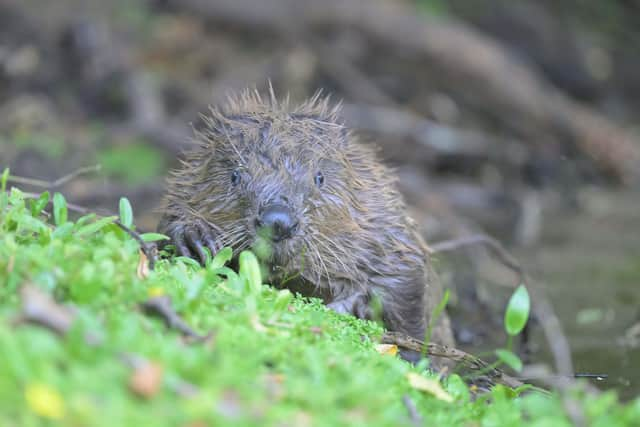
Meanwhile, a growing body of global science was showing just how important these animals are. Their wetlands massively boost biodiversity, their dams store water in times of deluge and of drought. Recognising this, The Scottish Government granted them protected status in 2019. Henceforth it would be an offence to harm them without a licence.
Conservationists rejoiced, but what looked like a red-letter day was not to be. A caveat allowed landowners to apply for lethal control licences to prevent damage to prime arable land. NatureScot, who issued these, had themselves identified over 100,000 hectares of habitat, unoccupied but suitable for beaver colonisation. However, government policy forbade their relocation to other parts of the country when they came into conflict with humans. The killing continued. In the first year of apparent protection, one in five of Scotland’s tiny beaver population (estimated then at just 450 animals) was shot under licence.
Against this backdrop we began our campaign to save beavers the bullet and relocate them to safety on Argaty. We would be the first landowners in Scottish history to attempt such a thing. Waters of Life is the story of a fight for Scotland’s beavers. I wrote it for anyone wishing to know how we did this and why, what it took from us and what it gave. Is ‘fight’ really the best word to use here? Ought I to substitute it for something less provocative? I could, but I shan’t. At its heart the question of whether or not we restore nature is a battle between people with wildly different beliefs and priorities. Anyone who claims otherwise has not had to dirty their hands. They do not know. So, I use the word very deliberately, but it is important to stress that this is the story of ‘a fight’ (rather than ‘the fight’) for Scotland’s beavers. The latter began long before me, before my family and friends and the things that we did. Others have strived harder, and for longer, to see these incredible creatures restored. They have their own tales to tell, and I would not presume to step into their space. My book might thus be best considered a chapter of that larger story: the fight for Scotland’s beavers. That fight continues to this day. I write my chapter in the hope that it has some small influence on the ones that will follow.
Attempting to restore a wild species to our own wild space opened my eyes to some sad truths. For years I had been aware that our environment was ailing, but it was only when I tried to do something to help that I truly understood why. Only then did I encounter the kinds of people, organisations and systems that make it so very hard to turn things around.
But it was not all doom and despair. Quite the reverse. Although this journey demanded much of me, it also gave me that most priceless of things: hope. Hope that the world might not always be so troubled, that we can still make it better. All of this was thanks to the many good people who helped us along the way. Where there are good people there will always be hope. With their help we achieved our goal; we brought beavers to safety here. Waters of Life is a window onto beavers’ lives, a first-hand account of the ways that they reshaped a farm, of the worlds that they created, the many lives that those worlds supported. It asks the question: if this is the difference that they could make to one farm, what benefits might they bring across a whole tributary, river or country? Make no mistake, beavers are a symbol of hope. Across the world ecosystems are crashing. But, back in our midst is a creature that can breathe new air into the lungs of old, failing lands. These animals are one of the most important allies that we have. Waters of Life is a celebration of them and of their return to Scotland. They matter. More than we know.
Tom is the owner of Argaty, a working farm based on the Braes of Doune in central Scotland, which aims to produce food sustainably whilst making a home for nature.
Waters of Life: Fighting for Scotland's Beavers by Tom Bowser is published by Birlinn, priced £14.99, out now.