
How East Neuk bolthole is taking centre stage in new horror game

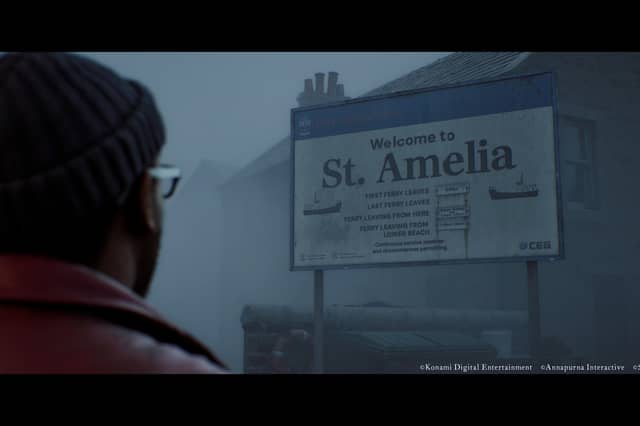

Hit franchise turns to Scottish haar for unique atmosphere
From narrow wynds and centuries old fishing cottages, to little details such as benches and the way the weak sunlight catches the haar, it promises to be an eerie evocation of a well-known east coast village.
Now, the team behind the latest instalment in one of the most acclaimed horror series in video game history have revealed the forensic research they conducted in the East Neuk and further afield in order to provide a “unique” and distinctly Scottish twist.
Glasgow-based development studio, Screen Burn, have been working for the past five years on the latest entry in the Silent Hill series, which has traditionally been set in fog-shrouded US locales.
But the new game takes direct inspiration from the fishing enclave of St Monans, reimagined in the game as the fictional community of St Amelia. Screen Burn’s small team took hundreds of photographs of the area, and even used LiDAR scanning -a high-tech measurement technique that uses laser light pulses to create exact 3D models of objects and environments.

With other Scottish locations, including Shetland and sites around the North Coast 500, helping the team visualise their in-game world, the end product, ‘Silent Hill: Townfall’ is being eagerly awaited by fans of the franchise ahead of its release next month.
Players take on the role of Simon Ordell who is called back to St Amelia to ‘put things right’, encountering a town lying quiet beneath a heavy fog, seemingly abandoned but not at rest. Already, previews in the gaming press have praised the title.
Jon McKellan, the game’s writer and director, said the Screen Burn team “froze in our tracks” after being presented with the opportunity to make a Silent Hill game. “It’s not an opportunity we ever thought we’d get, but it’s one we knew we all wanted right away.”
He and his colleagues created a pitch of what they felt would be a “really cool” and “unique” take on the franchise, and said they were “delighted” when its Japanese publishers, Konami, loved the idea.
Originally, Screen Burn was working towards a setting based in northern Europe, and not specifically, Scotland, but Mr McKellan said there the team wanted to create something that was “authentic” to them, and that if felt “natural” to base it in their homeland.

That personal connection, according to Mr McKellan and his colleagues at the BAFTA award-winning studio, allowed the team to grasp exactly what was needed in terms of atmosphere and visuals.
“When Jon first showed me the game and I saw this very obviously ‘Silent Hill’ misty, foggy environment, that felt like a walk to school when I was growing up,” explained Paul Abbott, the game’s art director. “Because I’ve grown up in towns like this, in a small fishing town that’s kind of similar to St Amelia. It’s a beautifully epic, gray, drizzly environment, and we’re bringing that to the game.”
He added: “It’s really important to not live your life behind the lens, and just absorb the place when you’re there. So it’s always important for artists to get out and see the place they’re supposed to be making.”
He added: “You’re mimicking several hundred years worth of life. That’s what we aim to do. A lot of the time, the player will just sort of walk around and absorb it and they won’t know why it feels like it’s a real place, but the effort that we’ve put in will make them feel like it's a real place and give them that sense of history.”

Speaking in a making of video uploaded by Konami, Mr McKellan said: “It’s the smell and the wind and the sound of the place, all of that together is what you’re trying to recreate. You’re not just trying to recreate the visuals, you’re trying to recreate the vibe, and there’s no better way of doing it than spending time there.
From specific streets and buildings, through to little details such as benches and wynds, swathes of St Monans were recreated almost identically in the game using the Unreal game engine, although Mr McKellan said there were some crucial differences.
“The alleyways are really fun to walk up and down in real life, but when you’ve got a monster chasing you, it’s just not a nice place to be,” he said.
Images and footage of the game released so far depict a dense fog hanging over the town, and Mr McKellan said that was taken directly from one trip to St Morans, when the haar was so thick, the coast was no longer visible, creating a sense of “danger” that found its way into the game. That sense of recreating what the team felt, not just what they saw, was key.
“The atmosphere was like blue in light, the sun was going down, and everything from that moment was when we kind of realised how this game was going to begin,” he explained.
“I got pretty obsessed with chasing the haar. I wasn’t painting images, I wasn’t trying to imagine what the fog would look like. I could go to a town that looks like St Amelia and find a fog that looks like Silent Hill, come back and show the team - here’s what the game needs to look like.”
True to its period setting - the game is set not in the present day, but in the mid-1990s - the attention to detail can be found in surprising ways; in one section, players are tasked with reactivating a house’s electricity meter, and must make their way to a nearby pharmacy in order to obtain pre-paid cards.
Comments
Want to join the conversation? Please or to comment on this article.