
Grenfell Tower Inquiry fire report: The key findings and figures criticised over 72 'devastating' deaths
The UK government will “carefully consider” the findings of the Grenfell Tower Inquiry to “ensure that such a tragedy cannot occur again”, Prime Minister Sir Keir Starmer has said
The devastating Grenfell Tower fire that killed 72 people was the result of “decades of failure” by government and the construction industry to act on the dangers of flammable materials on high-rise buildings, a long-awaited report has found.
The west London tower block was covered in combustible products because of the “systematic dishonesty” of firms who made and sold the cladding and insulation, inquiry chairman Sir Martin Moore-Bick said. He called out “deliberate and sustained” manipulation of fire-safety testing, misrepresentation of test data and misleading of the market.
Prime Minister Sir Keir Starmer said the report identified “substantial and widespread failings”, adding his government would carefully consider its recommendations “to ensure that such a tragedy cannot occur again”.
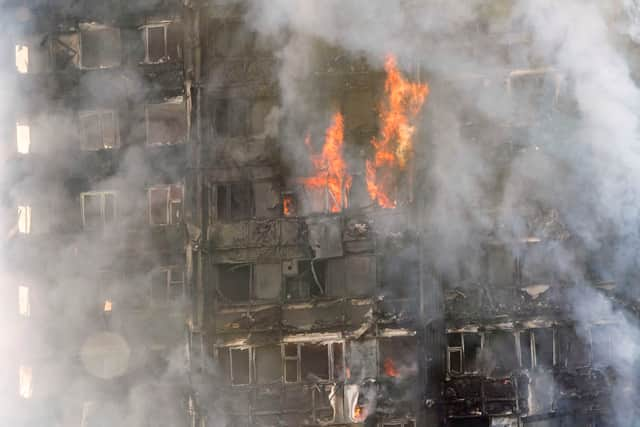

The seven-volume and near-1,700 page final report of the inquiry into the disaster laid out in damning detail how those in positions of responsibility had not heeded or acted on warnings from earlier fires.
Sir Martin said: “We conclude that the fire at Grenfell Tower was the culmination of decades of failure by central government and other bodies in positions of responsibility in the construction industry to look carefully into the danger of incorporating combustible materials into the external walls of high-rise residential buildings and to act on the information available to them.”
Addressing the bereaved and survivors on Wednesday when the report was published, Sir Martin said the “simple truth” is all the deaths were avoidable and those who lived in the tower were “badly failed” by authorities “in most cases through incompetence but in some cases through dishonesty and greed”.
Grenfell United, which represents some of the bereaved and survivors of the fire, said the report “speaks to a lack of competence, understanding and a fundamental failure to perform the most basic of duties of care” as they demanded that some of the construction firms involved should be banned from government contracts.

But they added while the final publication was a “significant chapter” in the years since the fire, “justice has not been delivered”, saying police and prosecutors must “ensure that those who are truly responsible are held to account and brought to justice”.
Here are the key findings from the long-awaited report.
What are the key findings from the final Grenfell Tower fire report?
The government ignored warnings
For almost three decades before the fire the government had “many opportunities” to identify the risks posed especially to high-rise budlings by flammable cladding and insulation, the report said.
By 2016, the year before the fire, it was “well aware of those risks, but failed to act on what it knew”.
After the Lakanal House fire in Camberwell, south London, in July 2009, in which six people died, the coroner’s recommendations were “not treated with any sense of urgency” and “legitimate concerns” were “repeatedly met with a defensive and dismissive attitude by officials and some ministers”.
A ‘deregulatory agenda’ within government saw safety matters ‘ignored, delayed or disregarded’
Following the Lakanal House fire, the government had a “deregulatory agenda, enthusiastically supported by some junior ministers and the secretary of state”, which “dominated the department’s thinking to such an extent that even matters affecting the safety of life were ignored, delayed or disregarded”.
There was ‘systematic dishonesty’ in product testing and marketing
Grenfell Tower came to be wrapped in flammable material because of “systematic dishonesty” among those who made and sold cladding panels and insulation products.
These firms “engaged in deliberate and sustained strategies to manipulate the testing processes, misrepresent test data and mislead the market”.

A former government agency, the Building Research Establishment (BRE), which provided advice on building and fire safety was “complicit in that strategy” when it came to the main insulation product from Celotex.
The BRE was privatised in 1997, but years before that “much of the work it carried out in relation to testing the fire safety of external walls was marred by unprofessional conduct, inadequate practices, a lack of effective oversight, poor reporting and a lack of scientific rigour.”
Its systems were concluded not to have been “robust enough to ensure complete independence” and it was judged to have played “an important part in enabling Celotex and Kingspan to market their products” for use in the external walls of high-rise buildings.
The certification bodies, the British Board of Agrement (BBA) and the Local Authority Building Control (LABC), “failed to ensure that the statements in their product certificates were accurate and based on test evidence”, while the UKAS, which is responsible for oversight of certification bodies, “failed to apply proper standards of monitoring and supervision”.
Statutory guidance on fire tests was ‘fundamentally defective’
Statutory guidance on complying with a requirement under the Building Regulations requiring the external walls of a building to “adequately resist the spread of fire over the walls and from one building to another” was concluded to be “fundamentally defective”.
The use of Class 0, meaning “limited combustibility”, as a standard of fire performance for products to be used on the outside walls of tall buildings was “wholly inappropriate” as neither of the main British Standard tests reflected the development of a fire on the outside of a building or gave the information needed to assess how an external wall incorporating the product would perform in a fire.
Managing fire safety was seen as ‘an inconvenience’ by the tower’s landlords
There was a “persistent indifference to fire safety, particularly the safety of vulnerable people” between 2009 and the time of the fire.
The council – the Royal Borough of Kensington and Chelsea (RBKC) and the landlord organisation – the Tenant Management Organisation (TMO) were jointly responsible for the management of fire safety at the tower.
But the demands of doing so “were viewed by the TMO as an inconvenience rather than an essential aspect of its duty to manage its property carefully”.
In turn, RBKC’s oversight of the TMO’s performance was “weak and fire safety was not subject to any key performance indicator”.
Unedifying ‘merry-go-round of buck-passing’ on the refurbishment
There was a “serious lack of competence” and in some cases “outright dishonesty” when it came to the tower’s 2015-2016 refurbishment.
The report said: “Regrettably, the Grenfell Tower refurbishment was marked by a serious lack of competence on the part of many of those engaged on it and, in the case of some manufacturers of construction products, outright dishonesty.”
The failure to establish clearly who was responsible for what, including for ensuring designs were compliant with statutory requirements, resulted in an “unedifying ‘merry-go-round of buck-passing’ in which the construction professionals all pointed the finger at each other as being the person whose responsibility it was to make one or other of the critical decisions”.
London Fire Brigade had a ‘chronic lack of effective management and leadership’
The fire service did not fail to understand the lessons of the Lakanal House fire – in fact its response “showed that it understood its significance immediately”, the report said.
But its failure “lay in its inability to implement any effective response”.
This failure had “many causes”, including a “chronic lack of effective leadership”, combined with “undue emphasis on process and a culture of complacency”.
Senior managers at the LFB failed to take steps to ensure that its arrangements for handling fire survival calls reflected national guidance, while senior officers were complacent about the operational efficiency of the brigade and lacked the management skills to recognise the problems or the will to correct them.
Residents were left feeling ‘abandoned’ and ‘utterly helpless’ in the immediate aftermath of the fire
The response of government and RKBC in the first week was described by the inquiry as “muddled, slow, indecisive and piecemeal”.
It concluded the council should have done more and that some aspects of the response “demonstrated a marked lack of respect for human decency and dignity and left many of those immediately affected feeling abandoned by authority and utterly helpless”.
The local authority had no effective plan and had not trained staff adequately to deal with such an incident but, the report noted, “none of that was due to any lack of financial resources”.
It credited members of the local community for their help in the immediate aftermath, which “only emphasised the inadequacies of the official response”.
Findings about cause of death
Inquiry chairman Sir Martin Moore-Bick made findings about the cause of death, in an effort to assist the coroner as well as “sparing the relatives of those who died the stress of prolonged proceedings”.
“In light of the expert evidence we are able to make findings about the cause of death, including findings that all those whose bodies were destroyed by the fire were dead or unconscious when the fire reached them,” the report stated.
Who are the key figures criticised by the Grenfell Tower Inquiry?
Several individuals have faced criticism in the Grenfell Inquiry’s final report over their role in the disaster. They include figures from both local and central government accused of repeated failures in their duties.
Below are the key figures criticised by name in the inquiry.
Lord Pickles, communities and local government secretary, 2010-2015
As secretary of state in the department responsible for building regulations, the inquiry found Lord Pickles oversaw a culture focused on deregulation, where civil servants felt unable to raise concerns about fire safety.
Sir Martin said there was a “wealth of material” to show Lord Pickles was an “ardent supporter” of deregulation and “the pressure within the department to reduce red tape was so strong that civil servants felt the need to put it at the forefront of every decision”.
Lord Pickles himself told the inquiry he would have regarded it as “ludicrous” if civil servants thought the drive for deregulation covered building regulations, but Sir Martin said documentary evidence supported claims by officials that deregulation was “a dominant influence within the department”.
He said it was “not uncommon” for the building regulations and standards division to receive emails thanking them for their efforts in meeting Lord Pickles’ “ambition on deregulation”.
The report said: “In the years that followed the Lakanal House fire the Government’s deregulatory agenda, enthusiastically supported by some junior ministers and the secretary of state (Lord Pickles), dominated the department’s thinking to such an extent that even matters affecting the safety of life were ignored, delayed or disregarded.”
It concluded: “The failure to foster a culture in which concerns could be raised and frank advice given represents a serious failure of leadership on the part of ministers and senior officials.”
During the inquiry itself, Lord Pickles provoked outrage from survivors after giving the wrong figure for the number of people killed in the disaster, saying 96 rather than 72.
Brian Martin, principal construction professional, Department for Communities and Local Government (DCLG)
Brian Martin had been the civil servant in charge of building regulations for fire safety for 17 years by the time of the fire, including the guidance in Approved Document B, the official fire safety guidance for the construction industry.
Sir Martin’s inquiry found he had been given “too much freedom of action without adequate oversight” and repeatedly failed to bring fire safety risks to the attention of his superiors.
The report said: “It is not clear how Brian Martin was chosen to be the official with day-to-day responsibility for the Building Regulations and Approved Document B, why he was allowed to remain in that position for so long, or why he was allowed to wield so much influence over the department’s response to developments.”
The inquiry found Mr Martin had shown “little appetite” for reviewing Approved Document B, even after the inquests into a fire at Lakanal House in Camberwell, south London, in 2009.
He also played a role in shutting down the Building Research Establishment’s investigation into the fire after barely a month, citing concerns about the cost of an investigation.
The inquiry accused him of making “misleading statements” to the Lakanal House inquests and providing “disingenuous” advice to then-housing minister Don Foster after the inquests concluded in 2013, in which he “set out to give the minister to understand that the coroner’s concerns were in fact groundless”.
Carl Stokes, fire assessor, Kensington and Chelsea Tenant Management Organisation (KCTMO)
A former firefighter, Carl Stokes was responsible for carrying out fire assessments for the whole of KCTMO’s estate.
The inquiry found he had been “allowed to drift into” his role, for which he was not qualified.
The report said: “He had misrepresented his experience and qualifications (some of which he had invented) and was ill-qualified to carry out fire risk assessments on buildings the size and complexity of Grenfell Tower, let alone to hold the entire TMO portfolio.
“As a result there was a danger that fire risk assessments would not meet the required standard.”
The report said Mr Stokes’ methods for carrying out fire risk assessments “suffered from serious shortcomings”, including often failing to check whether the TMO had taken action to respond to identified risks.
London Fire Brigade (LFB) officers had also expressed concerns about his competence, but KCTMO “continued to rely uncritically on him”, making the danger “more acute”.
Grenfell United, representing some of the bereaved and survivors, said it was “a damning indictment of this country that amateurs, like Carl Stokes and Brian Martin, can pose to be experts, putting countless lives at risk and taking the lives of our loved ones”.
Robert Black, chief executive, KCTMO
The inquiry found an “entrenched reluctance” on the part of KCTMO boss Robert Black to tell either his board or the local authority’s scrutiny committee about fire safety issues or LFB’s concerns about compliance with safety regulations.
It said: “That failure was all the more serious because there were chronic and systemic failings in the TMO’s management of fire safety of which the board should have been made aware.”
During the inquiry, retired judge Sir Martin Moore-Bick heard Mr Black waited two hours before forwarding a list of residents to firefighters on the night of the blaze, saying his organisation had no role in emergency planning.
Mr Black quit as KCTMO chief executive on June 30 2017, 16 days after the fire.
Nicholas Holgate, chief executive, Royal Borough of Kensington and Chelsea (RBKC)
Nicholas Holgate’s response to the disaster was strongly criticised by Sir Martin, who found he had been “unduly concerned for RBKC’s reputation”.
Describing Mr Holgate as “reluctant to take advice” from those with more experience, Sir Martin said he was “not capable of taking effective control of the situation and mobilising support of the right kind without delay”.
He resigned on June 22 2017, eight days after the fire.
Comments
Want to join the conversation? Please or to comment on this article.