
Curating Covid: story of the pandemic told at museum


Face masks, from medical-grade face coverings to hand-sewn fabric creations, were part of everyday life during the pandemic. Now designs from around the world are part of a new exhibition, Injecting Hope: Race for a COVID-19 Vaccine, at the National Museum of Scotland, writes Hannah Boddy.
Opening this weekend, a new free exhibition at the National Museum of Scotland tells the story of the global scientific efforts to develop a COVID-19 vaccine and explore the personal experiences of the pandemic in Scotland.
Injecting Hope: The Race for a COVID-19 Vaccine brings together more than 80 objects that were acquired in real time during the peak of the pandemic. Presented by the Science Museum Group, curators across the UK, including National Museums Scotland, collaborated to collect history as it happened.
One object in particular became an instantly recognisable emblem of the pandemic. Face masks, from medical-grade face coverings to hand-sewn fabric creations, were part of everyday life. They were worn in most public indoor settings, supermarkets, bars and restaurants and on public transport, but they have now all but disappeared. Initially essential tools in the global fight against the virus, they became a symbol of protection and altered the way we think about public health.

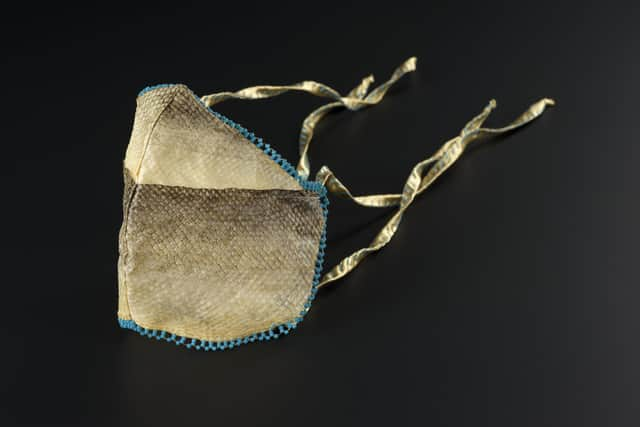
Masks became one of the object types collected by almost every department at National Museums Scotland, from science to art and design, reflecting the innovation, inspiration and artistry in their creation.
Exhibition Curator Sophie Goggins says: “It’s a great example of how different departments across the museum collect contemporary material for different reasons. It was a global experience, so we’ve got masks from Alaska and Oceania. We’ve got some by Scottish-based artists, and one with a clear panel for lipreading. We’ve also added in a mask that we acquired from one of our Visitor Experience team who wore it when we reopened the National Museum of Scotland.”
With so many masks produced, the challenge for curators was choosing the ones that could add the most to the story of the pandemic.
From our Science & Technology collections, we’ve included an example of the now iconic blue and white disposable masks in the exhibition. In 2020 they were included in all UK vaccination kits and, as supplies increased, became a popular protective option among members of the public.
There are now an estimated 12,500 people in Scotland who use British Sign Language, the widespread use of masks severely impacted those who also relied on lipreading. The exhibition features a mask with a transparent insert. This design went some way to resolving the issue, but the masks would often steam up.
Curators in our Global, Arts, Culture and Design department explored masks around the world, reaching out to contemporary artists, makers and designers whose practice sought to explore them as expressions of identity, heritage and socio-political discussion.
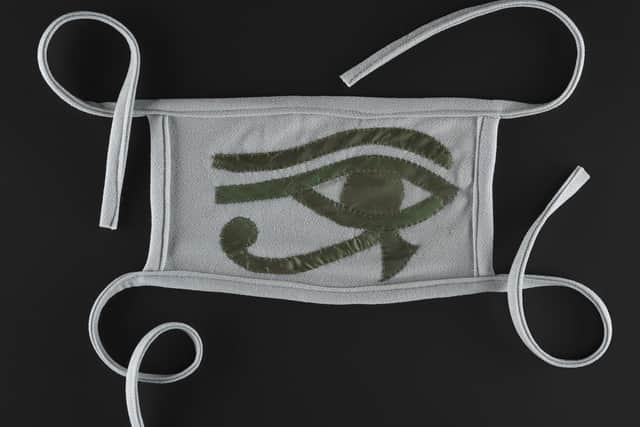
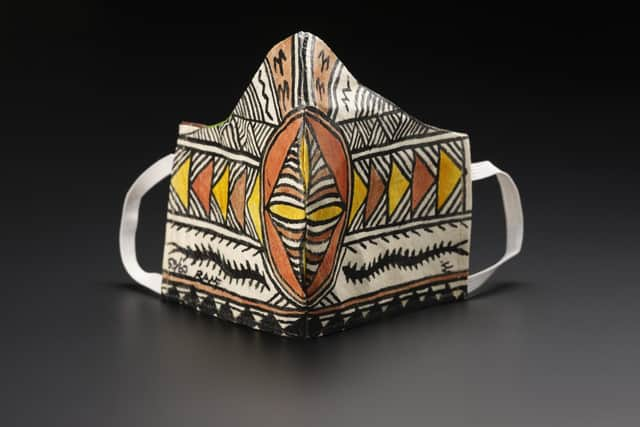
Samoan artist Reggie Meredith-Fitiao used barkcloth to create face coverings. The natural cloth is crafted using ancient techniques, from the inner bark of trees. A cotton mask from Egypt is adorned with an Eye of Horus design, an ancient a symbol of protection and healing, and Alaskan-based multidisciplinary artist Crystal Kaakeeyáa Rose Demientieff Worl, used salmon skin she harvested with her family.
Many artists found ways to interpret the pandemic in their work. Scottish-based textile artist Deirdre Nelson’s embroidered mask titled Guga, or gannet in Gaelic, is included in the exhibition. The wingspan of the seabird is 2m, corresponding to UK social distancing advice. Injecting Hope includes additional artworks, such as Angela Palmer’s sculpture, 2020: The Sphere that Changed the World, that reveals the complex beauty of the virus’s microscopic structure. It is made of 28 stacked sheets of engraved glass and as visitors walk around it, the virus disappears from view – reflecting the elusive nature of its threat to global health.
Also on show is Hope in Balance by Junko Mori, which was inspired by antibodies surrounding the virus and the human response to the disease. She chose to create the work using silver because of the metal’s antiseptic qualities.
Unlike many exhibitions at the National Museum of Scotland, this one highlights a very recent moment in history, which means visitors will bring their own experiences and memories.
In a National Museums Scotland blog post about the emotional power of masks and collecting during the pandemic, Senior Curator Sarah Rothwell recalled: “the thought that our own breath could now be the carrier for this new deadly pathogen was frightening. But as an asthmatic myself, the very idea that a mask would become part of my daily attire brought back childhood memories of the respirator I had to wear. I recalled how claustrophobic it made me feel.”
Another colleague described the impact that wearing a mask had on her experience as a new parent in 2020: “outside of our immediate family my baby barely saw anyone smile for the first year of his life. I do wonder if it affected his development, and as a first-time mum it could be very lonely. When I had my second son two years later, I was so surprised that strangers would have such a joyful response to seeing us out and about with the pram. They would be desperate to say hello and smile at the baby. It was such a contrast.”
Injecting Hope includes many personal stories from Scotland, as well as revealing how the vaccine was developed. It culminates with the audio installation I Remember. The artwork was created as part of Scotland’s Covid Memorial by artist Alec Finlay and produced in collaboration with members of the public. People across the country were invited to finish the sentence ‘I remember...’ while reflecting on their experience of COVID-19. The anonymous responses were collected by the artist and recorded by Scottish actor Robert Carlyle.
The story of the pandemic itself is a broad one, everyone experienced loss; freedoms, work, money, time, space and, most tragically, and in many instances, loved ones. Injecting Hope focuses on the worldwide scientific efforts to develop and deliver a COVID-19 vaccine, a testament to what can happen when a lot of people work together towards something and what we could do in future.
Injecting Hope is presented by the Science Museum Group (SMG). It opens at the National Museum of Scotland on Saturday and runs until Sunday 27 April. Entrance free