
New Glasgow skate park would be a welcome addition to Scotland's 'infrastructure of stoke'


From skateparks to artificial surfing waves, the rise of fun facilities across Scotland speaks of a desire to create pockets of utopia, writes Roger Cox
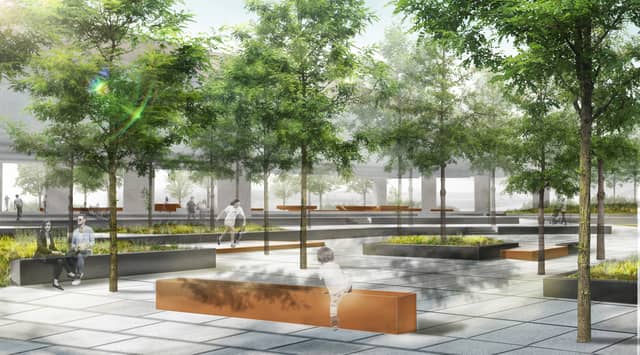
Earlier this month, plans were unveiled for the proposed Devon Street Urban Park on Glasgow’s Southside – a project which would see an 8,000 square metre area of disused land beneath a motorway flyover transformed into a public garden full of trees, sculptures and a multitude of custom-built features for skateboarders and BMXers to enjoy.
The project has been led since 2014 by Scottish artist-skateboarders Toby Paterson and Raydale Dower, and in 2020 they teamed up with BMX rider and professional ramp builder John Bailey. Their plan has already attracted £1.2 million in funding from the Susanne Marcus Collins Foundation, a philanthropic not-for-profit based in the US, and everyone from trials bike superstar Danny MacAskill to local councillor Jon Molyneux seems to think it’s a good idea.

If and when the project comes to fruition (and given the money already committed and the very obvious benefits, this seems like more of a “when” than an “if”), it will be the latest chapter in a remarkable story which has seen skateparks large and small proliferating all over Scotland in the last couple of decades, from the Loading Bay park in Port Dundas, North Glasgow, overseen by Bailey and opened in 2019, to the Banchory Skatepark, opened in 2022.
To get an idea of just how much concrete has been poured in the name of skateboarding in recent years, check out the interactive skateparks map on the Skateboard Scotland website, or indeed the “list view” of Scotland’s skateparks, which shows some 222 of them. Sure, a good few of these carry a little black-and-yellow exclamation mark – a warning that the park in question is not regularly maintained and “may not be worth a visit.” Still, 222 skate parks in a nation of five and a half million isn’t bad going. Think of it this way: we now have approximately half as many skate parks (albeit in variable states or repair) as we do Neolithic stone circles (also in variable states of repair). So, when future archaeologists start digging through thousands of years’ worth of peat in search of early 21th century Scotland, they may well find considerable evidence of this skatepark explosion.
That’ll be just the tip of the iceberg, though, because – if they're smart – these future archaeologists will recognise that skateparks are only a small part of something much bigger: what we might call Scotland’s “infrastructure of stoke”.
Nobody ever talks about the infrastructure of stoke (except in North Staffordshire, perhaps, where from time to time they must presumably talk about the infrastructure of Stoke.) That’s because I just made the term up. But for all that it’s a made-up term, the thing it describes very definitely exists.
When skiers, snowboarders, surfers and skaters talk about “stoke” or being “stoked” they are referring to the feelings of exhilaration they experience while doing their chosen activity – stoke is the common denominator that links all these things together. Yes, technically, they are all sports, and yes, technically, it’s possible to do them all competitively. However, the vast majority of skiers, snowboarders, surfers and skaters have zero interest in competition – for them, it's all about finding that stoke.

Looking back over the last two decades or-so of writing about what we might call stoke-based sports, I can chart a steady but inexorable growth in the Scotland’s stoke infrastructure. Only the other week, for example, I was writing about plans to install a new £22 million gondola system at Glencoe Mountain ski area, along with improved snowmaking facilities; a few weeks before that, I was writing about Lost Shore – the £55 million artificial surfing wave project nearing completion at Ratho, just outside Edinburgh.
Turn back the clock a little further, to 2012, and I was pulling on my wetsuit to trial the then brand new Foxlake wakeboarding facility just outside Dunbar. Spool back to 2003, and I was interviewing climber Duncan McCallum about his plans for the newly opened Edinburgh International Climbing Arena, also at Ratho.
Not all of Scotland's stoke infrastructure has aged well, of course – future archaeologists will no doubt stumble across the sorry remains of the Cairngorm Funicular at some point – but when they discover the remains of our ski resorts, our climbing walls, and our surf and skate parks, they will doubtless conclude that, back in the distant past, before “the great heating”, Scotland had at least figured out how to have fun.
What kind of remains will the Devon Street Urban Park leave behind for these archaeologists? Well, it might be a tricky dig, depending on what ends up happening to the motorway flyover directly above, but based on the plans released so far I think our descendants will be impressed. They will see something that aims to provide enjoyment, both for those who love sliding around on two wheels or four, and for those who enjoy being surrounded by trees and art. And they will conclude that when we early 21st century humans put our minds to it, for all our faults, we were at least able to aspire to creating little pockets of utopia.
For more on the Devon Street Urban Park, see https://glasgowurbansports.org/
Comments
Want to join the conversation? Please or to comment on this article.