
Scotland's larder: Djamila Siagh one of the Soul Food Sisters, Glasgow


A dedicated band of women run Soul Food Sisters in Glasgow, a social food enterprise that empowers and brings together migrant women to end social isolation and help them to develop their skills.
I'm talking to one of the sisters, Djamila Siagh, who knows from personal experience just how hard it is to move countries as she came to Glasgow from Algeria in 2001.

Sisterhood
The Soul Food Sisters project was originally set up by ten women, from different cultures who realised they were all struggling with similar issues: the lack of recognition for their qualifications, problems with childcare and the whole asylum process.
With so many issues in common they decided there was strength in numbers so they came together and created a project to help and support other women in Glasgow."

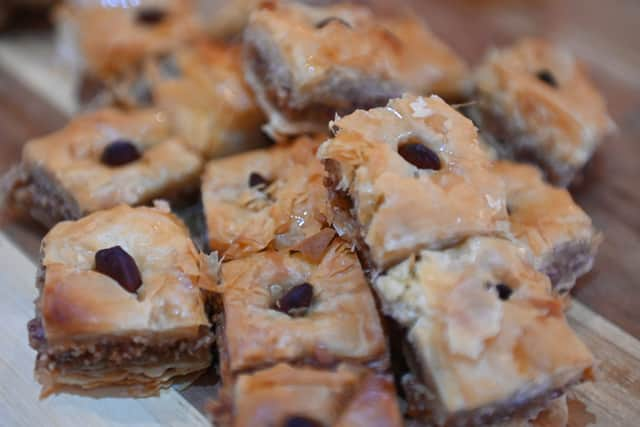
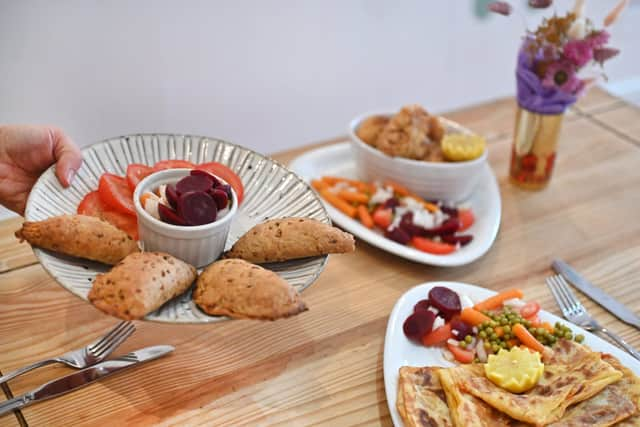
Using their diverse cultural backgrounds and food knowledge, Soul Food Sisters provide catering for events with the proceeds reinvested, in amongst other things; employment, workshops, training and networking opportunities for the women.
Family Origins
Djamila was born in Algiers; "My mum got married when she was very young, they came from a wealthy family. I think my grandma was scared for her daughters so she got them all married at a very young age."
There was a 27 year age gap between her mother and her husband, and, sadly her mother was widowed with four children aged only 24.
Djamila was the youngest of them and was only three weeks old when her father died.
After two years her mother remarried and then went on to have another four girls and two boys.
Her mother and stepfather encouraged Djamila to study, and in her home country she was a clinical psychologist.
She feels she is now using those talents again as part of the Soul Food Sister's' team who help female migrants and asylum seekers.

She sees her role as helping others; "so many people need support."
Although her father and step father were kind man, she feels her mother's experience of marriage was wrong.
"Girls need to have an opportunity to study and then chose to marry. I don't want to see any woman struggling that way."
Heart & Soul
But it was her mother's heart problems that brought her to Glasgow; "my mum came to the Golden Jubilee Hospital for an operation. I never planned to come to the UK, I never wanted to leave my country."
Her mother didn't want to travel to Scotland alone so her daughter accompanied her.
When her mother was recuperating, Djamila met her future husband, Mohamed in the hospital.
She said, "he was so kind."

The Algerian community knew there was a group of patients coming from Algeria, so arranged to visited them to provide food, support and looked after them.
She never anticipated getting married away from her family she said; "this was a big thing for me."
A mother's love
Djamila was still a little uncertain about Mohamed but her mother had different plans she said, 'if you want me to be happy this guy is the best for you.'
Her mother also spoke to Mohamed and gave him her blessing, saying, 'I want to leave my daughter with you.'
She passed away that day.
Her death hit Djamila very hard-she admits being depressed for almost two years, "I was always crying all the time. No one can take the place of your mum, she was my best friend."
But she married Mohamed, and said "He is the best, a lovely man."
But the registry office ceremony, though, was a far cry from the large family weddings held back home.

Lessons in life
As a French/Arabic speaker she had to get to grips with a new language, as well as becoming a mother in a new country, but she received a lot of support.
After a few years, she attempted to resume her studies; "to understand the society and to try to boost my confidence."
She studied three highers but any additional study was out of the question due to cost..
She explained, "I am not entitled to free education."Undaunted she completed a diploma in child pyschology online, saying, "motherhood was new to me so I needed to understand how to deal with my kids."
Good cause
She then became passionately involved in migrant issues having attended a Scottish refugee council meeting with a friend,.
She heard about other women's experiences who suffered abuse.
Djamila said, "I was shocked I was very grateful for the way I had come from my home to here."
"I had always been interested in asylum seekers issues and I wanted to try to understand why women in particular were struggling."
"It seemed easy for men adapt into the society, they can go to work where they meet other people and they can connect, even if they don't have very good English, while women and children struggled, so I wanted to be involved."
The main issues that the women faced were; exclusion, isolation, lack of support and information.
"People have big dreams when they cross the border but they don't know what is waiting for them. They find themselves struggling for years and this affects their mental health, well being and dignity. I hope the system will be better in the future," Djamila said.
Through her work with Scottish refugee council, Karibu and the Scottish Refugee Policy Forum, she the met one of the founding sisters who asked if she wanted to join Soul Food Sisters.
If you can't stand the heat?
She was then asked to attend an event and share her Algerian menu.
She was no expert in the kitchen, and laughs at the memory of the first meal she cooked for her husband; "plain rice which I put in the oven without water."
said before coming to the UK, "I have never cooked in my life."
Growing up her older sisters had always told her not to cook but to concentrate on her studies, and thankfully her cooking has improved greatly, she said now, "I follow the recipes."
At the workshops they hold, more than food is on offer, with support and sisterhood firmly on the menu.

Djamila said, "it is all about bringing people together, to talk and connect with others and facilitate a better life for everyone. At Soul food Sisters you reach this understanding that all women are struggling in the same way even Scottish people not just the migrants girls."
She said listening to others is a kind of therapy; "I have this opportunity to meet with people, understand and try to help. So many people are having a tough time and the Soul Food Sister Story is that you are not alone."
Rising to the challenge
Events are staffed by a mix of volunteers and employees but the pandemic has proved to be a challenge.
2019 had been the best year yet for the enterprise as the catering business was thriving; Djamila said, "but covid came to take all this hard work away. It was a very hard time."
The Soul Food Sisters cafe was closed, instead they adapted and continued to do a huge amount of outreach work within their communities to support assylum seekers and people suffering from homelessness by providing meals.

Lottery funding has given the Sisters a lifeline to continue their work but the ladies long term plan is to have a kitchen they can use for both food preparation and for hosting workshops, ideally in the west end or southside.
Djamila said, "we dream of this."
Global gathering
At Soul Food Sisters they have a global community of women, with a range of nationalities involved; Spainish, Algerian, Polish, Yemeni, Pakistani, Italian as well as Scots.
They have also caught the eye of some big names, war documentary photographer Giles Duley visited as well as Joanna Lumley.
Djamila said, "she was wonderful company, an incredible woman who was so interested even when the cameras stopped rolling she didn't stop listening."
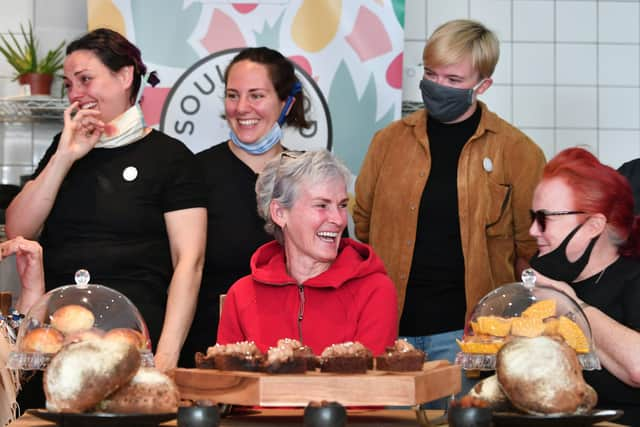
Another lockdown volunteer, was Viola Mondello who is a pastry chef at Cromlix house and as a result Judy Murray has been in touch. Her foundation held a tennis skills workshop at Tollcross, where 50 women and 20 children learned basic tennis skills, followed by a big lunch catered for by the Sisters.
Just now they are trying to get the business back on track post covid and are about to recruitment some employees and more volunteers, so they are optimistic for the future.
Food for thought
The best way to support the project is to employ them to cater for any event, or make a donation through their crowdfunder appeal.
Djamila is grateful to everyone who has supported them to date; "We are still here because of the support of all these people. This is a good project for women."
She also acknowledges the amazing contribution made by the former directors and volunteers, she said, "I just want to say a big thank you to them all."
Djamila said, "I am very grateful that Glasgow is my second home, in the beginning it was a very challenging time for me but in the end I am so happy to make my new home here. Glasgow is my heart and Scottish people are so friendly."