
Neolithic feasting sites discovered in lochs across Outer Hebrides among top archaeology of 2025
The finds cross the millennia and hint at the variety of archaeology in Scotland that is still being found.
The discovery of potential feasting sites on lochs throughout the Outer Hebrides where people gathered more than 5,000 years ago has been named as one of Scotland’s top archaeological finds of 2025.
The feasting sites have emerged along with a range of discoveries - from a Bronze Age well to a lost village and an amulet designed to protect horses - which reflect innovation, ritual, folklore and way of life across Scotland.
Dr Simon Gilmour, Director of the Society of Antiquaries of Scotland, said this year’s top discoveries “brought to life” the country’s human stories across five millennia with the public playing their part in making many of the finds.
Neolithic feasting sites in the Outer Hebrides
How people gathered and enjoyed food - and the importance of that - during the Neolithic period has been unravelled by major research on crannog sites in lochs across the Outer Hebrides
Daniel Brown, a Phd Researcher at the University of Bristol, made the connection between Neolithic crannongs - small artificial islands built on lochs - and food remains from thousands of elaborately decorated pots found in the water.
Among sites of interest was Eilean Dòmhnuill on Loch Olabhat, on North Uist.
Following months of research, it was concluded in September that the crannogs may have served as gathering places where people “practised unique culinary trends” during the Neolithic period, from around 4100BC to 2500BC, and that the sites were of great importance to the people that made the journeys to them.
Mr Brown said: “One of these sites was used for approximately 800 years and the pottery decorations and styles did not change over this time, which is unusual. This suggests that there was something symbolic about these particular designs at these particular places and that what was happening at these sites, and how it happened, was very important.”
The pots found at the crannogs once held meat products, which sits in contrast to the dairy products normally found in such pots in domestic settings and further indicates a special nature to the crannog gatherings.
Meanwhile, a “surprisingly high” amount of evidence that fish was being prepared was also discovered within the vessels, something that is very unusual in the Neolithic when compared to other regions of Britain and Ireland.
Rare Bronze Age structures in Shetland
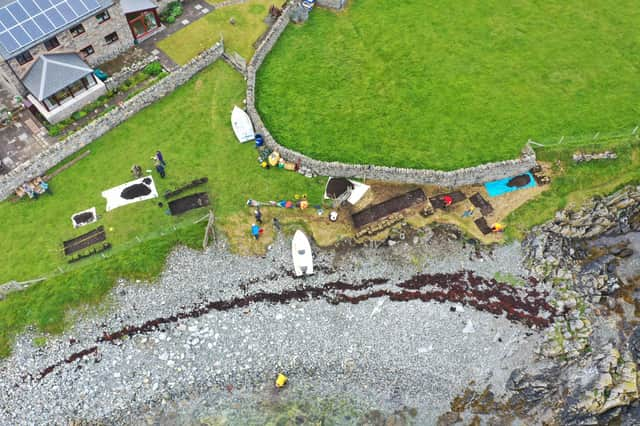

The discovery of prehistoric structures on a small island in Shetland has been hailed as another important moment for archaeology in Scotland in 2025 which could shed light on a Bronze Age mystery over the way people heated water - and what that water was used for.
At Nesting on the island of Gletness, which sits to the east of the Shetland mainland, volunteers found a complex burnt mound and an underground corbelled structure, thought to be a well.
Joanna Hambly from the SCAPE Trust, which led the excavation, described the concentration of archaeological sites at Nesting as “extraordinary”.
Burnt mounds generally date to the Bronze Age, which spans roughly 2500 BC to 800 BC, and are considered a by-product of a method for boiling water, where hot stones were dropped into a trough filled with water.
Complex burnt mounds are so-called because they have cells or small rooms inside them and surviving examples of these particular structures have so far only been found in Shetland and Orkney.
However, why people heated water in this way is still unknown. Theories include beer making, cloth production, leather working, communal cooking areas, washhouses or saunas, and even that they were connected to prehistoric funerary activity.
Stephen Jennings of Archaeology Shetland described the discovery of a potential well as a “rarity” , which could “yield a great deal of information contemporary with the use of the burnt mound.”
READ MORE: ‘Extraordinary’ discovery made at Neolithic site on Orkney
Evidence of a Possible Roman Siege in Dumfries & Galloway
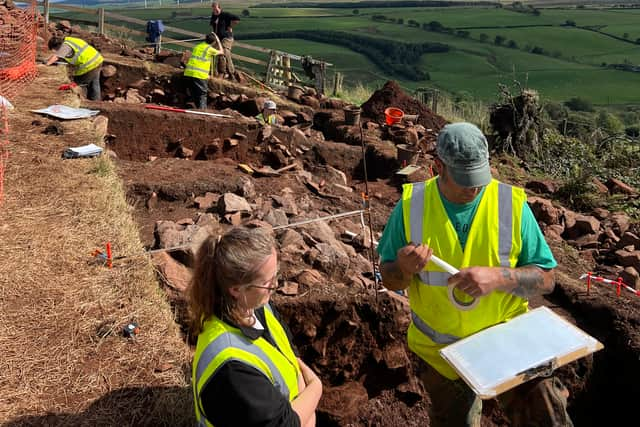
In August and September, experts collected evidence from a hillfort on Burnswark Hill , between Echlefechan and Lockerbie, which may suggest that the site was besieged by an invading Roman force some 1,900 years ago, making it one of only a handful of sites in Europe that still has upstanding evidence of a Roman attack.
Previously, some believed that the hillfort, which dates to the Iron Age - from roughly 800 BC to 400AD - was not significant enough to warrant a Roman attack and that the hillfort was long abandoned by the time the invaders reached the site.
However, survey work by a team from the University of Glasgow, the Trimontium Trust and the University of Manchester has revealed that Burnswark Hill was far more densely occupied during the time of the Roman invasion than previously thought, which they believe means that it was large enough to provoke an attack.
Subsequent excavations also revealed traces of a major phase of rampart construction or remodelling following the Roman attack. This has been interpreted as the hillfort’s inhabitants having survived or returned after a siege and beginning to rebuild.
Dr James O’Driscoll, of the University of Glasgow, said the finding “offered a rare glimpse into how Iron Age communities in Scotland built, defended, and reimagined their world in response to Roman power.
“It’s a story of resilience, identity, and survival that challenges long-held assumptions about Scotland’s past.”
Lost Medieval Settlement in the Borders

In May 2025, a lost medieval settlement occupied around 800 years ago was rediscovered near Horndean as part of the Uncovering the Tweed project. Local volunteers, school pupils and young adults from Borders Additional Needs Group worked alongside archaeologists from AOC Archaeology to excavate the site.
Horndean has long been suspected to be the location of a lost medieval village, known from historical documents and maps, but not proven until now.
The team found animal bones and pottery produced from the 12th century onwards.
It is believed the settlement may have been associated with a nearby medieval church, and was perhaps involved in providing for those who used it.
Early Modern Amulet from the Highlands

In April, the Treasure Trove Unit (TTU) confirmed the discovery of an elfshot amulet with a history that spans more than two and half millennia. Uncovered near Fortrose by metal detectorist Lawrence Deans, the artefact contains a Bronze Age flint arrowhead (c.2000 BC to 800 BC) which had been found by someone in the 17th or 18th century and mounted in a silver pendant as a charm.
According to TTU, horse lameness was believed to have been caused by fairies shooting the horse with stone arrowheads. Repurposing the elfshot into an amulet and keeping it close was thought to heal the horse and protect it from further injury.
The pendant will go on show at Groam House Museum in Rosemarkie next year.
Comments
Want to join the conversation? Please or to comment on this article.