
The furious letter of a Jacobite wife and a visit from the cruellest of Redcoats
‘He descended to the lowest degree of meanness’
Written on the roughest of paper almost 280 years ago, it was a letter penned in fury by a mother, a wife and Jacobite as her home lay destroyed around her.
Isabel Haldane, of Ardsheal House at Appin in Argyll, wrote the letter in August 1746 as the British Army tore through the countryside hunting for Bonnie Prince Charlie, his supporters and all things Jacobite to annihilate following the Battle of Culloden.

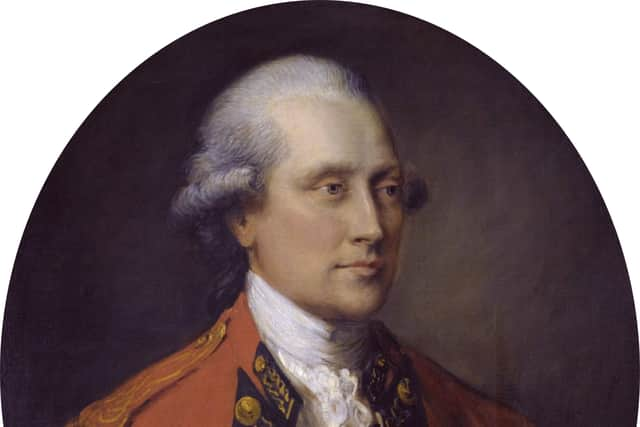
The letter complains of the conduct of Captain Caroline Frederick Scott, of Edinburgh, who searched for her husband, Charles Stewart of Ardsheal, who led the Appin Army onto the battlefield on April 16, 1746.

As the Jacobite commander hid out in a cave on nearby Ben Bheith, Isabel - who earlier told her husband that if he didn’t lead the men to fight, she would - defended the couple’s home and large family.
With no senior Jacobite to be found, Captain Scott, who earned the reputation as the cruellest operator during these days of reprisals , got to work.
As the family watched, trees were pulled down, the orchard was destroyed, and every slate tile and piece of timber was removed in order to sell at Fort William.
READ MORE: The Jacobites who fought on after Culloden
Food was taken - even a small amount of butter - and pots and pans were removed so no one could eat.
After he finished, Captain Scott asked for Isabel’s keys, offered her his hand and told her to go. She handed over her keys, but stayed - and found the piece of paper instead.
Not silenced nor scared, she wrote to Major John Campbell, a future Duke of Argyll, about the conduct of his officer.
She wrote: “I cannot understand that any man especially bred in a civilized country and good company could be so free of compassion or anything at all of the gentleman to descend to such a low degree of meanness.
"I begged [ ... ] but he would not allow me so much as the smallest of my pots to dress a little victuals for my children, no spoon or knife or fork or even a blanket, nor no kind of linen."
Signing off, she wrote: “Excuse the coarseness of the paper, my good friend Captain Frederick Scott leaving me none better.”
The letter was found deep in the papers of Major Campbell, held by the National Library of Scotland, by author Maggie Craig.
Ms Craig is the author of Damn Rebel Bitches, which examines the role of women in the 1745 Rising. The letter was central to a recent talk given by Ms Craig as part of Jacobite Week at the West Highland Museum in Fort William.
Ms Craig said: “Here we have this woman who was defending her house, looking after her children, making sure people had enough to eat. She was a very strong character, and the letter was furious.
“Captain Caroline Frederick Scott took everything - even her pots and pans . He didn’t leave her a pan, so she could make food for her children.
“Isabel was incredibly bold. She said to her husband ‘if you don’t take the men out, I will’.
“Being a lady, she had a little protection, but I think the fear would have been huge. This was war, and they spoke about it like it was war .”

Ms Craig said she believed that Isabel Haldane may have known Captain Scott given the wording and contents of the letter.
“I wondered how she would know he was raised in good company,” she said. “I think they must have known of each other. They were both gentry and both around the same age. Isabel was from Lanwick near Doune, and would have gone to Edinburgh to socialise.”
Ardsheal left for France in September 1746, but Captain Scott’s persecution of his wife and children continued, Ms Craig said.
The redcoat returned to Ardsheal House in December and set it on fire, with Isabel taking shelter in a barn. There, she gave birth to a daughter with Captain Scott then calling once more.
According to accounts, he told her: “I do think your husband was a great fool to join the rebels and to leave you and your children without a home.”
Ms Craig added: “But it was him who left them without a home”.
In the letter, Isabel asked Major Campbell for a “pass”, so that she could take her children to part of the “Low Country” for her education.
Isabel then moved to the Stirling area and later joined her husband in France, where he died in 1757. She later returned to England and moved to Northampton, where she died in the Peacock Inn. She is buried close by.
The Appin Army was made up of mostly Stewarts and MacColls, with MacLarens, Carmichaels, MacIntyres, MacCormacks and Livingstones among the ranks.
They lost 92 men at Culloden in the charge of the right wing of the Prince’s army, with the great-grandfather of explorer Dr David Livingstone and Isabel's nephew, George Haldane of Lanrick, among them.

After Culloden, Captain Scott became a type of “poster boy” for suppression of the Jacobites, with his diary featuring in the Scots Magazine.
Ms Craig said he took “a clear pleasure in destruction, harrying and burning” his way through the Highlands.
She said: “He received a message from Cumberland himself at High Bridge in early June 1746, to the effect that he should not burn any more houses that day. He declined to recall the party he had sent on ahead to do just that.”
Captain Scott said, according to accounts: “It is no matter. Let them proceed in the burning. They are not in the knowledge of the orders.”
It was on the same day that his patrol encountered three men near Glen Nevis, who were on their way to Fort William to surrender their weapons.
Ms Craig said: “The captain arranged an impromptu hanging, executing them by means of the ropes of a salmon net slung over a mill-spout. According to contemporary accounts, the men were laughing as the redcoats put the ropes around their necks, thinking that this was meant only to frighten them. They were wrong.
“Captain Scott gave the order and they were hanged there and then.”
Ms Craig said that potential finds waiting for historians in the country’s archives always “amazed” her.
She said: “When I read Isabel’s letter, when it was there in front of you, it was as if you could be with her. After 280 years, you can still feel her determination.”
Comments
Want to join the conversation? Please or to comment on this article.