


When crossing the Scottish border, we’re greeted with a sign that reads “Fàilte gu Alba” and to the average driver it may mean nothing but others will know it’s Scottish Gaelic for “Welcome to Scotland”. No different to “Fáilte go hÉirinn” signs in Irish or “Croeso i Gymru” equivalents for Welsh at their borders, immediately we’re made aware that we’ve entered a nation of rich Celtic culture; yet this heritage has been minoritised.
As written by Paul Kavanagh in Scotland’s Language Myths: “A minoritised language is a language which was once the language of the majority of a given country or large geographical region, but due to political and other factors became socially marginalised.” The Gaelic-speaking tradition predates even the reign of medieval Scottish Kings following Irish Gaelic’s arrival to Scotland around 500 AD.
Sadly, since then historical events like the Battle of Culloden and the ensuing Highland Clearances, education acts that banned Gaelic in schools, and the emergence of English-speaking dominance in society have seen Scots Gaelic wilt away. Of course, this plight is not exclusive to Gaels as many minority languages worldwide are in the same battle to exist in their own heartlands.
Bilingualism is the rule and not the exception in many countries, so why should Scotland differ? However, the next argument tends to be “well, be bilingual with a useful language!” That’s where our Scotsman readers come in. With over 1.5 million learners signed onto Gaelic on Duolingo, popular TV shows like Outlander featuring Gaelic, and new businesses opening like the Gaelic Cafe in Stornoway (which will hopefully inspire others), there is clearly a drive to use the endangered tongue.
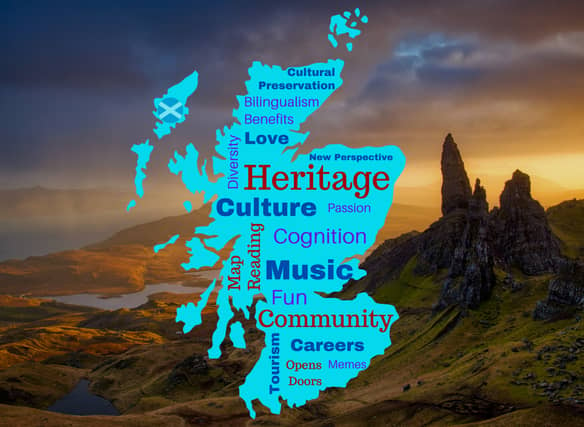
So, to help us articulate that best we created an engagement post that read “Scottish Gaelic is worth learning because…” and our Scotsman readers offered hundreds of insightful answers that we have condensed into this well-meaning list of twenty-one reasons to learn Gaelic.

13. Gaelic is worth learning because… You gain the Gaelic perspective
Federico Fellini said that “A different language is a different vision of life” and this sentiment was echoed by many of our Scotsman readers. One user wrote that “languages shape thoughts” and that the unique phrasing of Gaelic separates it from its would-be English counterparts. For example, in Gaelic it is said that things are not possessed “by you” but rather they are “at you” (or on you). In Gaelic to say “I love you” it’s “tha gaol agam ort” i.e., my love is on you. This perspective can be felt in other ways like Gaelic’s connection to nature and how its names and folklore reflect how close Scottish Gaels were to it. | PJPhoto69 and aurore murguet on Canva Pro

14. Gaelic is worth learning because… The rich culture and identity
Young Scot referred to Scottish Gaelic as “an important piece of Scotland's heritage and cultural identity, especially for people in the Highlands and Islands.” Emil Cioran, a Romanian Philosopher, adds to this with: “It is no nation we inhabit, but a language. Make no mistake; our native tongue is our true fatherland.” While debatable, the point of this is not to say that Scottish culture cannot exist or be celebrated without Gaelic, but rather that Gaelic is a big part of that culture and so a lot would be lost without it. Literature and poetry, music, traditional dance and more is linked to Scotland by way of Gaelic. | via Canva Pro

15. Gaelic is worth learning because… Of careers, it can open doors
In general, having a second language is beneficial as it offers additional career opportunities (after all, it demonstrates a skill that monolingual speakers have not attained.) As LearnGaelic wrote: “There is a range of jobs which open up to you when you speak Gaelic.” Even in the online influencer sphere, last year the passionate Scottish Gaelic advocate Calum Maclean surpassed the world-famous Glasgow-born singer Lewis Capaldi in being named “the most influential Scot on TikTok”. In a sea of TikTok memes that all emulate one another, having an endangered Celtic tongue under your belt is a unique edge. | via Calum Maclean

16. Gaelic is worth learning because… It’s good for child development
In their page about why children should learn Scottish Gaelic, Fiosrachadh do Phàrantan wrote: “Being bilingual helps children become more aware of language itself and how it works. A child speaking Gaelic will know that some nouns are masculine and feminine. This makes it easier to learn languages such as French and Spanish where the same rules apply.” They also mention that studies show “that children educated through Gaelic are on par with or outperform children educated in one language.” As a practice shared between parents and their children, it is something that families can mutually enjoy and bond over. | Andrea Piacquadio on Canva Pro