
Mysterious stone head found on tiny Scottish island of Rousay
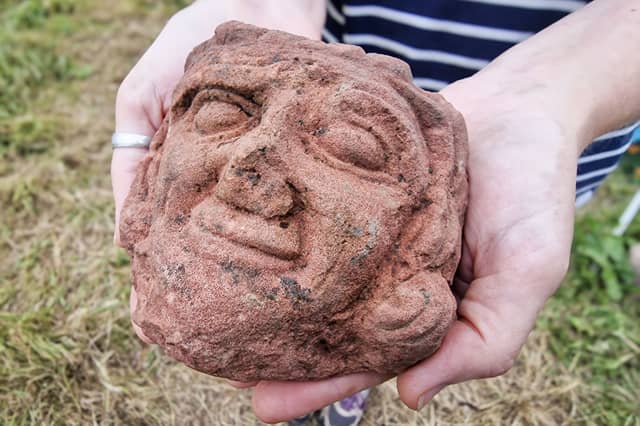

The head was found during an archaeological dig at Skaill Farm
A carved stone head found on a tiny Scottish island has been described as a “fascinating enigma”.
The head was found during an archaeological dig at Skaill Farm at Westness on Rousay in the Orkney Isles.
With its “beautifully carved locks of hair” and “real character”, the artefact is the latest find at the site.
It was discovered during the university’s annual summer excavation of the land at Skaill Farm.
Skaill Farm has long been of interest to archaeologists given its long timeline, with the site a hive of activity during the Norse Period, when it was home to Viking chieftain Sigurd of Westness.
The landscape features The Wirk tower and the remains of St Mary’s Church, both which have been linked to the Norse era and which were later added to during the medieval period.
Dr Sarah Jane Gibbon, of the UHI Archaeology Institute said the discovery of the stone head indicated that a “building of splendour” once stood nearby.
The head is similar to stonework found at St Magnus Cathedral in Kirkwall, which dates to the early 12th Century.
Dr Gibbon, one of the excavation co-directors, added : “This is such an exciting find.
“Over the years excavating at Skaill and The Wirk – the nearby hall tower – we have found several interesting, moulded pieces of red sandstone but nothing like this.
“The rich, red sandstone, with yellow inclusions, was likely quarried from the island of Eday and is the same as the moulded fragments from the nearby St Mary’s old parish church.”
“For now, the Skaill head must remain a fascinating enigma in terms of date, origin and use, but its discovery, along with many other fine pieces of carved red sandstone, as well as those built into the nearby kirk, strongly suggests a building of some splendour once stood in the vicinity.”
Rousay has often been dubbed the Athens of the North given its rich archaeological deposits, including at least 15 Neolithic chambered cairns, the earliest which dates to around 3,500 BC.
In 2019, archaeologists made a breakthrough at Skaill Farm after the remains of a Norse great hall, likely used for drinking and gatherings from the 10th to 12th Century, stood on the land.
The place name of Skaill derives from the Norse for hall and long suggested the area was home to a high-status site.
Following its discovery, the hall was linked to Sigurd of Westness, whose chieftainship of the area was documented in the Orkneyinga Saga.
Archaeologists found stone benches running down each side of the hall, which is around 13-metres long and runs down a slope towards the coastline.
The 13th century historical record documents that Sigurd of Westness was a friend of the 12th Century Earl of Orkney, Paul.
In 1136, Paul was staying with Sigurd at Westness when the notorious viking Sveinn Ásleifarson kidnapped the earl and spirited him away, leaving the Earldom open for Rognvald II to step in and take control.
Other finds from Skaill Farm include soapstone from Shetland, pottery and a fragment of a Norse bone comb.
The excavation is part of a wider project to track changes at the site from the late Norse period to the 19th Century, when the farm was abandoned during the Rousay clearances.
Comments
Want to join the conversation? Please or to comment on this article.