
Plans for one of the Borders’ largest commercial forests go to consultation
Campaigners warned the proposed forest will have a damaging impact the local environment and ecology as well as the area’s historical and cultural farming heritage.
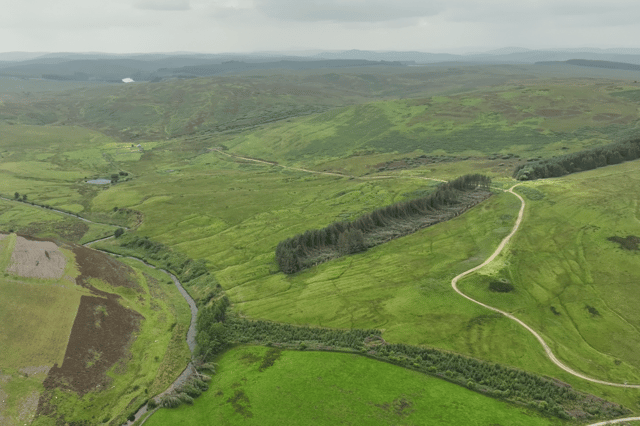


Plans for one of the larger conifer plantations in the Borders has gone under public consultation, prompting concerns about the spread of commercial forestry around a rural community.
The proposed Whitslaid development covers just under 500 hectares (ha) near Hawick. If approved, it would include 489ha of woodland, of which 479ha would be conifers and about 10ha broadleaf trees, according to the consultation paper.
When combined with the proposed legally challenged Todrig plantation next door, the developments would create almost 1,000ha of predominantly conifer forestry around the hamlet of Ashkirk. The Lilliesleaf, Ashkirk and Midlem Community Council (LAMCC) said would create the largest commercial forest site of its kind in the area.
Campaigners have raised concerns about the environmental impact of large-scale plantations dominated by non-native conifers, including on local black grouse populations. They argue that an over-reliance on spruce risks creating monocultures that could leave forests more vulnerable to disease, while concerns are also growing across Scotland about Sitka spruce self-seeding and spreading into land where it is not wanted.
Scottish Forestry, the Scottish Government agency responsible for regulating commercial forestry applications, said the Whitslaid proposals would comply with the UK Forestry Standard, which requires that no more than 65 per cent of a new woodland area is allocated to a single species.
It said Sitka spruce would only account for about 58 per cent of the plantation, alongside “a wide range of native and productive conifer tree species”. Other commercial species used in forestry include Norway spruce.
A spokesperson for LAMCC said it was difficult to see how forestry developments of this scale would benefit local communities.
“The proposed forestry will have a damaging impact on our unique Scottish southern lowland local environment and ecology as well as our historical and cultural farming heritage,” they said.
LAMCC also criticised the consultation and planning process, describing it as “confusing and opaque”, and said questions over tax incentives and the use of government funding to support forestry schemes remain unanswered.
It said the Whitslaid proposal needed to be considered alongside Todrig and another nearby application at Shieldswood, which it said would together create a “huge majority Sitka forest of around 1,000ha surrounding the hamlet of Ashkirk”.
Scottish Forestry said the purpose of the consultation was to allow local communities and other stakeholders to identify constraints and opportunities on the site before a final decision was made.
“If a proposal is approved at Whitslaid then the site owner would have to produce a management plan, setting out how they would ensure that open habitats remain free of any Sitka spruce regeneration in the future,” a spokesperson for the agency said.
Scottish Forestry defended the wider role of commercial forestry in Scotland, saying it provided sustainable timber, supported rural jobs and economic growth, stored carbon and could enhance biodiversity.
The controversy comes the Scottish courts ruled that Scottish Forestry had acted unlawfully when it approved a 579-hectare commercial plantation at Todrig, which was predominantly Sitka spruce, without requiring a full environmental impact assessment (EIA). The legal proceedings cost the public purse more than £100,000.
Scottish Forestry said the owner of the Todrig site was now carrying out additional survey work and that it expected a revised application to be submitted later this year.
The client behind the neighboring Whitslaid and Todrig forestry proposals is the investment management firm Gresham House, operating via the Gresham House Forest Growth and Sustainability Fund LP.
The consultation on Whitslaid remains open until 8 September 2026.
Comments
Want to join the conversation? Please or to comment on this article.