
‘Our fields have been torn up’: Crofters demand compensation as feral pigs run riot in Highlands



Campaigners have warned swelling feral hog populations could bring similar management challenges to the ongoing deer situation in Scotland.
Crofters and gamekeepers are calling on the Scottish Government to introduce compensation payments for damage caused by a growing population of feral pigs across Scotland.
The calls come after the Morrison family, who live near Fort Augustus in the Highlands, found their crofting land “torn up” overnight this month by what is believed to be a local herd of the animals.
The growing number of feral pigs, which are classified as an invasive non-native species, has raised concerns among rural communities and businesses over the past decade. NatureScot has warned that the animals breed prolifically and that, if left uncontrolled, their rooting behaviour can damage the environment and property, particularly agricultural crops and pig farms, as well as undermine efforts to control future outbreaks of animal disease.
Compensation funding is available to farmers and crofters when damage is caused by other species, including geese and sea eagles. However, no cash support is available when it comes to wild hogs.
Once extinct in Britain, the animals, believed to be hybrids of wild boar and domestic pigs, have made a resurgence in Scotland’s forests since the mid-1970s, probably as a result of a combination of accidental escapes and illegal reintroductions.
NatureScot estimates that the population is currently “in the low thousands”. However, recent modelling by researchers at the James Hutton Institute, King’s College London and the Zoological Society of London predicts a significant increase in the country’s wild boar population over the next 50 years, with hotspots expected to persist in the west Highlands, Dumfries and Galloway, northern Moray and Aberdeenshire, and Perthshire.
The Morrisons had only recently repaired damage caused by feral pigs in September, including reinstating a road and a car park, only for the animals to return and cause further destruction.
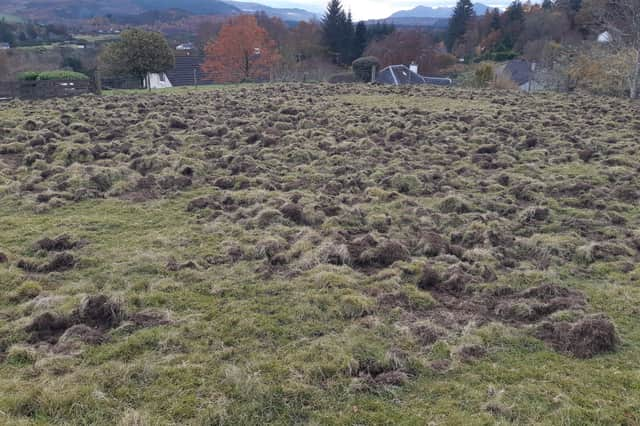
They now face the prospect of having to pay to restore their fields, with large areas likely to require rotavating and complete reseeding to provide grazing for sheep.
However, the crofters said they are unsure whether, or when, to undertake the work, given the likelihood that the pigs will return and undo their efforts.
The animals are understood to have emerged from nearby Forestry and Land Scotland (FLS) ground. The Morrisons said they have overseen the installation of new fencing, but the pigs can dig underneath it, creating breaches as they seek access to pasture at dusk in search of worms and roots.
NatureScot has said that managing the species is the responsibility of individual landowners. However, the Morrisons are questioning whether that position remains fit for purpose when landowners have tried, and failed, to contain what they see as an escalating problem.
“It’s very disheartening and frustrating,” said Ina Morrison, 83, who has witnessed up to six young adults and larger adults rooting through the field at one time.
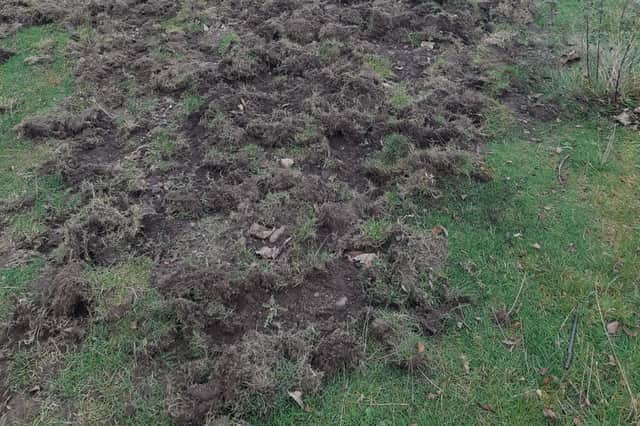
“We’ve got new fencing around the fields but they can just dig underneath. I am not sure asking landowners to manage the problem is the answer when there’s not much you can do. I do think there should be compensation because it is not going to be cheap to fix this.
“With some of the damage, it is even hard to walk over it, they’ve dug it up so much. I reckon 50% of the field behind our house has been dug up. In the other two fields, it’s bits here and there. Our next door neighbours have had problems as well.
“It started about the beginning of September, with one or two bits, then we basically had an explosion in all the fields.”
About 15 years ago, the Scottish Gamekeepers Association warned of rising feral pig numbers in Scotland, arguing that delays in controlling the population would create problems in the future.
Since then, numbers have increased sharply around Fort Augustus and Invergarry, despite some localised management.
Retired stalker Lea MacNally, who has witnessed the growth in local numbers, believes compensation should be considered. He said both NatureScot and FLS had been made aware of the latest incident near Fort Augustus, but no action had followed.
“Best practice guidelines need to look at this situation again,” he said.
“If it is a landowner’s responsibility and they take measures to prevent damage, yet damage still occurs, how do people work with that, going forward?
“Rectifying the damage to the fields in Fort Augustus will not be easy. These are fields, on a registered croft, that are actively farmed that now can’t be used.
“Farmers receive compensation for sea eagles taking lambs and can receive payments for damage by geese. Feral pig problems are beginning to come the fore now because populations in this area have been building for over a decade so surely compensation can’t be off the table.”
A spokesperson for FLS said: “We continually monitor feral pig populations, including through engaging with our neighbours and members of the public and running best practice events for local managers and property owners to help with their control plans.
“We are also hosting ongoing PhD research at three sites within the Great Glen, in a bid to help build a more comprehensive picture of the population level and the distribution of these animals to better inform our culling plans. So far this year we have culled 12 feral pigs in the Fort Augustus area.
“As with deer, nobody owns the feral pigs, and it is for each land manager to control the animal as and when they appear on their land in order to minimise the damage they might cause.”
NatureScot said it continued to urge land managers to control feral pig numbers.
A spokesperson for the agency said: “To assist with this, NatureScot and FLS have developed best practice advice and provided training to help land managers do this safely and humanely.
“Along with other public sector partners, we will endeavour to support land managers in their control of feral pigs. Currently, there is no funding available to compensate for damage and this would be a matter for Scottish Government to determine.”
Earlier this year, Highlands Rewilding, a rewilding company, carried out its first feral pig cull on Bunloit Estate near Inverness after reporting “a significant rise” in local populations. Staff on the estate said the growing number of roaming animals had caused “particularly heavy disturbance” to local habitat.
The Scottish Government has been contacted for comment.
Comments
Want to join the conversation? Please or to comment on this article.