
Hay's Way: Hard to remain a mere passing visitor on Jura



Katharine Hay finds herself immersed on the island
The ferryman raised a hand to usher me off the boat, but the car refused to start.
There is something uniquely embarrassing about having to leap out and fiddle under the bonnet while a queue of passengers waits behind you. Especially when you are on a small ferry to Islay, driving a borrowed vehicle and attempting to look as though you know what you are doing.
I was on my way to run a few errands for residents I have met while staying on Jura. MOTs aren’t required for drivers on some of Scotland’s islands, I imagine because garages are simply few and far between. It means some of the cars, including the one borrowed, while drivable, can be a bit more temperamental than those on the mainland.

Since arriving on Jura a couple of weeks ago, I have found myself increasingly immersed in island life, thanks largely to a community whose warmth and generosity have made it difficult to remain a mere passing visitor. What was intended to be a week or so walking up the island as part of Hay’s Way has become a stay of several weeks, with various opportunities to muck in, from manning the island’s sauna in return for free sessions, to picking up medicine a ferry ride away at the nearest vet for 16-year-old canine Jura resident, Tess.
A huge part of meeting islanders came with arriving in time for the Isle of Jura music festival, an event that marks the end of the summer for the islanders, or Diurachs as they are known as.
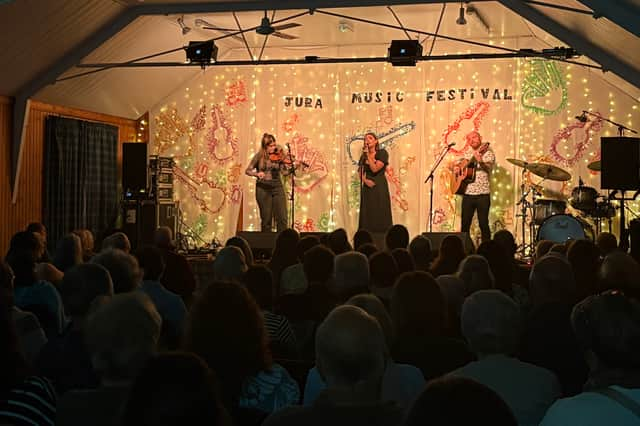
A particular highlight was Islay musician Mairi McGillivray, who performed Gaelic songs from her debut album, Mo Thìr. One song, Starlings, spoke about the nearly lost love between her Ileach - resident of Islay - grandparents. Separated for work reasons, the pair promised to write to each other but while apart, the mother-in-law kept the letters and destroyed them. Luckily the couple found each other again and went on to share a life together.
The festival’s appeal also lay not only in the foot-stomping music of Archie McAllister but in the chance to meet so many islanders in one place.
Jura’s roughly 200 residents most line the eastern part of the island, which takes between an hour and a half and two hours to head from south to north by car, along a 27-mile single-track road studded with grassy tufts and punctured with potholes. Progress is frequently impeded by the island’s more independent road users, the deer, who either wander casually in front or stand and stare at you for a while. The occasional herd of cattle sometimes swagger in front of vehicles, lumbering along like they don’t have a care in the world.
There is also a landowner’s tongue-in-cheek sign warning visitors to slow down and look out for ‘the three-legged deer.’ I still haven’t worked out whether this ‘beast’, as the stags are often referred to as, exists or not. But maybe that is deliberate so as to keep the joke for gullible visitors like myself going.
Another elusive creature, who may or may not exist, is a lone goat called Raymond on Eilean nan Gabhar, a small island that sits off Jura’s east side. Historically used for grazing livestock, it takes its name from the Gaelic for Goat Island. Whether Raymond is a genuine resident or an invention designed to entertain the locals is, for now, another of Jura’s unresolved mysteries.
Jura itself is home to a herd of about 500 wild goats. There’s an ongoing myth (another one) that these shaggy horned beasts swam ashore from wrecked Spanish Armada ships in 1588. I put the story to a scientist I interviewed this week about his leading work on a project investigating the history, genetics and evolution of St Kilda’s wild Soay sheep. There followed a deathly silence at the other end of the telephone, before a deeply unconvinced “Umm …”
In Scotland, wild goats have the same status as deer. On Jura, this means they can occasionally be shot during deer-stalking trips on the hill, a pursuit that remains one of the island’s principal attractions. I overheard one guest, who had been unsuccessful in shooting a stag, reflect on his options.
‘Well, I guess I could go and shoot a goat,’ he sighed.
But the island is, as its head stalkers put it, ‘the mecca’ for stalking stags in Scotland. After all, Jura, derived from Old Norse Dyray, means deer island. And during the rutting season it is not difficult to see why. Each day, stalkers and their guests head out to scale the island’s towering ridges in pursuit of stags, while the roar of rutting males carries across the landscape.

The sheer number of deer is striking, whether grazing on the sweeter ground lower down or moving through the high ground across the wilder interior of the island. The stags, in particular, are not merely an occasional sighting but an overwhelming presence. The symphony of their roars at this time of year is an experience to behold on Jura.
On much of mainland Scotland, deer numbers are being reduced by the thousands to protect woodland regeneration and support tree planting. Jura, by contrast, retains a healthy herd whose numbers far exceed those of the human population. The ratio is roughly 30 deer to every resident.
But even here, pressure is mounting to reduce the herd further, beyond the culling already undertaken by stalkers. This includes selecting old or sick animals, as well as stags with so-called switches - antlers that have developed with few or no points and can pose a serious danger to other deer - to keep health in the herd.
As ambitious environmental policies gather pace, traditional stalking — a significant source of employment on the island and income for the estate — has started to slip down the list of priorities for some estates. In its place, wildlife tourism is gaining ground, with visitors paying to spot Scotland’s so-called Big Five, including sea eagles, otters and red deer.
It’s certainly a time of change for those who have been working the hill for decades. Some stalkers told me that their jobs would, in effect, be rebranded as wildlife guides.
One local, observing the shift in what has been Jura’s raison d'être for decades, joked: “Best the photographers know deer don’t have any front teeth for smiling at the camera.”
Comments
Want to join the conversation? Please or to comment on this article.