
Hay's Way: Buoyed by an unexpected crew on the banks of a west coast loch
How instructors are making a difference in the lives of children and young adults through the great outdoors



Rolling down a steep track, my feet heavy as boulders, I arrived in Lochgoilhead with a splat.
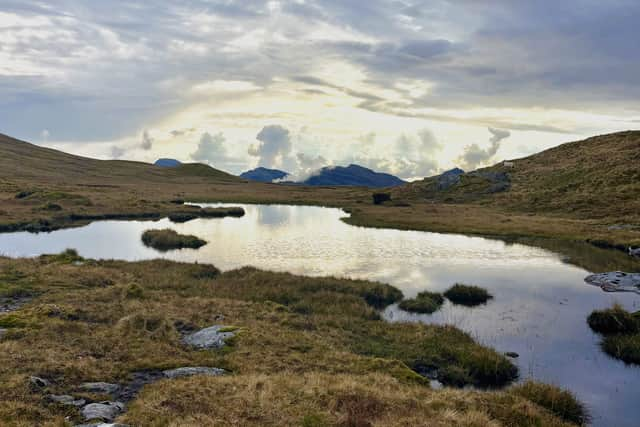
The village sits on the rugged Cowal peninsula at the head of Loch Goil, a still, striking sea loch that feeds into Loch Long. Until now, the walking had not been especially strenuous. The route through Scotland’s central belt and around Loch Lomond has been relatively gentle.
But as I entered the depths of Argyll and Bute, the climbs have become steadily more frequent. And steep.

The challenge this last week though was not only physical. Last weekend I hit something of a mental wall. Hay’s Way can be intensely sociable—at times overwhelmingly so. The regular cycle of listening, sharing, talking and writing can leave a craving for silence at times. The walking project is about looking outwards to document the rural landscape and those living within it. But it also, at times, fits with the philosophy of walking championed by figures such as Nietzsche and Robert Louis Stevenson—the idea that walking offers an escape from the ‘chatter of life’ and a chance to let ideas come. Fortunately, that is still something to be found when moving from village to village.
Yet I realised, too, what comes with making connections ‘on the road’ is a string of goodbyes, which I find difficult. There’s an element of interactions while on the move that can feel a bit superficial because they are just fleeting. But some connections linger, and moving on from them can be unexpectedly hard. Some strangers seem to know how to fill that void that can open when missing friends or family.

But it wasn’t long before this mental dip of mine was buoyed by an unexpected crowd: a local scout camp in Lochgoilhead.
In search of a shower and somewhere flat to sleep after a night spent awkwardly on tree roots and a slope, I wandered to the outdoor education centre to ask whether I might pitch my tent nearby. Within minutes, senior instructor Dalton Moore had offered me a bed in one of the camp’s hobbit-hut-style pods. Perhaps my exhaustion was harder to conceal than I imagined.


After excusing myself to go and have a much-needed nap, I heard a gentle knock at the door. It was another scout instructor, Liam Watson, handing me a wristband to enter the village’s once-a-year Live in Loch Goil festival which happened to be on the day I arrived.
As he fastened the band around my wrist and talked enthusiastically about the line-up still to come, I felt my eyes heat up at yet another kind gesture. The door closed and my tears wet the soft, longed-for pillow as I drifted off to slumber.
Scout Adventures Lochgoilhead, which celebrated its 60th anniversary last year, doesn’t normally open up its doors to wayward ramblers coming off the hill. It partners up with the festival to accommodate visitors and musicians at the community event, which saw headline act Beluga Lagoon play this year.
It was interesting talking to the scout instructors and hearing about the difference in the children and young adults they welcome onto the site. The camp, within about 50 miles of Glasgow, has a large catchment area stretching from the Central Belt to west coast islands including Jura and Tiree.

“We just had one pupil come over and join from Coll last year,” Mr Watson said, highlighting the fact that they try not to miss out on anyone.
The scout leaders said they noticed a massive difference between pupils from the more urban areas of East Renfrewshire and Prestwick to islander children. Mr Moore described the latter as “hardcore.”
“They are all farmer’s or fishermen’s kids,” he said.
“They just know the drill.”
The scout instructor recalled one exercise in which children were asked to build sandcastles while thinking about the engineering principles behind them. One seven-year-old girl from Jura, the daughter of a ghillie, devised what he described as an “entire empire”.
“She planned out a castle, a quarry for dry sand, another for wet sand, roads, a farm,” he said.
“It was surreal to watch, seeing someone so young think like that and take it all on board.”

Mr Watson, who doubles up as a local firefighter for two fire stations across the west coast, spoke about an emotional reunion between a teacher and her pupils from East Renfrewshire when they returned after spending a week at the scout centre.
“She was really worried about them going to secondary school,” he said.
“They were primary 7, but she said they had the mental age of primary 1 or 2 and that they were really going to struggle.
“But the difference the week here made. She was literally in tears.”
The scout leaders said some of the young people who venture to Lochgoilhead had never seen hills before. When it is time to pack up and go home, they said there’s a chance some children will never see the vast expanse of Scotland’s rolling landscape ever again. It was a sobering conversation, and one that brought perspective to my own experience. It also brought with a desire in me to promote outdoor education.
In the two days I spent in the village, just going for a coffee with the two scout leaders became a small adventure in itself. It involved a boat ride across to The Boatshed, a cafe on the opposite side of the loch. On the way back, they let me take a turn at the wheel of the RIB — something I had never done before. Far beyond my Duke of Edinburgh and scouting days, they still managed to make a difference to me.


The people I meet and speak to along the way don’t always make headlines, but you can meet them through my free, weekly newsletter. It’s really easy to sign up - simply go to the ‘newsletters’ tab on The Scotsman’s website and click on the option to sign up to the Hay’s Way/Scotsman Rural weekly newsletter. You can also follow my Instagram page: @rural_kat for more visual updates. And you can keep up with rural affairs daily news on The Scotsman under the section Hay’s Way.
Comments
Want to join the conversation? Please or to comment on this article.