
Cow collars to help walkers navigate livestock and boost sustainable farming backed by Scottish Government

Applications for funding to purchase the collars opened for farmers this week.
Cow collars used to boost sustainable farming practices and alert walkers to where livestock are roaming have been given financial backing by the Scottish Government.
The Future Farming Investment Scheme (FFIS) in Scotland is providing funding for farmers to purchase Nofence virtual fencing systems for their livestock, said to be the world's first of its kind for grazing animals.
The system includes collars fitted to cows which give out a short low level pulse, similar to an electric fence, when the animal reaches a virtual boundary created by the livestock owner. Cows are said to quickly learn the extent of their new boundaries and to avoid approaching the "virtual fence line" again.
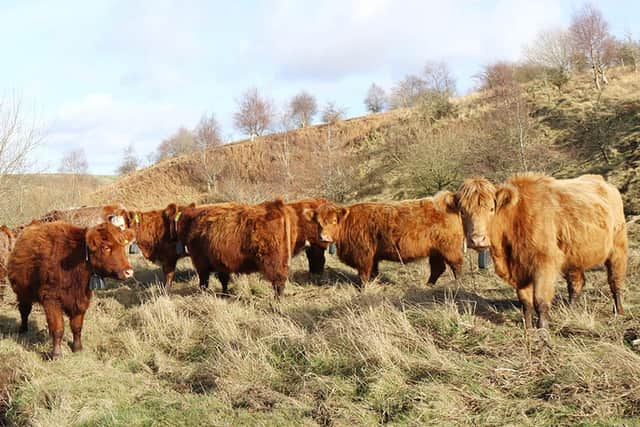

Applications for cash to purchase the technology opened this week.
Nofence, the Norwegian company behind the virtual fencing ystems, said the collars are also connected to an online tool for walkers to use to see where livestock are grazing.
For farmers, the collars are said to help lower cost inputs, improve animal welfare by removing risk of problems with fences and help protect sensitive habitats.
Using the technology also helps remove labour-intensive tasks, bringing greater flexibility for farmers.
For Rory Fyfe, who leads the Rewilding Kinkell Project and manages Kinkell Byre, an integrated farm wedding venue near St Andrews, Nofence virtual fencing technology has opened up new possibilities – not just for farming, but for community, ecology, and education.
This is, in part, due to virtual fencing opening access to ecologically valuable landscapes that would normally be impossible to fence.
These include areas such as steep slopes, coastal paths and some woodlands.
Mr Fyfe said: “The collars have worked very well for us. They make it easy to manage the cows and move them around, which is crucial in such a complex landscape with cliffs, paths, and public access.
“And the public can now see where the cows are through an online access tool, which has been great for local walkers and visitors.”
Farmers in Scotland can apply for grant support to purchase Nofence's virtual fencing systems, with up to 100% funding available for eligible investments.
Applications for the FFIS opened on Monday this week and will close on 22 August 2025, with full details on the Scottish Government’s Rural Payments and Services website.
A spokesperson for Nofence said: “The FFIS represents a major step by the Scottish Government to support farmers in making confident, forward-looking investments in farming.”
Founded in Norway in 2011 by goat farmer Oscar Hovde, Nofence is said to be the world’s first commercial virtual fencing system for livestock serving as a sustainable alternative to traditional fencing.
The animals’ grazing areas are managed using a GPS collar, which communicates with an app using a mobile network.
When the animals cross the virtual boundary, an escalating acoustic warning is played. If they ignore the sound they will get a light electrical pulse. Nofence said the animals learn this quickly in their training period of up to a week depending on variables like the breed and the age of the animal.
Comments
Want to join the conversation? Please or to comment on this article.