
'What will become of her?' - the pupils who refuse to go to school
School attendance remains below pre-pandemic levels - and for some pupils, the challenges of getting to class are complex and often painful, writes Catriona Stewart

Alexa, 13, will not go to school.
She has been cajoled, admonished, bribed and outright threatened.
On a day here and a day there she will get as far as the carpark. One morning she made it into reception.
But it was too much and she went back home. When her parents or her teachers ask her why she won’t go to school, Alexa is largely non-committal.
She cites anxiety, fear, but cannot articulate a clear root cause.
Her mum, Julia, 42, and dad Robert, 43, simply don’t know what to do.
“I look at her,” Julia says, “And I am afraid for her future.
“We are fortunate in being able to afford private counselling but, to be honest, it hasn’t done what I hoped it would.
“I feel now I’m moving to a place where I have to accept that Alexa’s not going to achieve what we thought with her education.”
Alexa’s attendance began to decline at the end of primary seven. She had a successful transition to S1, with a reduced timetable and holistic supports.
However, she began to refuse school again very quickly and has barely attended over the past six months, summer holidays nothwithstanding.
Julia, who has asked to use her first name only and Alexa’s middle name, wants to make clear that they are an aspirational, middle class family. And that they are at their wit’s end.
National picture
School attendance has become a hot issue in Scottish education.
While Scottish Government figures show attendance is up slightly year-on-year, it is still well below pre-pandemic levels.
For persistent absence, like Alexa’s, the pattern is the same.
International PISA figures published earlier this month showed Scotland’s attendance rates to lag behind our nearest neighbour.
Scottish pupils were almost twice as likely to skip class than English, with 4.1 per cent admitting they had failed to turn up to a lesson “three or four times” in the two weeks before the survey, compared with 2.5 per cent of their English peers.
The results prompted Professor Lindsay Paterson of Edinburgh University to say “school attendance in Scotland has become optional”.
The aftermath of covid
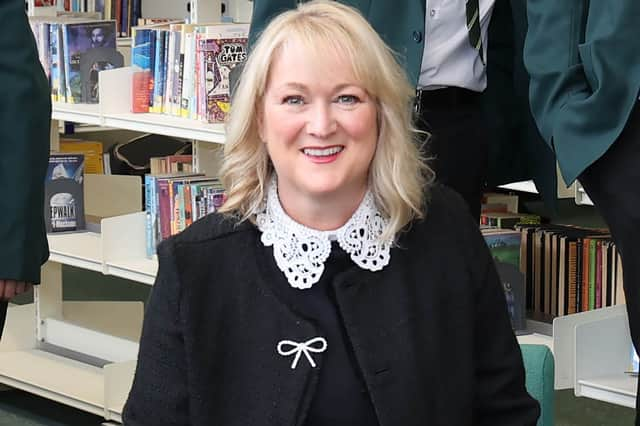
Lorna Lawson, head teacher of South Lanarkshire’s St John Ogilvie High School, has been teaching for more than 30 years.
“I’m sure you’re not going to be surprised at this but the pivotal moment was covid, and the decline after covid,” Mrs Lawson said.
“Prior to that, society believed you had to go to school. You absolutely had to and no one really broke away from that.
“Covid was the watershed moment where people realised there were other alternatives.”
She also recognises the description of children like Alexa.
“In your own school days,” the head said, “I’m sure you don’t remember people talking about anxiety as a reason not to be at school but that is absolutely massive now.”
Mrs Lawson is clear that there are multiple factors at play and, particularly in her catchment area of Hamilton, poverty is a barrier.
Poor diet, poor housing, cold in the winter - “these would drain any human being,” she says.
But parenting has also changed.
“Parenting is entirely different to what I would know in my earlier teaching career,” she added.
“Parents before would have been very much, ‘You’re going to school’.
“I'm not saying that's right or wrong. But it’s different nowadays, there’s a lot more listening and taking on board their opinions that we wouldn’t have had even 10 years ago.
“I think there's a lot of parents who really struggle to push the young person before something becomes entrenched.”

No stigma
Julia would say she has pushed Alexa to attend school. Her employer is unsympathetic about her family situation but her husband was able to take a six- month leave of absence from work to be at home with their daughter.
The advice is not to chide but to be nurturing.
Certainly one of the guiding principles of St John Ogilvie is to ensure there is no shame or stigma around non-attendance.
Staff are “super welcoming” and avoid questioning why the young person was off.
Teachers work very closely with parents and talk about the wider impacts of non-attendance - the loss of socialisation, say, as much as learning.
St John Ogilvie’s has particularly targeted pupils from SIMD1 and SIMD2 - the most socio-economically deprived groups - to raise attainment.
A mentoring programme improved attendance by up to 13 per cent.
Mrs Lawson says she feels for the parents whose children are school refusing.
“If someone is suffering from that level of anxiety that they can’t get across the door, that is actually really distressing to witness,” she says.
“Parents love their children and the torture it puts them through … it’s very difficult for them, they’re not experts and they can’t think of anything else to do.”

Chronic non-attenders are taught in a base that takes six to eight pupils at a time - sometimes even just for a couple of hours to have them in school.
“You have to have a lot of empathy and you have to have a strong moral compass not to abandon people just because they are not going to give you any kind of return in your figures,” Mrs Lawson said.
“It’s entirely different targets for these kids and you have to just value that and and value what they do contribute.
Protective environment
Also in South Lanarkshire, one of Mrs Lawson’s primary school colleagues, Pamela Kelly, has been working to improve attendance too.
Mrs Kelly, headteacher of Neilsland Primary School, has seen overall school attendance rise from 91.8 per cent in the 2021/22 session to 94 per cent in the 2025/2026 session.
The council uses the BEAM Project - Building Engagement, Attendance and Motivation - which saw an average 0.8 per cent attendance increase across the targeted group, with individual pupil improvements reaching up to 2.3 per cent.
Mrs Kelly says one of the crucial steps is to remove barriers to attendance while keeping expectations high.
“We are ensuring every pupil can fully participate in school life with dignity, pride and zero stigma,” she said.
“We’re building a protective environment so pupils do not feel poor or carry financial stress into the classroom.”
Neilsland Primary School gives free school uniforms, casual clothes, Christmas jumpers and Halloween costumes to pupils and all in-class learning resources are supplied, as are snacks.
Hamilton Foodbank provides an in-school food bank service while pupils can shower at school and use a washing machine.
Fridays saw the highest absence rates across the school so now pupils take part in Friday Fun-Fitness Club, which has seen a boost in pupils turn up to class.
Mrs Kelly said: “By relieving financial pressures, providing basic essentials, and building trusting relationships with families, the school eliminates common non-attendance triggers linked to poverty.
“This protective environment is directly credited as a driver behind the school's consistently high and improving attendance rates over the past five years.”
In 2024/25 some 28.5 per cent of pupils were persistently absent, meaning they missed at least 10 per cent of the school year, or equivalent to at least 19 full school days.
That is down from 31.4 per cent for 2023/24 - but still a significant rise on the pre-pandemic figure of 21.8 per cent.
Cost of the school day can be a factor in low attendance so the council’s tackling poverty team plays a significant role in supporting families.
It can help with anything from uniforms to food.
Pupils are also supported during school holiday periods with St Andrew’s High School in Coatbridge, North Lanarkshire, delivering 240 meals on Christmas Eve and giving hampers to families to help over the holiday period
Family engagment support assistants can also go out and knock doors and work with parents and carers to try and overcome the challenges.
Outreach services such as forest school can provide a way to link pupils back into education for children who don’t adapt to the traditional curriculum model.
James McParland, Chief Officer for education at North Lanarkshire Council, says the profile of young people who refuse school is very complex.
“In days gone by, the perception of young people with problematic attendance was one where you automatically reverted back to a stereotype or demographic that no longer exists,” he says.
“It can be anyone, in any shape or form.
“ Poverty proofing is not always financial.
“Poverty proofing can be as much emotional, or as much about the mental health supports that are required, because that may be where the gap is.”

He says there is no quick fix and resilience is needed from both parents and professionals with “a smile on your face”.
Some tough love is useful too.
“Is there a need to re-evaluate where the boundaries are?,” he says.
“Is there a need to have the little bit of what I used to refer to as a head teacher, the parental nudge that the path of least resistance is not always always the best?
“There comes a point, you know, tough love can be required, but it's very much about doing that with open arms and having that supportive ethos that underpins everything.”
Barry Syme is the principal educational psychologist for Glasgow City Council.
He calls apportioning blame or blaming parents around attendance, a “very simplistic” and “very traditional” way of considering the issue.
Of course it is parental responsibility to get the child to school but the situation is more complex.
“It’s not that we condone absence,” he says. “Most of the parents we see or work with have done absolutely everything they can to get their child to school.”
The “big stick” approach and threats of prosecution are “just a total waste of time”, he says, referring to a preferred “relational approach”.
The statistics bear it out. An analysis of the figures around 10 years ago when the council was taking parents to court showed a four per cent deterioration in attendance following the legal process.
Mr Syme says: “I think young people do want to come to school.
“I think they want to socialise with their peers.
“But I think schools, the environment, is a real challenge for some, particularly neurodivergent young people, in terms of the sensory profiles that we're seeing, the kind of large school, the environment, the noise.”
Quiet space is important. As is making sure the curriculum works for all young people.
Mr Syme says the impending curriculum review must not conflate being physically in school with being engaged in school.
“The idea of just coming in and getting into classes and going through an eight period day, those days are passed. We need to be thinking differently,” he adds.
The psychologist says social media causes complications in a variety of ways.
For one, young people will have looked up their perceived symptoms online and come to him saying ‘Is there something wrong with me?’
He explains that between 12 and 16 is a huge time for young people, particularly as the brain develops, particularly with modern pressures on teenagers.
Mobile phones mean that bullying is not just confined to specific times or locations but an ever-present danger.
His advice to head teachers is to ensure that when a young person walks into school they are welcomed and the fact they showed up is appreciated.
“We may well be the first person who’s actually recognised their effort that day,” he adds.
Some schools in Glasgow now station a senior teacher or the campus police officer - or both - at the front gate in the morning to give an enthusiastic welcome.
Mr Syme calls government attendance statistics a “really dumb measure”.
Percentages are essentially pointless. Instead, there should be a focus on targeting specific groups who are more vulnerable to drop out.
Second and third year girls within some of the secondary schools, Mr Syme says, have questionable attendance rates.
Transition points - from primary to secondary or junior to senior school - are tricky.
“What we are saying to schools in Glasgow now is, right, you are authorised to put more work into those groups and we’re not going to lose sleep over the numbers,” he says.
Meanwhile, mum Julia says she has not been offered anything like the supports outlined by the councils in this piece.
She and her family feel abandoned.
Mrs Lawson says she has been aware of families such as Julia’s.
“The parents have done everything they can, the school is doing everything it can and you know the parents are looking at the child thinking, ‘What is going to become of you?’,” the headteachers says.
Comments
Want to join the conversation? Please or to comment on this article.