
Sounds of 'most privileged' education at Scotland's only music school as it looks to bring more talent in
The only school of its kind in Scotland, St Mary’s is preparing the next generation of young classical musicians

Under a vaulted ceiling the young violinist is being subjected to forensic scrutiny of his performance technique.
His phrasing, his vibrato, his gravitational awareness - all dissected.
The orchestra that will accompany this St Mary’s Music School pupil when he plays at St Cuthbert’s Church, Director of Music John Cameron says, is “an absorbent organism”.
“Your line,” he tells the soloist, “has to be the one that's bejewelled and intoxicating.”
Mr Cameron turns to the rest of the class. “He relies on them entirely,” he adds, “But he has to beautify everything they do.”
This is a performance class at Scotland’s only dedicated music school and the scrutiny is not coming from the teacher but from fellow pupils.
Following the solo performance on violin, each youngster has to give constructive feedback on their classmate’s efforts.
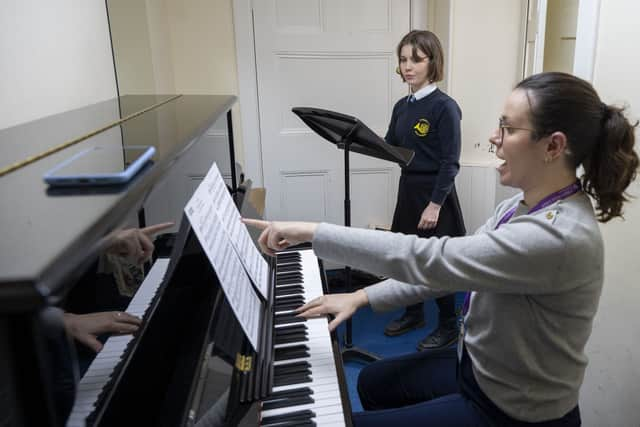

This builds confidence and resilience and fits the ethos of the school, which is to prepare talented young musicians for a life of performance.
Head Kenneth Taylor - originally a physics and chemistry teacher - has been in charge of St Mary’s boarding school for 13 years.
His office is lined floor to ceiling with cassettes, multiple bequeathments from late school supporters.
Pupils will come and borrow from the library of hundreds of tapes. Dr Taylor doesn’t bother collecting LPs - he dislikes the “romantic attachment to ambient noise” or what others might call the scratch of needle on vinyl.
“This school wouldn't be here if it wasn't for philanthropic giving,” the head teacher says.
St Mary’s is a private school as its 74 pupils are enrolled on talent, not ability to pay.
Or, as Dr Taylor puts it, “We don't educate rich children, we educate musically talented children.This is an exceptional education, the most privileged education.”

Its funding model, therefore, is unusual in that the Scottish government will cover the school fees following means testing.
There is still a gap to cover the costs, so charitable giving is vital.
The school also educates the choristers of St Mary’s Cathedral, aged from P5 to S2, who can be seen walking to morning rehearsals and back again for evensong.
Dr Taylor has been in post for more than a decade because, he says, “the commitment of the teachers and the motivation and enthusiasm of the pupils makes it a very difficult place to leave.”
There are very few full time members of staff and several have dual roles.

Class sizes are tiny compared to the state sector - the largest class is 12.
Alongside intensive music tuition they take a full range of Highers and an A level in music - the English qualification is more advanced - but there are no vocational subjects on offer.
“Music is their vocation,” Dr Taylor adds. “We take them on ability, but they must also want to share the music, they need to want to play to other people, and we take the business of performing very seriously.”
Everyone from S1 onwards at St Mary’s has their own personal accompanist to work with.
There are lunchtime concerts where pupils, who come from around Scotland, play to the rest of the school and any interested parents.
The school is trying to be more outward facing and is running a program it calls St Mary's Music School on Tour, travelling around Scotland and the north of England.
Pupils play at St Columba’s Hospice once a term and staff are building links with their counterparts at Edinburgh’s Big Noise orchestra.
“We're more outward looking than we were,” Dr Taylor says, “And looking to connect with other organisations.
“We’re also bringing in professional musicians from around the UK to run masterclasses.”

The masterclasses, organised by Mr Cameron, are also open to young people from other local authority schools.
It is a highly specialised and privileged education and the school must ensure its pupils are the correct fit.
Rebecca Minogue, head of admissions, says she is constantly asked what grade young people have to achieve to attend.
But that’s an irrelevance and the wrong question entirely. “We’re looking for musical talent and passion,” she says.
First they send an inquiry application - a recording of a performance.

Ms Minogue added: “What we were finding in the early days was parents were putting children into an audition situation, and there was no way they should have even been in the room.”
The application stage is layered and complex - it includes a two-day stay in the boarding house, an auction and ear tests, with the would-be pupil attending classes and joining the choir and orchestra.
Some applicants are turned off when they hit the reality of daily St Mary’s life - but others can’t get enough.
Ms Minogue said: “There’s an awful lot of parents who think their child's wonderful.
“But our job is to work out whether the child, the pupil, wants this.
“Pretty much get it right, because it's such a rigorous audition process.”
Children come from state schools but, Ms Minogue said, those who apply from private schools are “the real high fliers” because they already have access to good music tuition.
They just want nothing but music.
There are international students too but fewer from Europe since Brexit and the resulting loss of funding.
As part of its bid to be more outward-facing, the school also runs Saturday music classes for more than 150 children aged four to 14.
Ms Minogue said: “What that does is it really opens up the school right at the grassroots level.
“We also had an instrumental taster day so we're getting children from absolutely every demographic because they're wanting a good education.”
Back to the performance class, and Mr Cameron is encouraging his pupils - who range from primary age up to 19 - to speak frankly.
He says: “The music world is not for the fainthearted. It's not for those who want to dabble and not push any harder. It's dog eat dog.
“So we have to prepare these guys. If that’s what they want to do then they have to heard some less comfortable, unpalatable truths.”
Some St Mary’s pupils will leave the school and go on to entirely different careers.
One girl is preparing to study engineering at university, deciding music is not for her after all.
Many go on to feted international careers, all with the solid grounding of the St Mary’s programme.
“I push them,” Mr Cameron adds. “It is a tall order for some of the young ones to critique the older students because they look up to them.
“But I always question when they say something like, ‘It’s very nice’ because I want them to think a little further than that.
“I find the little ones are very good at saying things that are not rude but cutting, accidentally humiliating.
“Nothing cuts you down to size than a nine-year-old telling you that you can’t play a tune.
“Fortunately, most of ours really can.”
Comments
Want to join the conversation? Please or to comment on this article.