
Excluding rowdy pupils in Scotland's schools might be a quick fix - but it only causes worse damage
Report after report details the fears teachers have about unrest in Scottish classrooms - but excluding pupils without an alternative education option is not the answer.

The overarching theory is simple - and correct. A child must be in school to be learning.
It’s entirely understandable that the default position for Scotland’s schools is that exclusion should only be used as a last resort.
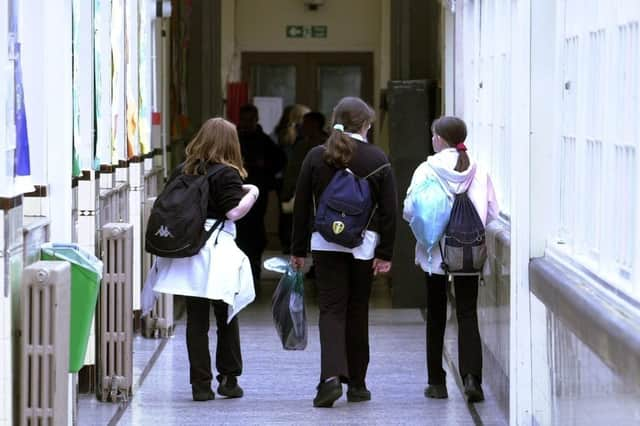

Exclusion from school is linked to poorer outcomes in adulthood - worse job prospects, offending in later life, substance abuse and poor mental health.
Previously, barring pupils from schools was a “reflex”, the former director of education for Glasgow City Council once told me.
Maureen McKenna, now retired, was passionate in her campaign to reduce the number of city young people missing school, whether excluded or truanting.
She was an early adopter of trauma-focused practice and mandated that head teachers in her schools should take a pupils’ home circumstances into account when disciplining them. All behaviour, goes the mantra, is communication.
This position has become the Scotland-wide position - keep pupils in school at almost any cost.
It’s worth noting that exclusions disproportionately affect children and teenagers from the most difficult home backgrounds. The most recent figures show the number of care experienced young people formally excluded from school is almost six times higher than the levels seen in the broader pupil population.
Exclusions come in various guises. The Promise, the legal framework aimed at making life more equitable for looked after and accommodated people, contains a commitment that “all formal and informal exclusions of care experienced pupils would end”.
Formal exclusion is when a young person is removed from school for behavioural reasons. Informal exclusions come in the form of reduced timetables - ostensibly to support the young person with, for example, improving behaviour or helping them increase their time in school if they’ve not been attending.
There are concerns these reduced timetables are a sop; a school has a pupil they simply can’t do anything with and so a reduced timetable is an excuse to see less of them.
It also does no harm to a school’s attendance figures as the pupil will still be registered as full time.
There was much praise for Glasgow’s record on reducing expulsions under Mrs McKenna’s tenure - as there has been for the drop in exclusion numbers Scotland-wide.
Over the past six or seven years, however, teachers complain about the ramifications of this policy.
One teacher in Glasgow’s east end told me her school had young people in school, but merely roaming the halls, unwilling to partake in class and with teachers unable to compel them.
If senior management won’t exclude these pupils, then there are few options other than to have them physically in the building. But then what?
Report after report - such as the Commission on School Reform on Monday - cites growing teacher fears of violence and increasing unrest in Scottish classrooms.

The latest School Leaders Scotland survey, which The Scotsman reported on last month, detailed the serious concerns teachers have about safety.
What struck me most about that report was the concerns teachers have about verbal abuse from parents, not just young people.
The commission’s report reflected on the same issue. It went further, citing a problem with “entitled” children and the need for head teachers to increasingly use exclusion as a punishment.
My mother still has her Lochgelly tawse in a box. She swears blind it was never used, but, as a teacher who began her career in 1965, every classroom had one.
If you don’t know what I’m referring to, that’s probably all for the best.
We’ve come a long way from the days of three-of-the-belt as a response to giving Sir or Miss a bit of lip. Instead, schools might use restorative justice to try to correct the misbehaviour of a teenager.
While this can often work well, some teachers label the system a nonsense. Some young people are simply not able to sit down and work out their problems with an explanation and an apology. You can see why it would be tempting to take a hard line on misbehaving young people.
Yes, increasing exclusions would ease teacher stress. Yes, it would be better for the learning environment on other pupils.
But that’s too simplistic. Children and young people faced mass trauma during the pandemic and there has been no concerted recovery plan to help them back into education - they were simply expected to get on with it.
Poverty has a devastating effect on family circumstances and, by extension, on a child’s prospects at school. We’re operating in economically uncertain times.
Mainstreaming has lead to an increase in pupils with additional support needs in classrooms without any matching resources to assist.
This is a complex picture, yet removing the children who cause too much trouble isn’t the solution unless there is a guaranteed alternative to ensure they still receive an education - at the moment, there isn’t.
Schools can’t fix behavioural issues without increased classroom supports, investment in social work resources, family buy-in and alleviating poverty. Those will take money and effort over time. Yes, excluding pupils is a quicker fix - but the damage done is agonisingly long term.
Comments
Want to join the conversation? Please or to comment on this article.