
Bridge: Could the card game loved by grannies and geeks be a secret weapon for education?

James Bond played bridge, as does Bill Gates. But now the game is appealing to educators for teaching some unusual soft skills
It may have a reputation as the preserve of Agatha Christie parlours and players in twinsets.
But bridge - a card game that has, in fact, a twisted history of celebrity and intrigue - is finding a new audience as an education tool.
Experts have found it confers hard-to-teach analytical and critical thinking abilities, as well as softer skills like patience and resilience.
“It’s about understanding probability and that you must sit back and listen and watch and assess,” said Sarah Gunn, chair of Scottish Bridge.
“These soft skills, which are hard to teach in a curriculum-based approach, can support some of the other more essential parts of the education system.”
Mrs Gunn began learning bridge as a child, making up a four with her mother and grandparents during family holidays.

There was a brief rekindling with the game at university but she came to it properly in her 40s thanks to the influence of her husband, who was taking lessons with friends.
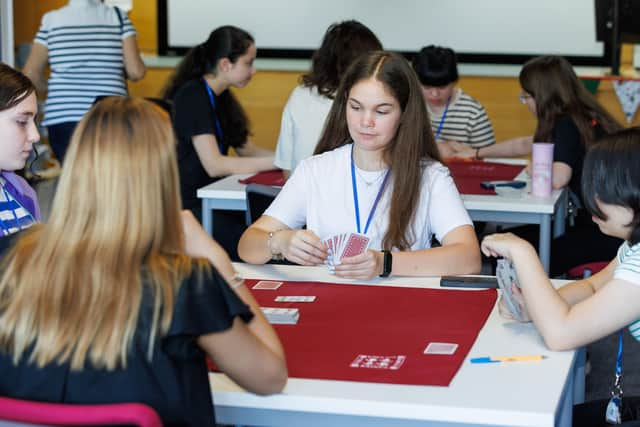
She is passionate about introducing children and young people to the game.
“Bridge gives children a specific kind of abstract thinking that you don't get taught,” she added.
“Children are very keen on quick wins but actually bridge is about taking it a bit more slowly.”
While the game has a certain fusty reputation, it is in fact a hit with celebrities such as Bill Gates and Claudia Winkleman.
Omar Sharif was reportedly obsessed, ditto Winston Churchill.
James Bond was also a bridge player.
Danny Hamilton says the game teaches logic and problem solving, concentration and patience.
The maths teacher set up a bridge club in his school - to great success.
In 2024, a trio of 15-year-old girls from the High School of Glasgow made history when they bested older players at the Peggy Bayer bridge tournament in Northern Ireland.
The schoolgirls are part of the BAMSA research project at the University of Stirling - Bridge: A MindSport for All - to harness the potential of the game to teach maths concepts and other skills.
“If you take any large group of kids, there'll be some who are competitive and want to have a challenge, who want to play matches against other kids,” Mr Hamilton said.
“Sport occupies that in a way, but bridge also satisfies that need in another way as an intellectual challenge.”
Although there are bridge apps and online games, one of the big pulls for parents is that it takes children away from screens.
READ MORE:Malcolm Offord hires veteran ex-Labour MP as advisor as Reform looks to re-brand in Scotland
There is a place, Mr Hamilton says, for online practice but playing with cards is the most effective and satisfying way to learn.
Some of the effects of learning bridge are unexpected.
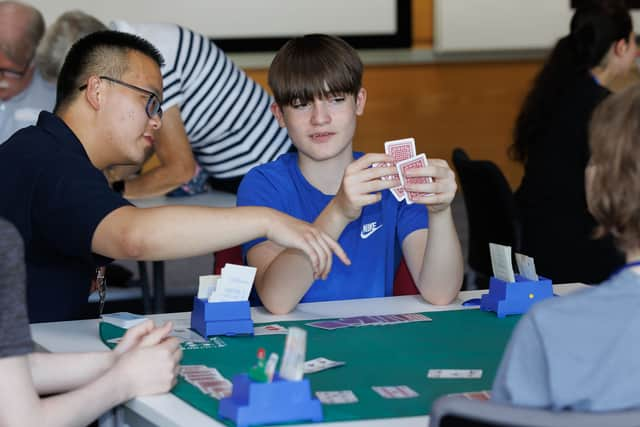
Mr Hamilton said: “What it really teaches that you don't get taught directly anywhere is logic and problem solving, and concentration and patience, because it's a hard game.
“It takes years to get good, and kids want to do everything really quickly, so having to really think through a problem and then maybe get it wrong and learn from it and do it better next time is a really useful skill.
“And that's where I've seen kids who have taken up bridge develop, they're just more thoughtful.”
Mr Hamilton would like to see bridge played more in schools but the difficulty is having a teacher who knows the game and who is dedicated enough to train pupils.
He said it can be “quite a hard sell” to head teachers who don’t know what the game is.
“If teachers knew what it was,” he added, “they’d be all in favour of it.”
He says that when he meets another bridge playing teacher he will assume they are maths teachers.
However, there’s no need to be particularly mathematically minded.
It supports higher order maths skills, like logic and numeracy.
He says players go on to work in financial settings because they have developed skills in logic and dealing with risk and calculation.
Mrs Gunn agrees that being a maths whizz is not essential.
“A friend of mine is a linguist, and she loves bridge because she said it's like a language,” she said.
“Bridge is divided into two parts. You've got the first part, where you use a language that everybody knows.
“You're speaking this language and telling your partner effectively about your hand and they can make a judgment and assess whether to take risks.”
Mrs Gunn said there has been an interesting shift from grandparents teaching young people about bridge to children teaching their grandparents.
She said: “Grandparents could be in their late 40s, early 50s, they probably don't know bridge, so ironically an eight-year-old could go and see their grandparents and teach them bridge.
“The grandparents might not know it, the parents might not know it.
“Children love to think that they're better than the grandparents, so they can teach them something.”
Bridge Scotland is currently working with the French Federation, which has developed a junior game called Le Petit Bridge and produced packs in England.
The French are working with schools in Poland and the Netherlands to roll out bridge in schools.
Early feedback shows an improvement in the mental agility of the children, numeracy, and teamwork, and communication.
The game has also assisted with increased emotional intelligence and sportsmanship - “managing when you lose, dealing with a slight frustration, and moving on to another game, leaving that one behind”.
Mrs Gunn added: “That's quite an interesting concept researchers hadn't thought would be quite so prevalent.”
Schools in China are introducing bridge because of this problem with being able to have a critical thinking approach.
AI is becoming so popular that parents and schools are thinking of ways to teach critical thinking ability.
On bridge’s old fashioned reputation, Mr Hamilton agrees that can be the case - but he embraces it.
“It definitely has a traditional reputation - as an after-dinner parlour game, you get it in Agatha Christie novels - and I quite like that side of it.
“It lends it a kind of gravitas as a traditional game.
“But in terms of the future, it's the opposite of that because it's kids playing and it's kids learning.
“So I think it's nice to have the traditional grandeur of it, as long as that doesn't put people off into thinking it's not for them.”
Comments
Want to join the conversation? Please or to comment on this article.