
Why reviving a Scottish stock exchange is a bad trade
Focus should be on boosting London and Edinburgh links with Europe



When I was growing up in Glasgow, my father tried to get me to understand the stock market by explaining the share prices and price-earnings ratios printed in a blur of black ink at the back of the Financial Times.
I found it dull and impenetrable, although the joke was ultimately on me as I ended up having a career in financial journalism at that very publication.
I also remember visiting the former Glasgow Stock Exchange in what is now Nelson Mandela Square. Looking up at the Venetian Gothic splendour of that building now, it’s tempting to contemplate reviving a Scottish stock exchange.
At first blush, the idea is appealing. Having a stock exchange is like having an airline or an opera house. Every nation tends to want one, even if many limp along with few listings and anaemic trading volume. According to the World Federation of Exchanges (WFE), 134 countries have an exchange including Iran, Jamaica and Bulgaria. Last year, one was even launched in Somalia.
The last effort in Scotland fizzled in 2019 when “Project Heather” failed to raise investor funding for would have been the first exchange since Glasgow’s closed in 1973 - even after Scottish Enterprise offered £750,000 towards developing it.
I asked the Scottish government for its position now. “While the establishment of any stock exchange in Scotland is a commercial matter, the Scottish government would closely engage with any proposals,” a spokesperson said.
Is there a commercial case for trying again? Unfortunately for any remaining nostalgists out there, the answer is a resounding “No”.
Let’s start with the essential feedstock for any exchange: company listings. The truth is there simply aren’t enough sufficiently mature businesses in Scotland to list on a Scottish exchange, notwithstanding a vibrant startup ecosystem in data, AI, robotics and life sciences.
Scotland is home to a dwindling number of LSE-listed companies as it is, with Irn-Bru maker AG Barr and packing group Macfarlane, which yesterday reported a sharp drop in 2025 operating profit, among them. As former Skyscanner executive Shane Corstorphine’s “Scaling Scotland” report recently laid out, while Scotland produces a healthy number of businesses that reach the 50–250 employee bracket, they are smaller on average than UK peers.
It’s a problem with which Singapore, possessing a similar population to Scotland, is familiar. The city-state’s bourse until recently suffered a years-long dearth of listings due to a lack of critical mass in local companies. The knock-on effect was thin liquidity in its secondary market, with investors preferring to trade in Hong Kong. Things finally started to improve last year, in part by the exchange courting listings from mainland Chinese companies.
Nor does it make sense to set up a platform in Scotland that would immediately find itself competing with London. The LSE’s junior market, Aim, is already home to a handful of Scottish companies including Beeks, a Glasgow-based trading technology business.
A third problem is that consolidation has been the defining trend in Europe for the past 20 years, with national bourses absorbed into larger platforms that offer greater efficiencies to investors and issuers.
That process started with sub-national exchanges being swept up under one roof – as happened in Spain in 1989 when bourses in Madrid, Barcelona, Bilbao, and Valencia created a single order-book, then in 2001 were folded into an exchange group called BME, itself owned by a company that runs Switzerland’s stock exchange.
While each of the four former exchanges have kept their names and physical presence, this is to serve as “commercial centres” to support local companies listed on BME, where all trading happens on a single electronic trading platform. Thus, Catalonia still has a “Barcelona Stock Exchange”, but securities are listed and traded on a centralised financial infrastructure.
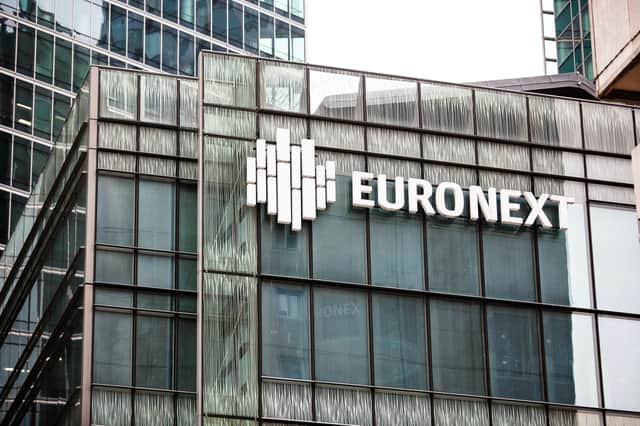
Europe’s national exchanges were themselves later folded into larger groups, offering investors a large “pool of liquidity” where traders can exploit market depth to get the best prices. This is now a permanent feature of borderless electronic markets dominated by pension funds, hedge funds and ultra-fast traders driven by algorithms and AI – precisely the customers of Beeks, in fact. One of these groups, Euronext, runs a “federation” of formerly independent bourses in Amsterdam, Brussels, Dublin, Lisbon, Milan, Oslo and Paris. Last year it added an eighth by buying Greece’s national exchange, Athex.
Exchanges in Stockholm, Helsinki, Copenhagen, Iceland, and Baltics have long been part of US exchange group Nasdaq.
It is true that pro-competition rules from Brussels in 2007 also broke down exchange monopolies, prompting the emergence of smaller rival platforms.
But as WFE head of research Pedro Gurrola-Perez points out, the new entrants that were successful “have done so by offering cheaper trading in the secondary market but have not broken into the listings space.”
Today, the only revival needed is in companies raising funds in London. We must also figure out how the financial centres of London and Edinburgh can breathe fresh life into cooperation with the EU at a time when geopolitics is driving a rapid post-Brexit rapprochement with the UK.
This explains why UK City minister Lucy Rigby was in Germany this week meeting with the Bundesbank, a month after visiting to Brussels to meet EU financial services commissioner Maria Luís Albuquerque.
“Our main threat as the EU is not the UK, it’s the US and China,” explains Rosa Armesto, director general of the Brussels-based Federation of European Securities Exchanges. “We have big funding gaps for defence, green energy and so forth and one way to generate the financing is to develop deeper liquidity pools, and to do that through closer integration of our capital markets”.
Comments
Want to join the conversation? Please or to comment on this article.