
Why a record-breaking, 36-storey ‘student skyscraper’ is essential for Glasgow’s survival
“Decisions like these are crucial in advancing the area’s development and will contribute to the broader revitalisation of Sauchiehall Street.”
It’s set to be the tallest residential building in Scotland, has sparked criticism from some in the local area, but should act as a catalyst for regeneration in a part of Glasgow that has fallen on hard times in recent years.
Plans for The Ard, a 374-foot, 36-storey tower block that will house hundreds of students, were given the green light this week by city councillors. The high-rise development will see the regeneration of 70s-built Portcullis House, a brownfield site at Charing Cross to the west end of the city centre. Its construction will involve the partial retention of the old HMRC tax office building on India Street.
Upon completion, the core structure will become Glasgow’s second-tallest behind the science centre - which stands at almost 420 feet - and rank as Scotland’s tallest purely residential building.
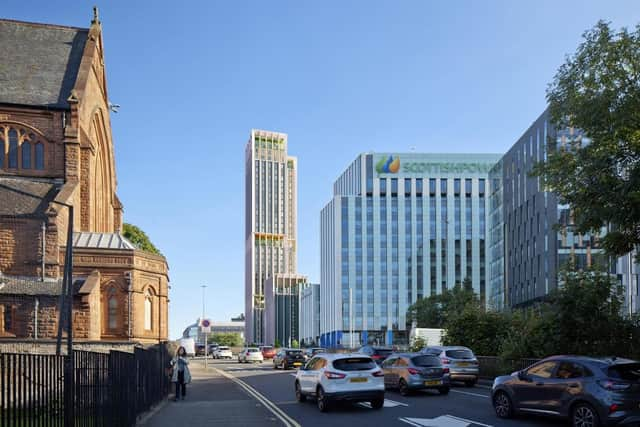

The vast scheme will provide accommodation for almost 800 students and, its backers argue, help to meet the increasing rental housing demands of Glasgow’s universities. The proposals for what some have dubbed a “student skyscraper” raised fears that the tower could overshadow nearby historic buildings and objections were put forward. However, the plans were approved by the city council’s planning committee and officials are confident that the landmark project can be “successfully integrated and provide a positive contribution to the built environment”.
Since 2011, Watkin Jones, the property development group masterminding the scheme, has completed nine managed student accommodation developments in the city, providing upwards of 4,000 student homes. It insists that its latest scheme will address a “chronic undersupply” of student accommodation and free up homes more appropriate for families.
Promised features include games rooms, co-working spaces, external terraces, a gym, a “master-chef kitchen” and private dining areas, in addition to a library and study zones. A “sky lounge” will offer residents a viewing platform with citywide views while a ground-floor café will be open to students and the wider public.
The Ard will also feature third-party spaces and a rent-free facility for the Glasgow Social Enterprise Network (GSEN), a charitable organisation that supports future entrepreneurs and collaborates closely with Glasgow’s university students. It will be housed within a second ten-floor building on the site. The overall development will see visual improvements made to the street and a wider gap installed between the adjacent ScottishPower office building. The enhancements to the “public realm” will include upgrades to Charing Cross Station’s footway.

The influx of hundreds more students to the area could help revive the fortunes of Glasgow’s west end and in particular Sauchiehall Street - one of the city’s most famous thoroughfares - which has suffered a series of blows amid the high street downturn, cost-of-living crisis and switch to home working. The departure of several big names from the street, including Marks & Spencer and BHS, has left large units vacant while the hospitality sector has been hit hard by lower footfall, particularly on weekdays.
Despite that, Glasgow was given a vote of confidence by investors earlier this year amid attempts to rejuvenate swathes of the city centre. The research, by Lismore Real Estate Advisors, showed property companies were the most bullish, with more than 90 per cent of them forecasting a “year of opportunity”.
Stuart Orr, senior development manager at property giant Land Securities, who was interviewed by Lismore for the research, said: “Despite setbacks, Glasgow’s resilience shines through, with strategies focusing on sustainable mixed-use and purpose-built student accommodation (PBSA) developments. Glasgow’s potential remains recognised, even amidst day-to-day urban issues.”
Glasgow Chamber of Commerce’s chief executive, Stuart Patrick, said the city’s student population was burgeoning with its three largest institutions targeting continued, significant growth.
“Delivering high-quality student homes will address this increasing demand and will also serve to retain skilled young people in the city as well as regenerating the city centre, which is a key aspiration of the city council,” he said.
Noting the recent approval for the demolition of the former ABC music venue and cinema on Sauchiehall Street, Patrick added: “With much debate and discussion about what Glasgow needs to thrive, decisions like these are crucial in advancing the area’s development and will contribute to the broader revitalisation of Sauchiehall Street.”
Portcullis House, originally developed in the 1970s, had been operating as office space with the most recent tenant being HMRC. However, the building has been vacant since 2020, having failed to attract a new occupier. Previous plans for a residential development on the site were put on hold in the summer of 2021.
Iain Smith, planning director at Watkin Jones, said: “Amidst the chronic undersupply of student housing in Glasgow, this development marks a significant step forward in addressing the demand for additional student accommodation, and also represents our commitment to creating sustainable homes in key regeneration areas.
“The Ard will not only revitalise the current brownfield site at Charing Cross, bringing much needed redevelopment to Glasgow, but will also enhance the public realm and support the thriving student community. We are excited to welcome the Glasgow Social Enterprise Network to The Ard as well, and to support them in their vital collaborative work with students and entrepreneurs.”
GSEN’s team brings together more than 270 social enterprises and organisations that support its aims, working extensively with students from Glasgow’s universities. It plans to occupy a ground floor unit free of charge and use the space for a variety of purposes. This includes providing training opportunities for both social enterprises and students, as well as delivering a tech recycling programme, offering free or low-cost tech to students and social enterprises, serving to reduce tech waste.
Comments
Want to join the conversation? Please or to comment on this article.