
Scottish university working on ‘dissolving’ circuit boards that could slash electronic waste
“Moving towards more sustainable, recyclable electronics is vitally important to help reduce the impact of our technology sector” – Mahmoud Wagih
Engineers from a Scottish university are teaming up with industry to develop biodegradable circuit boards in an effort to cut down on electronic waste.
The partnership between the University of Glasgow and Jiva Materials will look to develop environmentally-friendly circuit boards for use in wireless communication technologies.
Printed circuit boards, or PCBs, account for up to 40 per cent of the world’s electrical and electronic equipment waste. Conventional PCBs, which use flame-retardant composites or ceramics, are impossible to recycle and are sent to landfill. More advanced circuits often contain lingering chemicals which can harm the environment, humans and animals when they leach into groundwater.
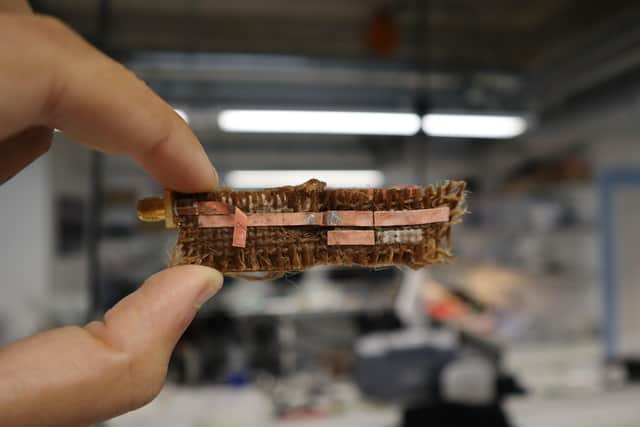

To help tackle the issue, Jiva Materials has developed a biodegradable circuit board made from natural fibres such as jute and flax, coated with a water-soluble resin. At the end of their lifespan, the boards can be degraded in hot water, while their copper tracks and integrated circuit chips delaminate and can be subsequently recycled.
Researchers from the university’s James Watt School of Engineering are working with Jiva to unlock the full potential of the boards.
Mahmoud Wagih, reader at the University of Glasgow’s James Watt School of Engineering, and the project’s lead, said: “We’re pleased to be working with Jiva Materials on this project, which could have a major impact on reducing the carbon footprint of the electronics industry. Moving towards more sustainable, recyclable electronics is vitally important to help reduce the impact of our technology sector, particularly with the rise of single-use devices across the industry.
“Working with natural and plant-based circuit materials is inherently challenging, particularly in wireless applications for RF and microwave applications. Together with our partners at Jiva Materials, we are developing new designs which improve the circuits’ efficiency, accelerating the adoption of green PCBs.”
Stephen Driver, Jiva Materials’ chief executive, added: “PCBs are a critical component for all electronics and are the silent and invisible polluter. The complex demands on what appears to be a simple component are challenging, and changing the resin’s reinforcement materials to biodegradable alternatives requires extensive testing and analysis.”
Comments
Want to join the conversation? Please or to comment on this article.