
Scotland’s tech sector ‘cautiously optimistic’ as AI drives growth - ScotlandIS survey
“Companies are operating in a tougher, more complex environment, and that’s clearly shaping how they approach growth” – Karen Meechan, CEO
More than seven in ten Scottish tech businesses are optimistic about their prospects in 2026 despite a challenging trading backdrop, the findings of a major new study would suggest.
The latest Scottish Technology Industry Survey from ScotlandIS shows that the majority (71 per cent) of tech firms remain optimistic about their outlook for the coming months. This marks a dip from previous years – 73 per cent in 2025 and 80 per cent in 2024.
Despite the softening in headline optimism, the broader results point to solid underlying pipelines and improved financial stability, according to ScotlandIS.

The digital technology trade body noted that more than half (58 per cent) of the technology companies polled had enjoyed rising sales in 2025, while 84 per cent expect to see sales growth this year. Cashflow pressures are also said to have eased, with 36 per cent of businesses reporting improvement and only 11 per cent experiencing “substantial difficulties” (down from 16 per cent in 2024).
Examining the anticipated growth more closely, expectations remain strong across most customer sectors. This is particularly the case in energy and utilities, financial services, and healthcare and pharmaceuticals, which ScotlandIS said reflected an increased demand for digital technology support in highly regulated and data-intensive industries.
In terms of technology, artificial intelligence (AI) continues to act as a central driver of innovation and growth, the survey shows, with almost all respondents now using AI in some form. Full adoption has doubled to 18 per cent, while only 2 per cent report no use of AI at all (compared to 10 per cent the previous year). Results around its use cases also indicate a “clear shift from experimentation to implementation”.
At the same time, the “opportunity landscape is evolving”, the report notes. Although AI and machine learning (cited by 59 per cent of tech firms), data analytics (36 per cent) and cybersecurity (36 per cent) remain key focus areas, slightly lower levels of interest – alongside reduced enthusiasm for cloud and IoT – suggest a maturing market and more targeted innovation strategies.

Now in its 19th year, the latest survey was conducted between December 1, 2025 and February 14 of this year. It received almost 350 responses in total, from ScotlandIS members and non-members.
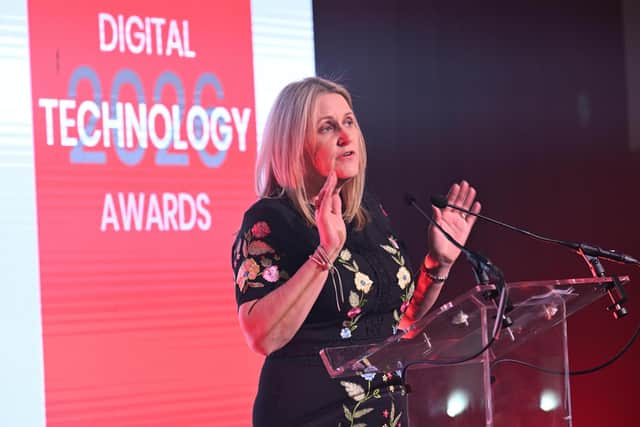
Karen Meechan, chief executive at ScotlandIS, said: “It’s encouraging to see optimism holding across Scotland’s tech sector, even as confidence levels ease slightly. The fundamentals are strong – businesses are growing, investing and continuing to innovate.
“Although it fell after the survey period, the unveiling of Scotland’s AI strategy will likely provide the sector with a further boost – bringing much needed clarity and direction.
“Of course, the outlook is not without its challenges. Companies are operating in a tougher, more complex environment, and that’s clearly shaping how they approach growth. But crucially, it doesn’t seem to be stalling it,” she added.
“In terms of practicing what we preach, AI has a big role to play in this. One of the most significant shifts we’re seeing is the move from simple adoption to using the technology in ways that deliver real impact. I believe our businesses can be true innovators in this space.”
ScotlandIS works with its members and partners to support the wider digital transformation of business and society. An estimated 100,000 people work in digital technologies roles across the Scottish economy, while ScotlandIS members employ about 60,000 people.
Scotland’s digital tech sector contributes in the region of £7.5 billion to Scotland’s economy, measured by gross value added (GVA), and the country is home to some 3,900 digital tech businesses.
At £36,900, the average annual salary of a digital tech worker is about a quarter higher than the average of all workers in Scotland.
Last month, it emerged that Meechan would be stepping down after more than two decades of “stellar service” with the tech industry organisation and five years in the top role.
She will move on from her role as chief executive of ScotlandIS towards the end of May. To maintain continuity, the group’s chief operating officer, Nicola Taylor, will be acting chief executive from May 29 until a new leader is appointed.
Having held the position of chief executive since 2021, Meechan has steered ScotlandIS through various economic headwinds and is credited as being a “strong, influential voice” for its members and the wider tech sector north of the Border. Prior to her role as chief executive, she held the titles of head of operations from 2004 and chief operating officer in 2019.
Meechan said: “ScotlandIS has been my entire career and, without doubt, some of the best years of my life. From the people I’ve had the privilege to work with to our incredible members showcasing Scottish tech to the world, I’ll always look back on my time here with pride.
“But it feels like the right moment for my next adventure. The organisation has gone from strength to strength in recent years, driven by a fantastic team and hugely supportive board. I’m confident that under their watch ScotlandIS will continue to listen closely to the needs of its members and the wider industry, and that the new CEO will keep driving the change our sector deserves. With that, they will have my full support,” she added.
Recruitment for a new chief executive was due to get underway and both internal and external candidates would be considered, the organisation confirmed in March.
Comments
Want to join the conversation? Please or to comment on this article.