
Reality check for Scotland's offshore wind ambitions after China setback
Even if Ming Yang had been allowed, Scotland’s offshore wind sector would still be facing considerable difficulty
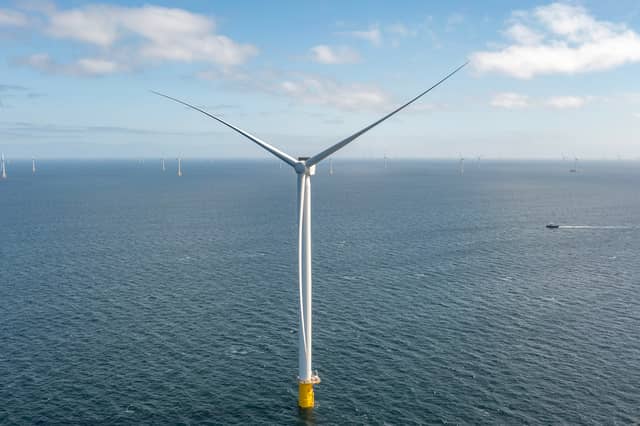


It’s been over a week since the UK government’s decision not to allow Chinese wind turbine manufacturer Ming Yang into the supply chain by building a components factory in Scotland.
There’s been understandable blowback from those who see this as a missed opportunity to develop Scotland’s industrial base for renewables. “Sabotage,” said deputy first minister Kate Forbes in response to Downing Street’s decision.
Yet this was ultimately a geopolitical call. While Ming Yang’s UK chief executive Aman Wang said this week the company is “open to working with the UK government”, I understand Ming Yang has decided geopolitical considerations must now play a bigger role as it mulls alternative locations for a factory, with Italy on a shortlist.
Read more: Labour government blocks Chinese wind factory plans for Scottish Highlands over security fears
So where does this leave Scotland? Even if Ming Yang had been allowed, Scotland’s offshore wind sector would still be facing considerable difficulty.
Globally, the financial and political environment has deteriorated to a point where conditions are far less favourable than when the ScotWind leasing round kicked off four years ago.

As the Global Wind Energy Council’s latest offshore wind report puts it: “Like other infrastructure sectors, macroeconomic headwinds have raised the cost of capital and impacted project economics. The industry has also endured increasing ideological attacks and a persistent and rising tide of disinformation.
“These wider challenges have collided with ineffective policies, such as slow permitting and [government subsidy] auction design. As a result, investors are left exposed and without clear pathways to returns, making them far more cautious about which projects really make economic sense.”
In Scotland, this has hit a number of ScotWind projects, as well as those known by the acronym INTOG, combining floating wind demonstrators and others designed to allow oil rigs to switch to wind-generated power from diesel.
Oil companies’ recent retreat from renewables has seen Shell pull out of Campionwind, one of the largest in ScotWind.
Some specialist offshore wind developers have also withdrawn, including BlueFloat Energy, which recently sold out of three floating ScotWind projects – Bellrock, Broadshore and Stromar - and two INTOG ones. The buyer was its former co-owner in all five projects, London-based Nadara. The Stromar case also involved Denmark’s Ørsted giving up its shareholding.
There are also Scotland-specific challenges. One is the fact that Scottish offshore wind projects pay higher transmission costs than English ones due to distance from the electricity market down south.
Industry body Scottish Renewables said in a February report that the charge, known as Transmission Network Use of System (TNUoS), “discourages investment in Scotland”.
Some developers see this as existential for their projects. In January, West of Orkney wind farm said it could not proceed unless “unfair” transmission charges were reformed. TNUoS was a factor behind a recent decision by Ocean Winds, a joint venture between Engie of France and Portugal’s EDP Renewables, to inform Crown Estate Scotland (CES) that it would be handing back its ScotWind option to develop the Arven South floating wind farm off Shetland.
Arguably, with hindsight, the biggest issue has been hubris. In the pre-Ukraine war days when CES ran the ScotWind lease auction, developers bought into the boldness of Holyrood’s vision to establish Scotland as a pioneer in floating wind. Unlike the fixed-bottom wind farms deployed in waters up to 60 metres deep, the floating variant sits on platforms tethered to the sea bed further out to harness stronger winds.

Scotland was to play an outsized role, with over half of ScotWind projects earmarked for floating. Forbes told me in January that such ambition was justified because it had been assumed in 2021 that the CES auction would attract supply chain investments, while signalling to countries with offshore wind aspirations that Scotland was the “early mover” from which they could learn.
The attraction of Ming Yang was that it specialises in the huge turbines required for floating projects.
But things didn’t pan out this way. Cracking floating technology has proven harder than thought because too few of the non-turbine components have yet been developed to a level that would attract industrial scale financing. Now, floating globally “remains stuck in a pre-commercial holding pattern,” according to a report by The Carbon Trust and Global Offshore Wind Alliance.
Some countries are already trimming their sails. France last month lowered its offshore wind capacity target for 2035, acknowledging longer development timelines.
None of this is to suggest that Scottish offshore wind is dead in the water. Great British Energy has invested in a small floating project, Pentland, off the Caithness coast. Last week the University of Strathclyde and Japan Marine United Corporation, a shipbuilder, agreed a research partnership to “help address some of the key technical and manufacturing challenges facing floating offshore wind”.
In the meantime, there are signs of a possible new direction for ScotWind. While a core group of developers including Nadara, Ocean Winds and ScottishPower Renewables remains committed to floating, some are also studying an emerging fixed-bottom solution that can be deployed in waters further out than 60 metres.
Crucially, this would also be cheaper, opening the way for a more financeable alternative to floating for perhaps half of ScotWind. It would also create opportunities for Ming Yang’s European rivals, Siemens Gamesa and Vestas, which is already planning a turbine parts factory in Scotland.
The UK government seems open to the concept, recently concluding a consultation on introducing a new technology category for “innovative foundation designs for deepwater sites” that might be eligible for the next subsidy auction round, scheduled for July.
With Trump’s war on Iran up-ending the energy calculus, some intriguing new industrial pathways might be ahead for offshore wind in Scotland.
Comments
Want to join the conversation? Please or to comment on this article.