
Milburn realises people are our greatest asset
Neets review must help themillions left in limbo back intosociety, writes Victoria Carson
When we built the Queensferry Crossing in 2017, we did not expect to realise immediate economic and social benefits. Just like when we had built the Forth Road Bridge 50 years earlier, we knew that those benefits would take decades to present themselves in full. Everyone understands that central characteristic of infrastructure investment - we are building a legacy rather than expecting a short-term return.

The Queensferry Crossing was an investment in a social need and an economic opportunity. So was the Borders Railway, and the Dundee Waterfront Project, and the programme of new school builds. They are investments in legacy.
Our people also represent a social need and an economic opportunity. The greatest resource a country has is its people. They are the family members, the community pillars, the carers and the workforce. And yet, when people need to be invested in we tend to think about the short term rather than the long term. Instead of investing in legacy, we spend on dependency.
This is why the UK Government’s review into young people not in employment, education or training (Neets), written by Alan Milburn, is so critical throughout the UK, including here in Scotland. The evidence he is working with is harrowing. Young people, often following a diagnosis of neurodiversity, anxiety or depression, are routinely being placed on cash benefits, removed from the workforce, and to a degree removed from society entirely. And there are a million of them.
Mr Milburn has found that for every £1 invested in employment support (the legacy), £25 is spent on benefits (the dependency). In some geographies he found the ratio to be £1-to-£70.
At the Wise Group, we work with people and families in the deepest levels of poverty. They are not generally hovering around the threshold between poverty and comfort; they are well beneath that. More than three-quarters of the households we support are dealing with at least five interconnected areas of need. These people don’t live in the sort of silos that state structures place them in. They live whole lives, and the support we offer them tries to recognise that. Our Relational Mentoring approach provides a consistent relationship, helping individuals and families navigate challenges, build stability and move towards education, employment and greater independence.
And this is the absolute key. We have a tendency, particularly in Scotland, to see the increasing provision of benefits to be a sign of public policy success. It is not. Quite the opposite, the movement of a person from education, employment and independence to worklessness and dependency is a clear and consequential public policy failure. And, as the Work and Pensions Secretary Pat McFadden has repeatedly said, it is an enduring public policy failure, because a young person placed on benefits is unlikely ever to work.
To continue the analogy from earlier, this is the opposite of our approach to infrastructure. Infrastructure investment is the hard option today, but has lasting and enduring payoff into the future. Expanding benefits is the easy option today, but the consequences are negative and have a very, very long tail.

We need to flip this thinking on its head, and we at the Wise Group hope that both the UK Government and the Scottish Government will enthusiastically embrace Mr Milburn’s review and see the opportunity for a better tomorrow.
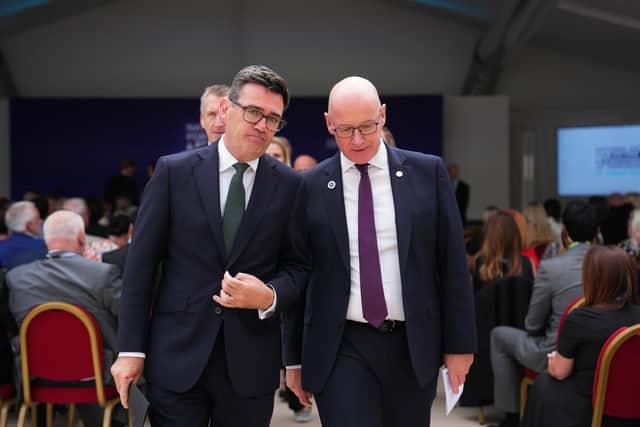
The Prime Minister Andy Burnham and the First Minister John Swinney both have the concept of opportunity running through their political DNA. Mr Burnham talks frequently of reindustrialisation, for instance. But he cannot reindustrialise when one million people from his young workforce are not in education, employment or training. Mr Swinney has, from the day he walked into Bute House, said that child poverty is his number one priority. But income security and economic participation reinforce one another.
If there is one thing we understand at the Wise Group, it is that work is good for you. Investing in people's ability to participate in the workforce requires the same long-term thinking as investment in infrastructure does. We start from the point of understanding the legacy that successful support can leave behind, and the contrast between that support and the decision to allow someone to fall into benefit dependency.
We see in real time what this looks like. It looks like a young person with anxiety being incentivised to complete an apprenticeship rather than being incentivised to take time out. It looks like an autistic student completing their studies and progressing towards an enduring career, during which they learn to manage their condition, rather than being told they are not able to do so. It looks like an employer retaining a valued member of staff, supported through more difficult times by their colleagues rather than being isolated at home.

It looks like a household becoming more financially secure. It looks like children growing up with greater stability and opportunity, in a culture of work and independence. It looks like a strong workforce, with stable household incomes, and reduced use of state benefits and public services.
r Milburn has recognised that economic growth and tackling poverty are two sides of the same coin, and he has also recognised that - like infrastructure - meaningful welfare reform requires investment upfront, with returns realised over time.
Scotland is investing in infrastructure, industries and skills to create opportunities for growth. Our colleges and universities are developing new pathways into employment, while investment in energy, technology and other growth industries is creating demand for talent. The opportunity is considerable.
But those opportunities will not be realised unless we open the door for our future workforce, rather than consigning them to a life behind a closed door.
Victoria Carson is Director of Engagement and Policy at The Wise Group