
Launchpad CEO says focus needed to scale Scottish tech economy
Launchpad CEO Jon Quick says Scotland must back emerging tech firms with conviction to build globally significant companies
For Scotland to create more high-turnover tech firms, it must tighten its focus on emerging founders that have technology with real transformative potential.
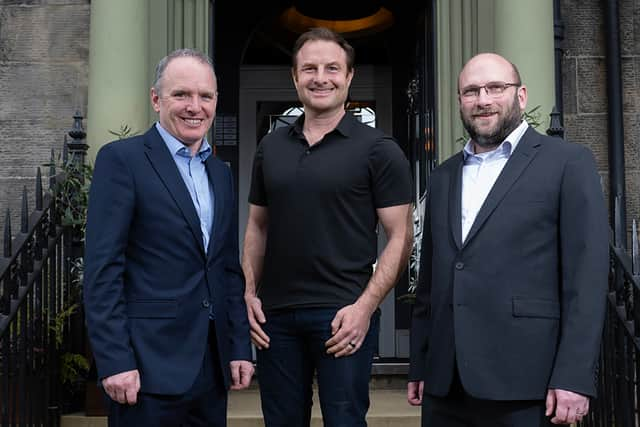

This was one of the messages of Jon Quick, CEO of Edinburgh and Los Angeles-based robotics automation firm Launchpad, who said the country is at a pivotal moment as it looks to shift from a traditional economy to a technology-led one.
Speaking ahead of Scotsman Insider’s Tech 50 edition, Jon said Scotland has the talent to build globally significant technology companies but what it needs now is concentration.
He said: “When you give everyone a little bit, everyone makes progress. But nobody really stands out. The goal is to find and back the Bruce Mouats and Andy Murrays of Scottish tech. The companies that can become world champions and Olympic medallists.
“If Scotland wants globally significant tech firms, it has to concentrate capital, customers and support behind the businesses that show real product-market fit. It takes a lot to build globally competitive businesses and there’s unfortunately minimal value if you only build half a bridge.
“The talent is here. The research is here. The ambition is here. What’s required now is the will.”
Launchpad is a privately owned AI-first robotics automation firm founded in 2020 and run by chief executive Jon Quick and president Yoav Zingher.
Headquartered in Los Angeles, the company established an Edinburgh base as its UK research and development hub, attracted by Scotland’s AI talent pool and support from Scottish Enterprise.
The business is owned by its founders and institutional investors following multiple funding rounds.
In 2025 it closed a $11 million Series A, co-led by Lavrock Ventures and Squadra Ventures, with participation from strategic investors including Lockheed Martin Ventures, Ericsson Ventures, Cox Exponential, the Scottish National Investment Bank and PXN Group.
The funding is being used to accelerate product development, expand its robotics platform and scale operations across the US and UK, with Scotland positioned as a long-term centre for R&D, engineering and manufacturing capability.
The Launchpad CEO also said the US growth environment offers lessons in how capital concentrates around traction.
He said: “In the US, you don’t get meaningful backing just because you exist. You get it because you’ve fought your way to real traction.
“That discipline creates focus. If Scotland leans into that mindset and differentially backs companies once they’ve pulled ahead, you’ll see stronger outcomes.”
The Launchpad CEO said the country would struggle to create more high-growth tech firms unless founders believed more deeply in the full revenue potential of what they are building.
He cautioned company owners about selling out too early when there may be far larger long-term rewards.
He said: “In the US, an early exit is often looked down on. It usually means you’ve left a lot of money on the table. More than that, how many great ideas and great companies can one team really build? If you have one, why wouldn’t you see it through?
“If your company is worth a billion dollars or more, why would you sell for a small fraction of that? You stay. You scale. You go after the bigger outcome.”
Jon said high-growth tech companies are also what recycle capital back into the system.
Adding that it is the founders and executives who then go on to mentor, invest and build again.
Jon said: “High-growth tech companies create the next generation.
“Google produced countless millionaires who then founded companies, wrote cheques, advised and built again. Anthropic, Waymo, Instagram and Pinterest all have ties to Google.
“When you get one or two genuinely large exits, behaviour changes.
“Young talent decides to start a company instead of joining or staying at a larger one. Experienced people join them because they’ve seen what’s possible. Money flows into the sector.
“Big outcomes create confidence. And confidence unlocks the kind of capital that lets the next generation scale, and puts the focus on what’s possible instead of the companies that didn’t make it.”
The responsibility for success, said Jon, should not rest solely with investors. He called for a broader ecosystem approach where breakthrough companies are identified and supported with intent.
He said: “This can’t just sit with investors. Building breakthrough companies is an ecosystem effort.
“You need capital, yes. But you also need customers willing to buy, institutions willing to champion, experienced operators willing to mentor and government willing to act with intent.
“Identify the companies that are pulling ahead. Then align everything behind them.”
Scotland’s tech maturity, he said, will depend less on the number of companies supported and more on identifying those with clear global differentiation and backing them decisively.
Without that concentration, the country risks under-realising its potential.
Robotics and the Industrial Opportunity
Scotland’s traditional industries could regain a competitive edge through AI and robotics.
Launchpad CEO Jon Quick believes robotics and AI present a strategic opportunity for Scotland, particularly given its strengths in construction materials, food and drink and industrial supply chains.
“Robotics are an industrial equaliser,” he says. “It’s not about replacing people. It’s about amplifying them, strengthening supply chains and making it advantageous to bring manufacturing back to Scotland.”
Jon points to persistent labour shortages in advanced economies and the geopolitical fragility exposed during Covid and supply chain disruptions.
The opportunity for Scotland, he argues, is not to dominate robotics broadly but to apply it intelligently within industries where it already has depth.
“If the number one robotic solution for the food and drink industry comes out of Scotland, eventually it finds its way everywhere else. That’s when you really win.”
Scotsman Insider’s recently published Scotland 500 list showed Scotland’s economy is driven not by unicorns and start-ups, but by a core of large employers.
The new annual ranking of the country’s biggest companies shows that corporate Scotland is dominated by mature, profitable businesses with substantial workforces rooted in property, manufacturing, engineering and services.
TOP FIVE TAKEAWAYS
- Back fewer companies, harder - Incremental funding creates incremental outcomes.
- Create pillar firms - Large successes generate capital, experience and belief.
- Robotics is strategic, not speculative - Automation strengthens Scotland’s industrial base.
- Governance matters as much as growth - Fundraising is not success; execution is.
- Normalise failure - Venture returns require risk and outlier ambition.
Comments
Want to join the conversation? Please or to comment on this article.