
Is assisted dying suicide by any other name?
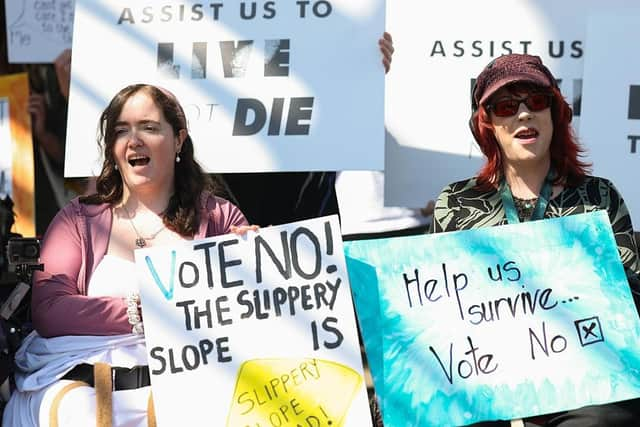
Are the assisted dying bills at Holyrood and Westminster a Rubicon we should not cross?
The June 2016 Statute of Canada amended that country’s Criminal Code to provide that a person over 18 may receive Medical Assistance in Dying (MAiD) if inter alia ”they have a grievous and irremediable medical condition” which requires that “their natural death has become reasonably foreseeable”. This latter provision, clearly a safeguard, was removed by further legislation in 2021, so widening the availability of the medical assistance.

Unsurprisingly, it was made obligatory to monitor the impact of this law. In 2016 the number of Canadian MAiD deaths was 1018. That annual number has increased year on year. In 2021 the number had reached 10,092, almost ten times that initial figure and in 2023 it was around 15,300. This was about 4.7 per cent of all deaths in Canada, a sizeable percentage.
Both the Assisted Dying for Terminally Ill Adults (Scotland) Bill and its Westminster counterpart the Terminally Ill Adults (End of Life) Bill assiduously avoid the use of the word “suicide”. This is no doubt

well-meaning, intended to be kind to those facing the most difficult and profound choices in the event of this legislation being enacted. It is crucial, however, to appreciate the immensity of the principle that would be introduced by these Acts, that the State and medical profession may actively facilitate suicide. As regards doctors, it is difficult to envisage a measure that so contradicts that provision within the Hippocratic Oath which precludes physicians from administering poison even if requested to do so or from suggesting such a course of action.
One does not have to swear by or believe in Apollo or the other Greek gods to appreciate that the oath is a reflection of how, since ancient times, Western civilisation has held particular expectations over how one would expect health practitioners to treat patients. What is most striking about this legislation is surely not the slipperiness of any slope but that a Rubicon would be traversed.
Of course, where such a crossing has already been undertaken, as in Canada, the focus has switched to the ease with which the scope of the legislation may be widened and the increased prevalence of medically assisted dying. The proponents of introducing MAiD to Scotland often emphasise that it would be used only in exceptional circumstances, but with the passage of time the practice in Canada has become increasingly unexceptional.
There is no reason to suppose that the Canadian trend would not be followed here. It is easy to amend legislation, diluting safeguards. The Scottish Bill makes assistance available for the terminally ill. This is defined by stating that “a person is terminally ill if they (sic.) have an advanced and progressive disease, illness or condition from which they are unable to recover and that can reasonably be expected to cause their premature death.”
There is nothing to prevent a future Act removing “from which” and all words thereafter, thereby widening the availability of this assistance. This would be a development similar to the Canadian amendment. Indeed, it could be argued, on the basis of the paramountcy of personal autonomy and the right to choose, even terminal illness should not be a prerequisite for obtaining this assistance.
Nobody can doubt the difficulty of the task facing MSPs and MPs as they grasp with sound but conflicting arguments over this proposed legislation. However, so far and to their great credit, our politicians have conducted their debates with maturity and mutual respect.
Andrew Stevenson is Secretary, Scottish Law Agents Society