
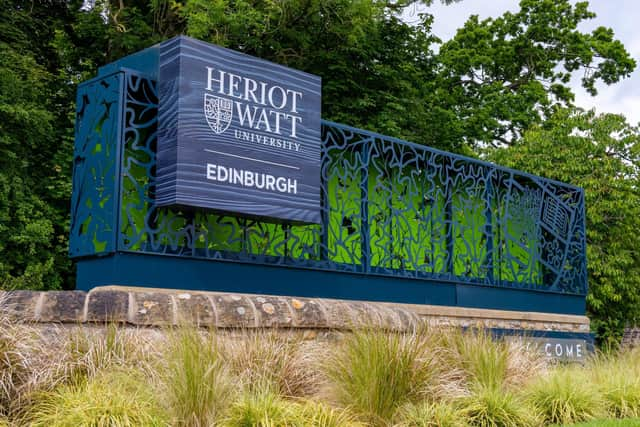
Heriot-Watt University hails ‘milestone’ chip that promises sharper views of universe

“This is a significant milestone for a research programme that began more than 15 years ago” – Professor Robert Thomson
Some of astronomy’s most ambitious goals could be closer to achieving thanks to the efforts of researchers at Heriot-Watt University.
After some 15 years of research, the university has taken a small glass chip, developed in the lab, to one of the world’s leading observatories. The photonic device, just an inch or so in size, has allowed telescopes at the CHARA Array in California to be linked together, doing a job that has traditionally needed bulky and complex optical systems.
The chips can be swapped within hours so new designs can be tested far more quickly.

The CHARA Array is one of the world’s top facilities for high-resolution astronomy and consists of six telescopes that can be linked together to study celestial objects in extraordinary detail. To make this possible, the light collected by each telescope must be combined with extreme precision.
Now, the photonic chip developed by Edinburgh-based Heriot-Watt - which can guide light through thin glass channels in the manner of integrated circuits guiding electrons - has been successfully used for the first time in on-sky observations at the array.
The achievement could help transform the way future astronomical instruments are designed, making them smaller, more robust and easier to upgrade while still delivering the precision needed to study distant stars and planetary systems.
Researchers believe the technology could eventually support some of astronomy’s most ambitious goals, including studying how planetary systems form and evolve while helping scientists directly detect and characterise planets around other stars.
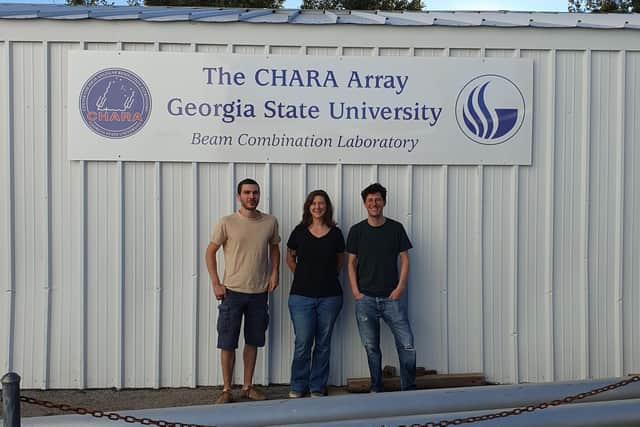
The international project brought together researchers from Heriot-Wat and universities in Germany and the US. The photonic chip at the heart of the instrument was developed at Heriot-Watt’s Institute of Photonics and Quantum Sciences by Professor Robert Thomson and Dr Aurélien Benoît. The team also played a central role in the observing campaigns that demonstrated the technology on the telescope array.
Thomson said: “This is a significant milestone for a research programme that began more than 15 years ago. Astronomers can achieve much sharper views of the universe by combining observations from several telescopes at the same time. Doing this allows the telescopes to work together as though they were one much larger telescope.
“Traditionally, combining the light from multiple telescopes requires bulky instruments with complex arrangements of mirrors and lenses. We have shown that much of that work can instead be carried out by a glass chip only a couple of centimetres in size.”
“Seeing this technology progress from fundamental research and early laboratory demonstrations to successful operation at one of the world’s leading facilities is a particularly significant outcome and a demonstration of the power of international collaboration,” he added.
The chip sits at the heart of an instrument called Chariot, which was designed as a testbed for new photonic technologies. During observing campaigns in 2024 and 2025, Chariot successfully combined light from telescopes at the CHARA Array and recorded signals from a range of stars, demonstrating the precision required for advanced astronomical research.
The instrument also detected signals from stars fainter than those reached by the system it replaced.
Comments
Want to join the conversation? Please or to comment on this article.