
Glasgow facility behind tech powering modern internet celebrates 20th anniversary
“The centre has more than doubled in size over its lifetime, helping us play a leading role in advancing fundamental research” – Prof Martin Weides, director
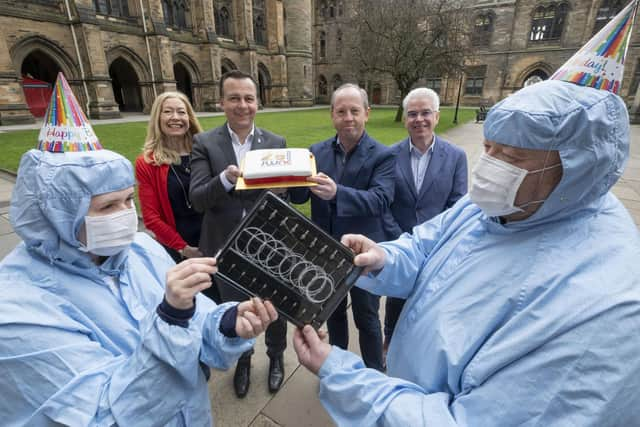
A Scottish facility that helped create the technology that underpins the modern high-speed internet is celebrating its 20th anniversary.
The University of Glasgow’s James Watt Nanofabrication Centre is one of the UK’s key facilities for research, development and training in nanoscale devices. It is home to a £35 million suite of equipment and has supported the work of nearly 200 high-tech companies globally.
Since the facility’s first test run on March 26, 2006, researchers have established a string of world records, witnessed their groundbreaking technology used to see far below the Earth and on board the International Space Station, and trained hundreds of postgraduate students who now contribute to the world’s tech giants.

They have also helped establish a series of spin-outs that are commercialising fundamental research in sectors including healthcare, quantum technologies and photonics.
The centre’s work on fabricating custom semiconductor lasers used in the world’s largest data centres has had a major impact over the last two decades.
In 2016, Sivers Semiconductors won volume production contracts to supply lasers for fibre-optic communications thanks to the support and expertise of the centre. These products have enabled faster optic fibre internet and television services to consumers.
Professor Martin Weides, director of the James Watt Nanofabrication Centre, said: “The University of Glasgow has been at the cutting edge of nanofabrication over six decades, from establishing our first e-beam in 1978 by converting a scanning electron microscope, to buying the UK’s first commercial e-beam tool in 1990, to our leading position today.
“However, it was the first electron fired from our e-beam tool by Dr Stephen Thoms on March 26, 2006 that sparked a remarkable expansion of the university’s capabilities which has surpassed even our initial ambitions. The centre has more than doubled in size over its lifetime, helping us play a leading role in advancing fundamental research, enabling commercial partnerships, and supporting global and domestic supply chains.”
He added: “We have helped fabricate prototype parts for major international companies to use in everyday devices like mobile phones, as well as established our own spin-outs across sectors of industry which will help spur economic growth.”
Comments
Want to join the conversation? Please or to comment on this article.