
Glasgow-based startup takes the grunt work out of the energy transition
Hypercube is part of a growing ecosystem of Scottish AI champions


Imagine you are running a wind farm project that’s a couple of years into the planning stage.
On a Friday night in late September, the ecologist you’ve hired to conduct an environmental impact report tells you bad weather has scuppered the last bat survey of the season.
It gets worse: the next survey window isn’t until March. A six-month slip on a £100 million project lands in the inbox of a project manager who happens to be off. What to do?
It’s this sort of dilemma that Adam Sroka, a Manchester University physicist turned data scientist, believes artificial intelligence was made for.
Hypercube, the Glasgow start-up he co-founded, has built an AI widget that reads that email, recognises it could sink the project, warns the managing director, checks the contract for slippage clauses and starts hunting for an ecologist who is free at the weekend.
By Monday morning, the project manager finds dozens of actions to approve, edit or discard in pre-drafted emails, all ready to go to the right people so the problem can be fixed quickly.
This use of AI is central to Hypercube’s “Project Assist”, one of a handful of AI applications its data science geeks have designed to make life easier for energy companies.
“It’s very much like a cockpit for project managers on big, complicated portfolios,” says Sroka, 39, of Project Assist which, like the other products, is driven by an agentic AI platform called CAIRN (“because it’s a Scottish word with ‘AI’ in the middle”).
At a time when AI’s uses are hotly debated – revolutionary productivity booster or existential human threat? – Hypercube is part of a growing ecosystem of Scottish AI champions that appear to be providing a convincing answer.
Three others, all Edinburgh-based, are Wordsmith AI, which uses agentic AI to organise lawyers’ work; Malted AI, which focuses on financial services; and Aveni, a fintech spun out of Edinburgh University. Some are winning wider recognition. Last month, Hypercube came 10th in an inaugural Financial Times ranking of the UK’s fastest-growing companies, which recognises those with the highest compound annual revenue growth over three years. Between 2022 and 2025, Hypercube’s revenue grew by 191 per cent a year on that measure.
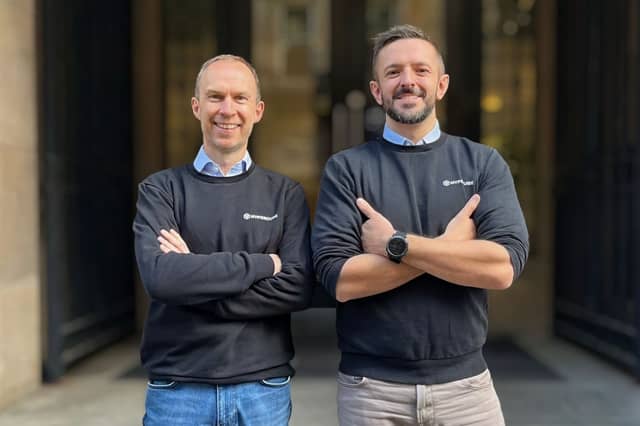
Sroka started the business as an IT consultancy with £478 he had in his bank account from a brief foray into event management. At the time, he was working at Glasgow-based Incremental Group, where he met Iain Cherry, 52, now Hypercube’s chief operating officer. It wasn’t until Sroka was hired as head of machine learning by a Cambridge-based start-up that he saw first-hand how much the energy sector could gain from better technology. “It’s where I fell in love with power trading, grid-scale batteries and building renewable energy infrastructure. I spotted that most of our customers were pretty behind,” he explains. Sroka then persuaded Cherry, a former strategy executive at Lockheed Martin in Glasgow, to join him in a new venture, and Hypercube was properly born.
Their first big client was InterGen, an Edinburgh-headquartered energy company that runs power stations across the UK and is developing one of Europe’s largest battery energy storage projects in Essex.
Remarkably, Sroka claims Hypercube has been profitable from the start, funding itself mostly from revenue generated by the 60 clients it has supported since founding. It has 36 clients now, around 60 per cent of which are in the UK, with the rest overseas.
Some external funding has come from a £150,000 loan last year from Momenta Finance, a London-based SME lender accredited by the British Business Bank, and an R&D grant of almost £100,000 from Scottish Enterprise. This year, the agency gave a further £50,000 to help Hypercube develop an AI-powered marine mammal monitoring capability for offshore wind. Hypercube’s 34 employees are drawn from universities in Scotland and elsewhere, and it is advertising for data science posts at a hub it operates in Aberdeen. “The competition for senior AI expertise is real, but we find people want to work on problems that matter,” says Cherry.
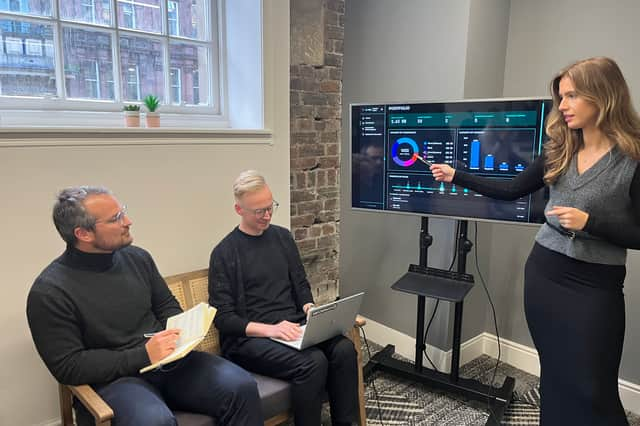
Ivona Voroneckaja, a former University of Glasgow statistics lecturer with a PhD in machine learning, is Hypercube’s product manager. She demonstrates on a screen how an AI agent reviews and scores supplier submissions faster and more consistently in another offering, Procurement Assist. “A job that took weeks can now be done in 15 minutes,” she says.
The company’s approach has been to present AI not as an off-the-shelf solution but as something that helps people in specific roles. “The AI is assisting the human to do the work,” Cherry says.
Moreover, Hypercube engineers work with a new client for an initial four weeks to run a product on the client’s historic data before any subscription starts. “This implementation process is as important as the technology itself, so their team can see the results on work they already know,” Sroka explains.
Making AI directly relevant to people like this points to how it could be more widely adopted by Scottish businesses – a key aim of a roundtable convened this week by Scottish government innovation minister Alyn Smith.
“Companies like Hypercube show what is possible when talent, ambition and the right support – including through our enterprise agencies – come together,” he said in a statement yesterday. “Our job is to make sure people are in charge of AI and confident that it is regulated in a way that works for them.”
Meanwhile, Hypercube recently embarked on its first seed funding round. “We hover close to zero on profitability because we spend everything on growth and pedalling hard,” says Sroka. “As we like to joke, fly close to the ground but never crash, is the plan.”
Comments
Want to join the conversation? Please or to comment on this article.