
Data Dashboard: Scotland's next growth wave in plain sight
Funding rounds, senior hires, and a large £5m–£25m turnover cohort point to a new phase of scaling.
There are 1,912 Scottish firms currently operating in the £5m–£25m turnover band, a collection of companies that represent the country’s most immediate pipeline of future mid-market employers and acquisition targets.

These are established businesses with customers, operating depth and growing management complexity.
They are past the start-up phase and entering the stage where capital structure, leadership quality and execution discipline determine whether they scale to the next level.
The wider economic backdrop entering 2026 is stable but not without pressure.
UK CPI inflation fell to 3.0 per cent in January 2026 while Scotland’s unemployment rate stands at 3.7 per cent for the September to November 2025 period.
However, corporate insolvencies have edged upward to 52.1 per 10,000 companies in the 12 months to January 2026.
Stability is visible, but resilience is being tested and transaction data reinforces that picture.
Total Scottish deal volumes reached 585 in 2025, up from 545 in 2024, including all types of transactions.

Median deal value, where deal value is publicly available, sits at £5.75m, suggesting steady activity in the lower mid-market rather than large capital deals.
Median is the middle deal value when all the values are lined up from smallest to largest.
The buyer profile is also revealing and shows that strategic consolidation remains the dominant theme.
Over the past 12 months (February to February), 83 per cent of Scottish businesses were acquired by trade buyers.
Management-led transactions accounted for 8 per cent, private equity and venture capital 5 per cent and other buyers 4 per cent.
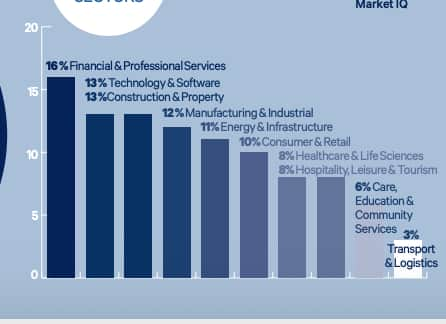
Sector distribution shows a broad base of activity.
Financial & Professional Services leads at 16 per cent of transactions, followed by Technology & Software and Construction & Property at 13 per cent each.
Manufacturing & Industrial represents 12 per cent, Energy & Infrastructure 11 per cent and Consumer & Retail 10 per cent.
Healthcare & Life Sciences and Hospitality, Leisure & Tourism each account for 8 per cent, Care, Education & Community Services 6 per cent and Transport & Logistics 3 per cent.
Funding signals remain selective but credible platforms are attracting capital.
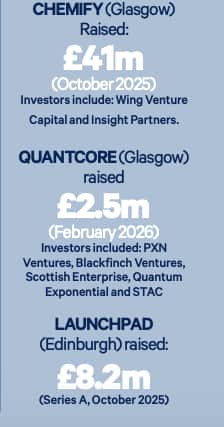
Edinburgh and US based Launchpad secured £8.2m in its series A funding in October last year as it looks to make an impact with automation in Scotland’s manufacturing sector.
The round was co-led by Lavrock Ventures and Squadra Ventures, with participation from the Scottish National Investment Bank, Ericsson Ventures and Lockheed Martin Ventures
Glasgow-based Chemify raised £41m in October, backed by Wing Venture Capital and Insight Partners, underlining continued appetite for deep tech platforms with global applications.
Quantum hardware company Quantcore, also based in the West, has raised £2.5m in seed funding to develop a sovereign UK supply chain for quantum components.
The University of Glasgow spin-out secured investment from PXN Ventures, Blackfinch Ventures and Scottish Enterprise, with additional backing from Quantum Exponential and STAC.
Senior appointments are also pointing to intent with Sofant Technologies appointing Will Whitehorn as chairman as the Edinburgh-based firm prepares for commercial launch across defence and aerospace markets.
In Glasgow, Nami Surgical has named Nikki Palfrey as chief executive while completing a £1.9m investment round to transition into commercialisation, targeting a robotic-assisted surgery market forecast to exceed $25bn by 2030.
Scotland’s growth engine is not being driven by hype or outsized valuations. It is being shaped by disciplined trade consolidation, mid-market deal flow, selective scale-up funding.
Comments
Want to join the conversation? Please or to comment on this article.